

324
S.E. Ibarra-Obando et al.
2.5
2.5
0
~3
~2.
0
~2.
1995
0
1995
0
1996
.=,
~
00
6'"' "'
w2
o ~~Y o
w 1.5
0
0
~
1C2 1.0
0
0
a..
0
o oo t; o
0 Q 0
~1
0
o~o
10 o9~
0 0
z 0.5 ooo \9 \o 'b
:I:
0 ~0 0
(9
00
a..
0
0
33
34
35
36
33
34
35
36
36
38
40
SALINITY
SALINITY
SALINITY
7
0
100
20
6
1995
~80
0 0
1995
~15
0
1996
0
0
0
00
~5
.=,
D o o
o0
0
~'
w 60
oo
w
~3
~
0
~ 10
)
0
02
0
~40
0
()
0
oO
...J
0 0 3lls&ll ~ QS' o<>
::J 5 o o
1
0 0
iii 20
iii
0
33
36
33
34
35
36
34
36
38
40
SALINITY
SALINITY
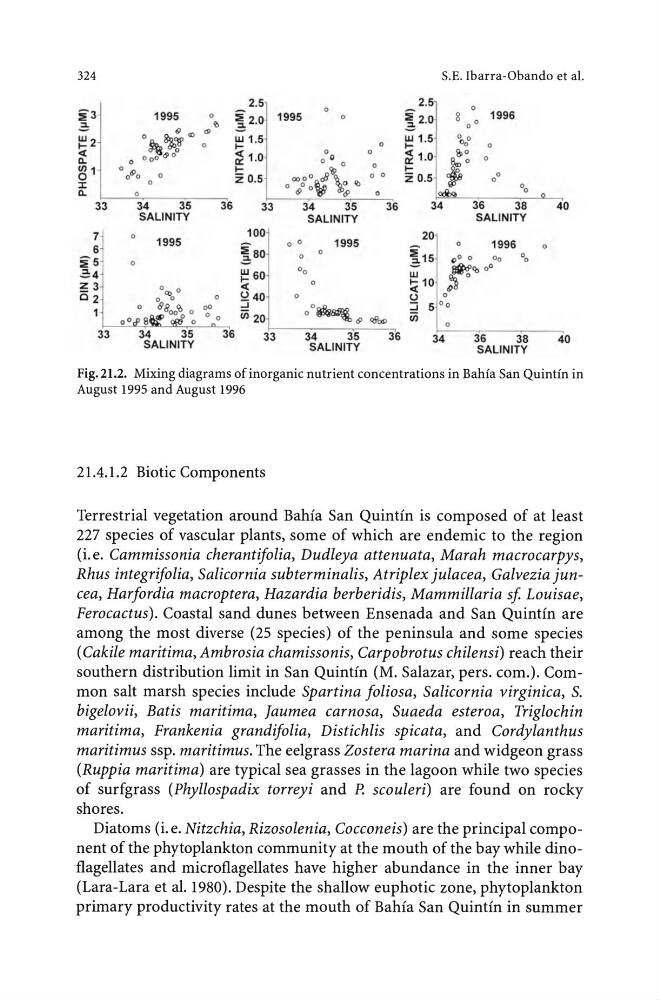
Fig. 21.2. Mixing diagrams of inorganic nutrient concentrations in Bahia San Quintin in
August 1995 and August 1996
21.4.1.2 Biotic Components
Terrestrial vegetation around Bahia San Quintin is composed of at least
227 species of vascular plants, some of which are endemic to the region
(i.e. Cammissonia cherantifolia, Dudleya attenuata, Marah macrocarpys,
Rhus integrifolia, Salicornia subterminalis, Atriplex julacea, Galvezia juncea, Harfordia macroptera, Hazardia berberidis, Mammillaria sf. Louisae,
Ferocactus). Coastal sand dunes between Ensenada and San Quintin are
among the most diverse (25 species) of the peninsula and some species
( Cakile maritima, Ambrosia chamissonis, Carpobrotus chilensi) reach their
southern distribution limit in San Quintin (M. Salazar, pers. com.). Common salt marsh species include Spartina foliosa, Salicornia virginica, S.
bigelovii, Batis maritima, ]aumea carnosa, Suaeda esteroa, Triglochin
maritima, Frankenia grandifolia, Distichlis spicata, and Cordylanthus
maritimus ssp. maritimus. The eelgrass Zostera marina and widgeon grass
(Ruppia maritima) are typical sea grasses in the lagoon while two species
of surfgrass (Phyllospadix torreyi and P. scouleri) are found on rocky
shores.
Diatoms (i.e. Nitzchia, Rizosolenia, Cocconeis) are the principal component of the phytoplankton community at the mouth of the bay while dinoflagellates and microflagellates have higher abundance in the inner bay
(Lara-Lara et al. 1980). Despite the shallow euphotic zone, phytoplankton
primary productivity rates at the mouth of Bahia San Quintin in summer
S.E. Ibarra-Obando et al.
2.5
2.5
0
~3
~2.
0
~2.
1995
0
1995
0
1996
.=,
~
00
6'"' "'
w2
o ~~Y o
w 1.5
0
0
~
1C2 1.0
0
0
a..
0
o oo t; o
0 Q 0
~1
0
o~o
10 o9~
0 0
z 0.5 ooo \9 \o 'b
:I:
0 ~0 0
(9
00
a..
0
0
33
34
35
36
33
34
35
36
36
38
40
SALINITY
SALINITY
SALINITY
7
0
100
20
6
1995
~80
0 0
1995
~15
0
1996
0
0
0
00
~5
.=,
D o o
o0
0
~'
w 60
oo
w
~3
~
0
~ 10
)
0
02
0
~40
0
()
0
oO
...J
0 0 3lls&ll ~ QS' o<>
::J 5 o o
1
0 0
iii 20
iii
0
33
36
33
34
35
36
34
36
38
40
SALINITY
SALINITY
Fig. 21.2. Mixing diagrams of inorganic nutrient concentrations in Bahia San Quintin in
August 1995 and August 1996
21.4.1.2 Biotic Components
Terrestrial vegetation around Bahia San Quintin is composed of at least
227 species of vascular plants, some of which are endemic to the region
(i.e. Cammissonia cherantifolia, Dudleya attenuata, Marah macrocarpys,
Rhus integrifolia, Salicornia subterminalis, Atriplex julacea, Galvezia juncea, Harfordia macroptera, Hazardia berberidis, Mammillaria sf. Louisae,
Ferocactus). Coastal sand dunes between Ensenada and San Quintin are
among the most diverse (25 species) of the peninsula and some species
( Cakile maritima, Ambrosia chamissonis, Carpobrotus chilensi) reach their
southern distribution limit in San Quintin (M. Salazar, pers. com.). Common salt marsh species include Spartina foliosa, Salicornia virginica, S.
bigelovii, Batis maritima, ]aumea carnosa, Suaeda esteroa, Triglochin
maritima, Frankenia grandifolia, Distichlis spicata, and Cordylanthus
maritimus ssp. maritimus. The eelgrass Zostera marina and widgeon grass
(Ruppia maritima) are typical sea grasses in the lagoon while two species
of surfgrass (Phyllospadix torreyi and P. scouleri) are found on rocky
shores.
Diatoms (i.e. Nitzchia, Rizosolenia, Cocconeis) are the principal component of the phytoplankton community at the mouth of the bay while dinoflagellates and microflagellates have higher abundance in the inner bay
(Lara-Lara et al. 1980). Despite the shallow euphotic zone, phytoplankton
primary productivity rates at the mouth of Bahia San Quintin in summer