

296
@
BASALT
5,500 TO 4,000 yr BP
0
5
~
MUD
~ SAND/RUBBLE
~ MASSIVE CORALS
0 METERS 150 0 BRANCHING CORALS
P.W.Glynn
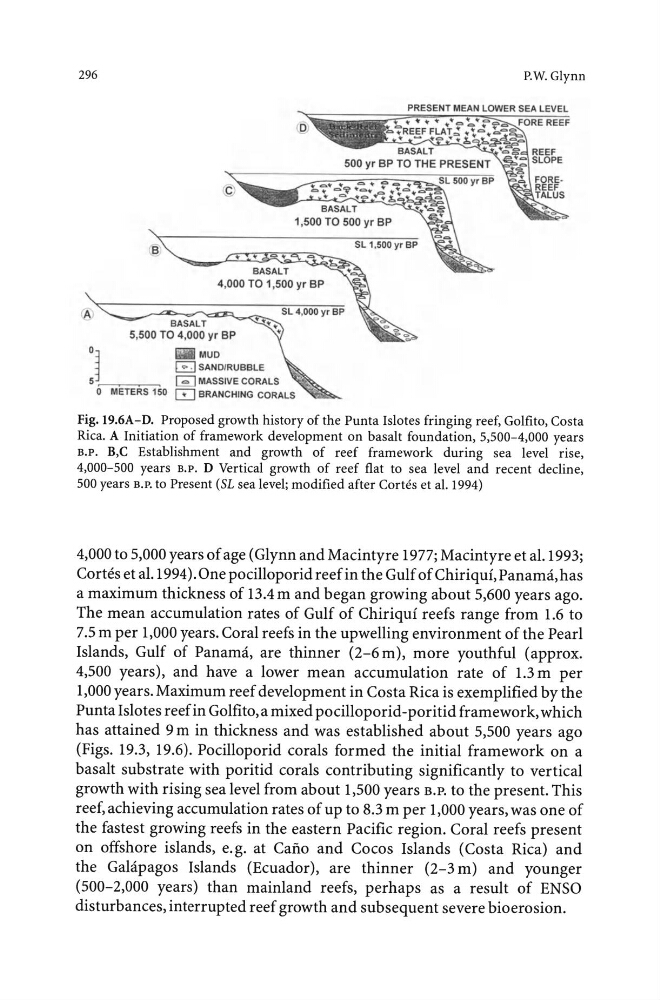
Fig. 19.6A-D. Proposed growth history of the Punta Islotes fringing reef, Golfito, Costa
Rica. A Initiation of framework development on basalt foundation, 5,500-4,000 years
B.P. B,C Establishment and growth of reef framework during sea level rise,
4,000-500 years B.P. D Vertical growth of reef flat to sea level and recent decline,
500 years B.P. to Present (SL sea level; modified after Cortes eta!. 1994)
4,000 to 5,000 years of age (Glynn and Macintyre 1977; Macintyre et al. 1993;
Cortes et al. 1994). One pocilloporid reef in the Gulf of Chiriqui, Panama, has
a maximum thickness of 13.4 m and began growing about 5,600 years ago.
The mean accumulation rates of Gulf of Chiriqui reefs range from 1.6 to
7.5 m per 1,000 years. Coral reefs in the upwelling environment of the Pearl
Islands, Gulf of Panama, are thinner (2-6m), more youthful (approx.
4,500 years), and have a lower mean accumulation rate of 1.3 m per
1,000 years. Maximum reef development in Costa Rica is exemplified by the
Punta Islotes reef in Golfito, a mixed pocilloporid-poritid framework, which
has attained 9 m in thickness and was established about 5,500 years ago
(Figs. 19.3, 19.6). Pocilloporid corals formed the initial framework on a
basalt substrate with poritid corals contributing significantly to vertical
growth with rising sea level from about 1,500 years B.P. to the present. This
reef, achieving accumulation rates of up to 8.3 m per 1,000 years, was one of
the fastest growing reefs in the eastern Pacific region. Coral reefs present
on offshore islands, e.g. at Caiio and Cocos Islands (Costa Rica) and
the Galapagos Islands (Ecuador), are thinner (2-3m) and younger
(500- 2,000 years) than mainland reefs, perhaps as a result of ENSO
disturbances, interrupted reef growth and subsequent severe bioerosion.
@
BASALT
5,500 TO 4,000 yr BP
0
5
~
MUD
~ SAND/RUBBLE
~ MASSIVE CORALS
0 METERS 150 0 BRANCHING CORALS
P.W.Glynn
Fig. 19.6A-D. Proposed growth history of the Punta Islotes fringing reef, Golfito, Costa
Rica. A Initiation of framework development on basalt foundation, 5,500-4,000 years
B.P. B,C Establishment and growth of reef framework during sea level rise,
4,000-500 years B.P. D Vertical growth of reef flat to sea level and recent decline,
500 years B.P. to Present (SL sea level; modified after Cortes eta!. 1994)
4,000 to 5,000 years of age (Glynn and Macintyre 1977; Macintyre et al. 1993;
Cortes et al. 1994). One pocilloporid reef in the Gulf of Chiriqui, Panama, has
a maximum thickness of 13.4 m and began growing about 5,600 years ago.
The mean accumulation rates of Gulf of Chiriqui reefs range from 1.6 to
7.5 m per 1,000 years. Coral reefs in the upwelling environment of the Pearl
Islands, Gulf of Panama, are thinner (2-6m), more youthful (approx.
4,500 years), and have a lower mean accumulation rate of 1.3 m per
1,000 years. Maximum reef development in Costa Rica is exemplified by the
Punta Islotes reef in Golfito, a mixed pocilloporid-poritid framework, which
has attained 9 m in thickness and was established about 5,500 years ago
(Figs. 19.3, 19.6). Pocilloporid corals formed the initial framework on a
basalt substrate with poritid corals contributing significantly to vertical
growth with rising sea level from about 1,500 years B.P. to the present. This
reef, achieving accumulation rates of up to 8.3 m per 1,000 years, was one of
the fastest growing reefs in the eastern Pacific region. Coral reefs present
on offshore islands, e.g. at Caiio and Cocos Islands (Costa Rica) and
the Galapagos Islands (Ecuador), are thinner (2-3m) and younger
(500- 2,000 years) than mainland reefs, perhaps as a result of ENSO
disturbances, interrupted reef growth and subsequent severe bioerosion.