

Eastern Pacific Coral Reef Ecosystem
287
entire eastern Pacific is located on the NE side of Marfa Cleofas Island,
Marias Islands (Fig. 19.2A). This reef is still undescribed, but a preliminary
reconnaissance reveals that it is constructed dominantly of pocilloporid
corals and forms a nearly closed ring several km in circumference (H.W.
Chaney, pers. comm.). A coral reef tract extends along the southern coast
of Mexico at Huatulco (Fig. 19.1, site 3). Several fringing pocilloporid reefs,
with 1-5m vertical buildups, are present in this area in bays, inlets or
behind islands, generally oriented away from zones of high turbulence
(Fig. 19.2C). Although the extent of reef development off the coasts of Guatemala, El Salvador and Nicaragua is virtually unknown, a few small fringing reefs have been reported at Los C6banos, El Salvador (Fig. 19.1, site 4;
Fig. 19.2B). Both Costa Rica and Panama have seasonal upwelling
(Fig. 19.1, sites 5, 8) and non-upwelling (Fig.19.1, sites 6, 7) areas with relatively few weakly developed and several robust coral reefs in these respective environments. Coral reefs in the upwelling area of the Gulf of Papagayo (Fig. 19.1, site 5) are mostly dead, highly eroded and covered with
filamentous algae. Evidence suggests that the entire dead coral reef tract in
the Gulf of Papagayo possibly succumbed to extreme cooling during
upwelling in the Little Ice Age, about 300 years ago (Glynn et al. 1983).
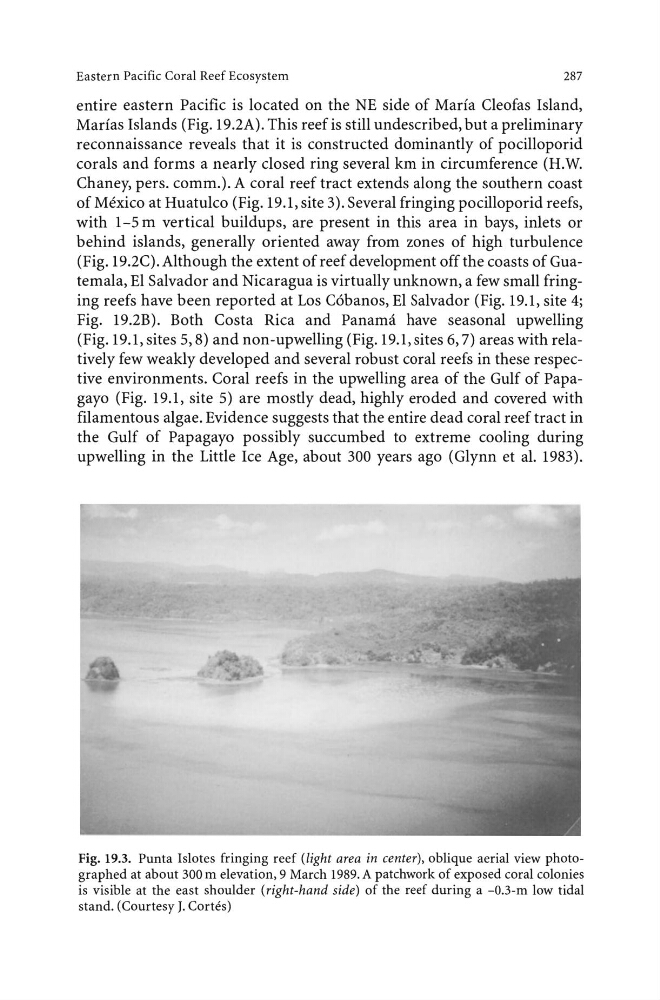
Fig. 19.3. Punta Islotes fringing reef (light area in center), oblique aerial view photographed at about 300m elevation, 9 March 1989. A patchwork of exposed coral colonies
is visible at the east shoulder (right-hand side) of the reef during a -0.3-m low tidal
stand. (Courtesy J. Cortes)
287
entire eastern Pacific is located on the NE side of Marfa Cleofas Island,
Marias Islands (Fig. 19.2A). This reef is still undescribed, but a preliminary
reconnaissance reveals that it is constructed dominantly of pocilloporid
corals and forms a nearly closed ring several km in circumference (H.W.
Chaney, pers. comm.). A coral reef tract extends along the southern coast
of Mexico at Huatulco (Fig. 19.1, site 3). Several fringing pocilloporid reefs,
with 1-5m vertical buildups, are present in this area in bays, inlets or
behind islands, generally oriented away from zones of high turbulence
(Fig. 19.2C). Although the extent of reef development off the coasts of Guatemala, El Salvador and Nicaragua is virtually unknown, a few small fringing reefs have been reported at Los C6banos, El Salvador (Fig. 19.1, site 4;
Fig. 19.2B). Both Costa Rica and Panama have seasonal upwelling
(Fig. 19.1, sites 5, 8) and non-upwelling (Fig.19.1, sites 6, 7) areas with relatively few weakly developed and several robust coral reefs in these respective environments. Coral reefs in the upwelling area of the Gulf of Papagayo (Fig. 19.1, site 5) are mostly dead, highly eroded and covered with
filamentous algae. Evidence suggests that the entire dead coral reef tract in
the Gulf of Papagayo possibly succumbed to extreme cooling during
upwelling in the Little Ice Age, about 300 years ago (Glynn et al. 1983).
Fig. 19.3. Punta Islotes fringing reef (light area in center), oblique aerial view photographed at about 300m elevation, 9 March 1989. A patchwork of exposed coral colonies
is visible at the east shoulder (right-hand side) of the reef during a -0.3-m low tidal
stand. (Courtesy J. Cortes)