

The Estuary Ecosystem of Buenaventura Bay, Colombia
271
a. RIVERINE MANGROVE
b. BAR MANGROVE
c. FRINGE MANGROVE
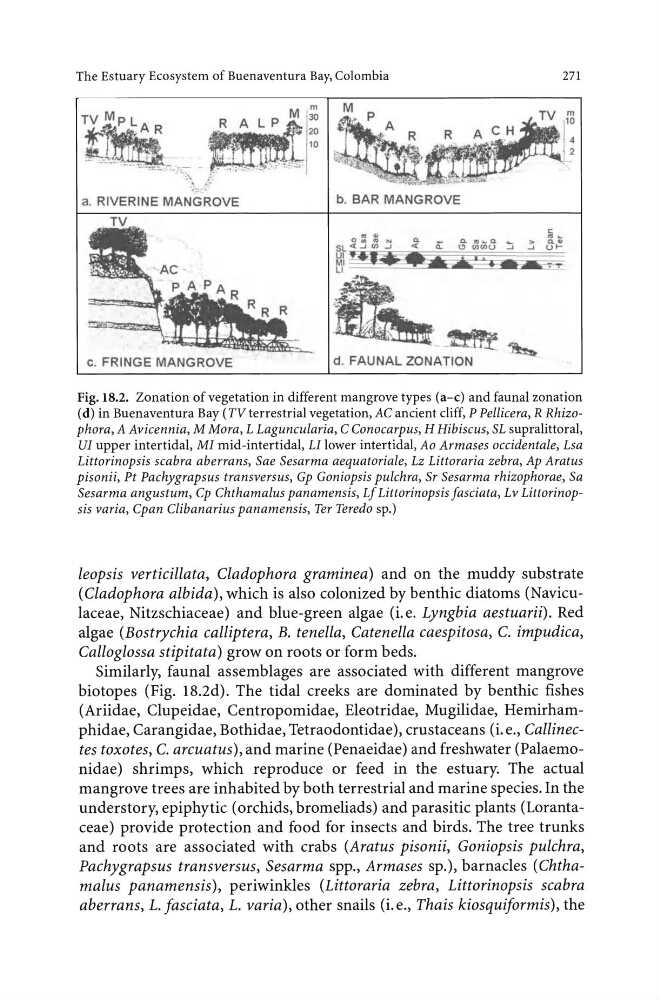
Fig. 18.2. Zonation of vegetation in different mangrove types (a-c) and faunal zonation
(d) in Buenaventura Bay (TV terrestrial vegetation, AC ancient cliff, P Pellicera, R Rhizophora, A Avicennia, M Mora, L Laguncularia, C Conocarpus, H Hibiscus, SL supralittoral,
UI upper intertidal, MI mid-intertidal, Lllower intertidal, Ao Armases occidentale, Lsa
Littorinopsis scabra aberrans, Sae Sesarma aequatoriale, Lz Littoraria zebra, Ap Aratus
pisonii, Pt Pachygrapsus transversus, Gp Goniopsis pulchra, Sr Sesarma rhizophorae, Sa
Sesarma angustum, Cp Chthamalus panamensis, Lf Littorinopsis fasciata, L v Littorinopsis varia, Cpan Clibanarius panamensis, Ter Teredo sp.)
leopsis verticillata, Cladophora graminea) and on the muddy substrate
(Cladophora albida), which is also colonized by benthic diatoms (Naviculaceae, Nitzschiaceae) and blue-green algae (i.e. Lyngbia aestuarii) . Red
algae (Bostrychia calliptera, B. tenella, Catenella caespitosa, C. impudica,
Calloglossa stipitata) grow on roots or form beds.
Similarly, faunal assemblages are associated with different mangrove
biotopes (Fig. 18.2d). The tidal creeks are dominated by benthic fishes
(Ariidae, Clupeidae, Centropomidae, Eleotridae, Mugilidae, Hemirhamphidae, Carangidae, Bothidae, Tetraodontidae), crustaceans (i.e., Callinectes toxotes, C. arcuatus), and marine (Penaeidae) and freshwater (Palaemonidae) shrimps, which reproduce or feed in the estuary. The actual
mangrove trees are inhabited by both terrestrial and marine species. In the
understory, epiphytic (orchids, bromeliads) and parasitic plants (Lorantaceae) provide protection and food for insects and birds. The tree trunks
and roots are associated with crabs (Aratus pisonii, Goniopsis pulchra,
Pachygrapsus transversus, Sesarma spp., Armases sp.), barnacles (Chthamalus panamensis), periwinkles (Littoraria zebra, Littorinopsis scabra
aberrans, L. fasciata, L. varia), other snails (i.e., Thais kiosquiformis), the
271
a. RIVERINE MANGROVE
b. BAR MANGROVE
c. FRINGE MANGROVE
Fig. 18.2. Zonation of vegetation in different mangrove types (a-c) and faunal zonation
(d) in Buenaventura Bay (TV terrestrial vegetation, AC ancient cliff, P Pellicera, R Rhizophora, A Avicennia, M Mora, L Laguncularia, C Conocarpus, H Hibiscus, SL supralittoral,
UI upper intertidal, MI mid-intertidal, Lllower intertidal, Ao Armases occidentale, Lsa
Littorinopsis scabra aberrans, Sae Sesarma aequatoriale, Lz Littoraria zebra, Ap Aratus
pisonii, Pt Pachygrapsus transversus, Gp Goniopsis pulchra, Sr Sesarma rhizophorae, Sa
Sesarma angustum, Cp Chthamalus panamensis, Lf Littorinopsis fasciata, L v Littorinopsis varia, Cpan Clibanarius panamensis, Ter Teredo sp.)
leopsis verticillata, Cladophora graminea) and on the muddy substrate
(Cladophora albida), which is also colonized by benthic diatoms (Naviculaceae, Nitzschiaceae) and blue-green algae (i.e. Lyngbia aestuarii) . Red
algae (Bostrychia calliptera, B. tenella, Catenella caespitosa, C. impudica,
Calloglossa stipitata) grow on roots or form beds.
Similarly, faunal assemblages are associated with different mangrove
biotopes (Fig. 18.2d). The tidal creeks are dominated by benthic fishes
(Ariidae, Clupeidae, Centropomidae, Eleotridae, Mugilidae, Hemirhamphidae, Carangidae, Bothidae, Tetraodontidae), crustaceans (i.e., Callinectes toxotes, C. arcuatus), and marine (Penaeidae) and freshwater (Palaemonidae) shrimps, which reproduce or feed in the estuary. The actual
mangrove trees are inhabited by both terrestrial and marine species. In the
understory, epiphytic (orchids, bromeliads) and parasitic plants (Lorantaceae) provide protection and food for insects and birds. The tree trunks
and roots are associated with crabs (Aratus pisonii, Goniopsis pulchra,
Pachygrapsus transversus, Sesarma spp., Armases sp.), barnacles (Chthamalus panamensis), periwinkles (Littoraria zebra, Littorinopsis scabra
aberrans, L. fasciata, L. varia), other snails (i.e., Thais kiosquiformis), the