

266
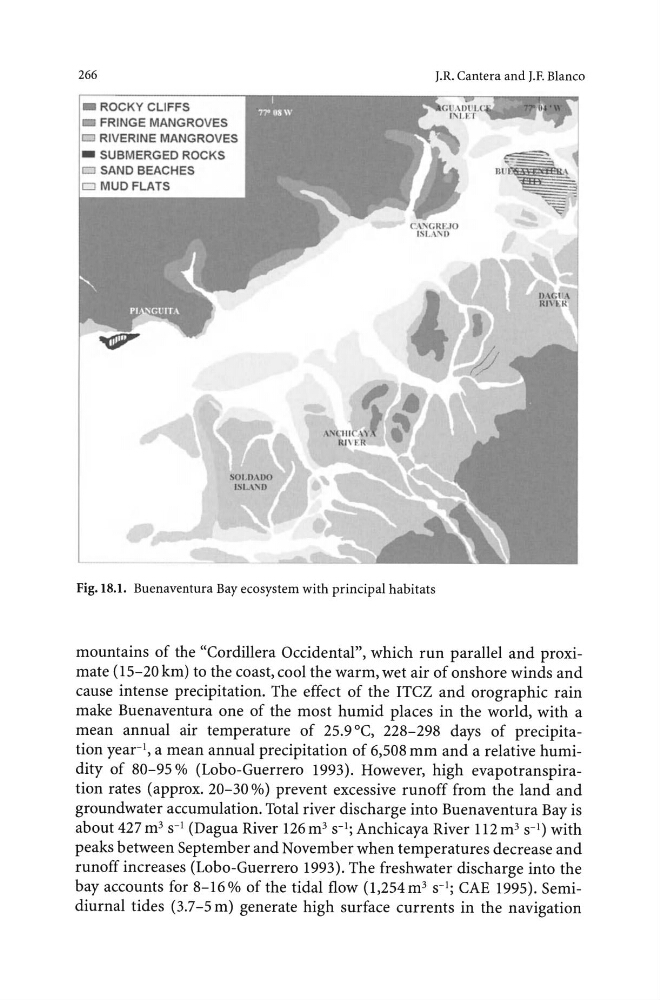
• ROCKY CLIFFS
FRINGE MANGROVES
c:J RIVERINE MANGROVES
• SUBMERGED ROCKS
o SAND BEACHES
o MUDFLATS
J.R. Cantera and J.F. Blanco
Fig. 18.1. Buenaventura Bay ecosystem with principal habitats
mountains of the "Cordillera Occidental", which run parallel and proximate {15-20 km) to the coast, cool the warm, wet air of onshore winds and
cause intense precipitation. The effect of the ITCZ and orographic rain
make Buenaventura one of the most humid places in the world, with a
mean annual air temperature of 25.9 °C, 228-298 days of precipitation year', a mean annual precipitation of 6,508 mm and a relative humidity of 80-95% (Lobo-Guerrero 1993). However, high evapotranspiration rates (approx. 20-30 %) prevent excessive runoff from the land and
groundwater accumulation. Total river discharge into Buenaventura Bay is
about 427m 3 s- 1 (Dagua River 126m 3 s- 1 ; Anchicaya River 112m 3 s- 1 ) with
peaks between September and November when temperatures decrease and
runoff increases (Lobo-Guerrero 1993). The freshwater discharge into the
bay accounts for 8-16% of the tidal flow {1,254m 3 s- 1 ; CAE 1995). Semidiurnal tides (3.7 -5 m) generate high surface currents in the navigation
• ROCKY CLIFFS
FRINGE MANGROVES
c:J RIVERINE MANGROVES
• SUBMERGED ROCKS
o SAND BEACHES
o MUDFLATS
J.R. Cantera and J.F. Blanco
Fig. 18.1. Buenaventura Bay ecosystem with principal habitats
mountains of the "Cordillera Occidental", which run parallel and proximate {15-20 km) to the coast, cool the warm, wet air of onshore winds and
cause intense precipitation. The effect of the ITCZ and orographic rain
make Buenaventura one of the most humid places in the world, with a
mean annual air temperature of 25.9 °C, 228-298 days of precipitation year', a mean annual precipitation of 6,508 mm and a relative humidity of 80-95% (Lobo-Guerrero 1993). However, high evapotranspiration rates (approx. 20-30 %) prevent excessive runoff from the land and
groundwater accumulation. Total river discharge into Buenaventura Bay is
about 427m 3 s- 1 (Dagua River 126m 3 s- 1 ; Anchicaya River 112m 3 s- 1 ) with
peaks between September and November when temperatures decrease and
runoff increases (Lobo-Guerrero 1993). The freshwater discharge into the
bay accounts for 8-16% of the tidal flow {1,254m 3 s- 1 ; CAE 1995). Semidiurnal tides (3.7 -5 m) generate high surface currents in the navigation