

The Bahia Blanca Estuary, Argentina
i= 6
Cl.
w 8
0
10
12
i= 6
Cl.
~ 8
10
12
I
s
10
211
c
B
D
0
5
10
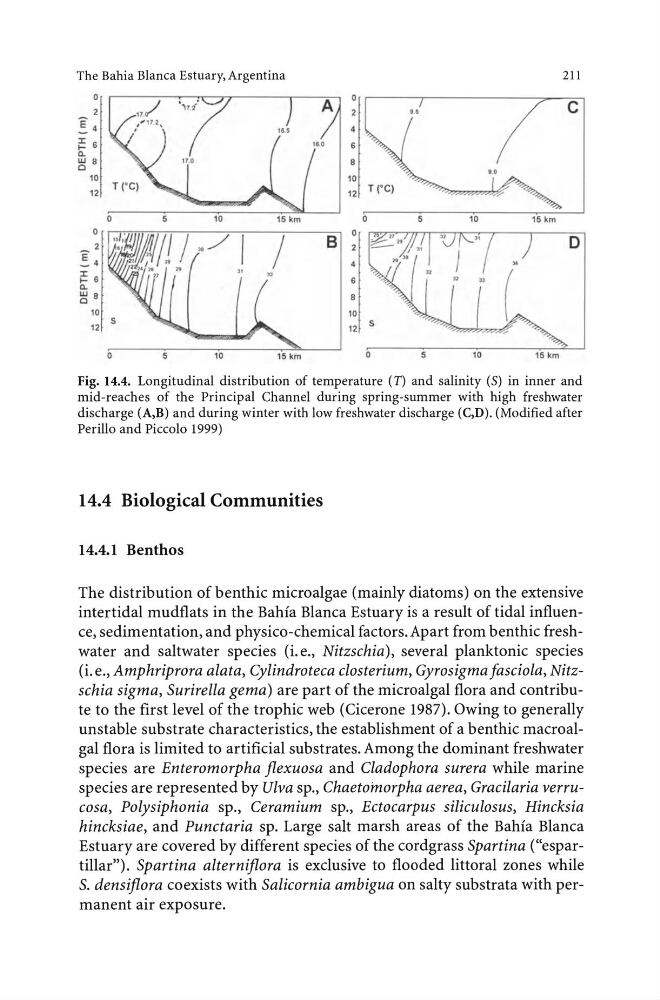
Fig. 14.4. Longitudinal distribution of temperature (T) and salinity (S) in inner and
mid-reaches of the Principal Channel during spring-summer with high freshwater
discharge (A,B) and during winter with low freshwater discharge (C,D). (Modified after
Perillo and Piccolo 1999)
14.4 Biological Communities
14.4.1 Benthos
The distribution of benthic microalgae (mainly diatoms) on the extensive
intertidal mudflats in the Bahia Blanca Estuary is a result of tidal influence, sedimentation, and physico-chemical factors. Apart from benthic freshwater and saltwater species (i.e., Nitzschia), several planktonic species
(i.e., Amphriprora alata, Cylindroteca closterium, Gyrosigma fasciola, Nitzschia sigma, Surirella gema) are part of the microalgal flora and contribute to the first level of the trophic web (Cicerone 1987). Owing to generally
unstable substrate characteristics, the establishment of a benthic macroalgal flora is limited to artificial substrates. Among the dominant freshwater
species are Enteromorpha flexuosa and Cladophora surera while marine
species are represented by Ulva sp., Chaetoinorpha aerea, Gracilaria verrucosa, Polysiphonia sp., Ceramium sp., Ectocarpus siliculosus, Hincksia
hincksiae, and Punctaria sp. Large salt marsh areas of the Bahia Blanca
Estuary are covered by different species of the cordgrass Spartina ("espartillar"). Spartina alterniflora is exclusive to flooded littoral zones while
S. densiflora coexists with Salicornia ambigua on salty substrata with permanent air exposure.
i= 6
Cl.
w 8
0
10
12
i= 6
Cl.
~ 8
10
12
I
s
10
211
c
B
D
0
5
10
Fig. 14.4. Longitudinal distribution of temperature (T) and salinity (S) in inner and
mid-reaches of the Principal Channel during spring-summer with high freshwater
discharge (A,B) and during winter with low freshwater discharge (C,D). (Modified after
Perillo and Piccolo 1999)
14.4 Biological Communities
14.4.1 Benthos
The distribution of benthic microalgae (mainly diatoms) on the extensive
intertidal mudflats in the Bahia Blanca Estuary is a result of tidal influence, sedimentation, and physico-chemical factors. Apart from benthic freshwater and saltwater species (i.e., Nitzschia), several planktonic species
(i.e., Amphriprora alata, Cylindroteca closterium, Gyrosigma fasciola, Nitzschia sigma, Surirella gema) are part of the microalgal flora and contribute to the first level of the trophic web (Cicerone 1987). Owing to generally
unstable substrate characteristics, the establishment of a benthic macroalgal flora is limited to artificial substrates. Among the dominant freshwater
species are Enteromorpha flexuosa and Cladophora surera while marine
species are represented by Ulva sp., Chaetoinorpha aerea, Gracilaria verrucosa, Polysiphonia sp., Ceramium sp., Ectocarpus siliculosus, Hincksia
hincksiae, and Punctaria sp. Large salt marsh areas of the Bahia Blanca
Estuary are covered by different species of the cordgrass Spartina ("espartillar"). Spartina alterniflora is exclusive to flooded littoral zones while
S. densiflora coexists with Salicornia ambigua on salty substrata with permanent air exposure.