

208
G.M.E. Perillo eta!.
runoff from the Sauce Chico River may peak between 10 and 50m 3 s- 1 , with
a recorded maximum of 106m 3 s- 1 in 1977. Freshwater inflow from other,
smaller tributaries into the estuary is intermittent and only significant
during periods of high local precipitation.
14.3.2 Tides
The principal energy input into the Bahia Blanca system is produced by a
standing, semidiurnal tidal wave. The propagation of the wave is affected
by the geometry of channels. Reflection on the channel flanks and the head
convert the original progressive form into a standing wave, while bottom
and wall friction drain energy from the wave. The amplitude of the tidal
wave increases with a decrease in depth and/or breadth of the channel;
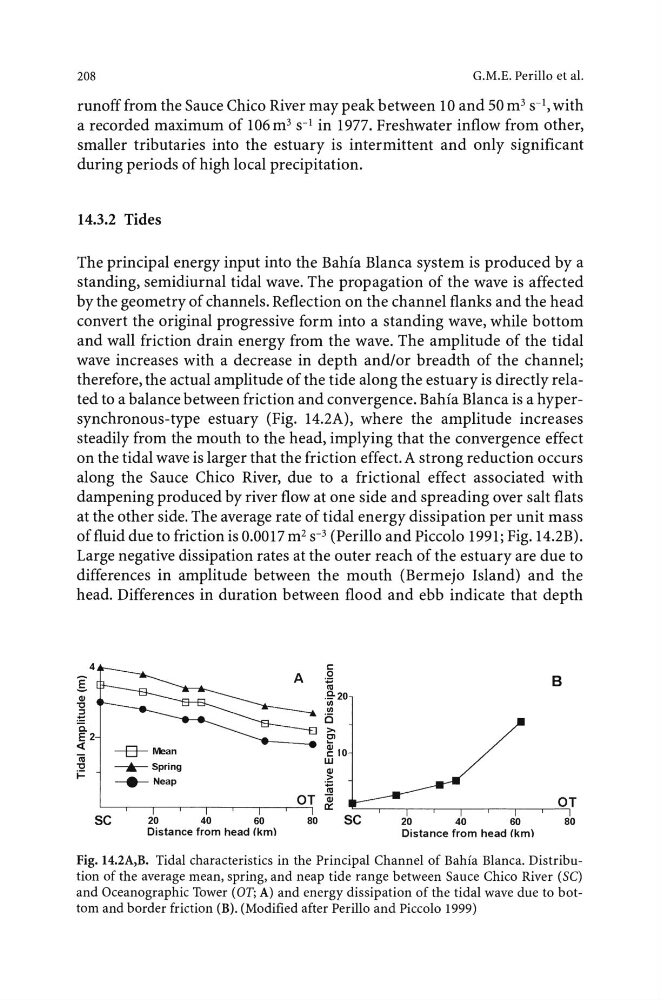
therefore, the actual amplitude of the tide along the estuary is directly related to a balance between friction and convergence. Bahia Blanca is a hypersynchronous-type estuary (Fig. 14.2A), where the amplitude increases
steadily from the mouth to the head, implying that the convergence effect
on the tidal wave is larger that the friction effect. A strong reduction occurs
along the Sauce Chico River, due to a frictional effect associated with
dampening produced by river flow at one side and spreading over salt flats
at the other side. The average rate of tidal energy dissipation per unit mass
of fluid due to friction is 0.0017 m 2 s- 3 (Perillo and Piccolo 1991; Fig. 14.2B).
Large negative dissipation rates at the outer reach of the estuary are due to
differences in amplitude between the mouth (Bermejo Island) and the
head. Differences in duration between flood and ebb indicate that depth
4
sc
---8- Mean
___.__ Spring
------Neap
20
40
60
Distance from head lkm)
A
80
c
0
:;
.9-20
"' "'
0
,.,
C>
~10
w
Cl)
. ~
(;j
~
B
20
40
60
80
Distance from head lkml
Fig. 14.2A,B. Tidal characteristics in the Principal Channel of Bahia Blanca. Distribution of the average mean, spring, and neap tide range between Sauce Chico River (SC)
and Oceanographic Tower ( OT; A) and energy dissipation of the tidal wave due to bottom and border friction (B). (Modified after Perillo and Piccolo 1999)
G.M.E. Perillo eta!.
runoff from the Sauce Chico River may peak between 10 and 50m 3 s- 1 , with
a recorded maximum of 106m 3 s- 1 in 1977. Freshwater inflow from other,
smaller tributaries into the estuary is intermittent and only significant
during periods of high local precipitation.
14.3.2 Tides
The principal energy input into the Bahia Blanca system is produced by a
standing, semidiurnal tidal wave. The propagation of the wave is affected
by the geometry of channels. Reflection on the channel flanks and the head
convert the original progressive form into a standing wave, while bottom
and wall friction drain energy from the wave. The amplitude of the tidal
wave increases with a decrease in depth and/or breadth of the channel;
therefore, the actual amplitude of the tide along the estuary is directly related to a balance between friction and convergence. Bahia Blanca is a hypersynchronous-type estuary (Fig. 14.2A), where the amplitude increases
steadily from the mouth to the head, implying that the convergence effect
on the tidal wave is larger that the friction effect. A strong reduction occurs
along the Sauce Chico River, due to a frictional effect associated with
dampening produced by river flow at one side and spreading over salt flats
at the other side. The average rate of tidal energy dissipation per unit mass
of fluid due to friction is 0.0017 m 2 s- 3 (Perillo and Piccolo 1991; Fig. 14.2B).
Large negative dissipation rates at the outer reach of the estuary are due to
differences in amplitude between the mouth (Bermejo Island) and the
head. Differences in duration between flood and ebb indicate that depth
4
sc
---8- Mean
___.__ Spring
------Neap
20
40
60
Distance from head lkm)
A
80
c
0
:;
.9-20
"' "'
0
,.,
C>
~10
w
Cl)
. ~
(;j
~
B
20
40
60
80
Distance from head lkml
Fig. 14.2A,B. Tidal characteristics in the Principal Channel of Bahia Blanca. Distribution of the average mean, spring, and neap tide range between Sauce Chico River (SC)
and Oceanographic Tower ( OT; A) and energy dissipation of the tidal wave due to bottom and border friction (B). (Modified after Perillo and Piccolo 1999)