

176
U. Seeliger
10 5
' ' " ' G ' ' ' ' ~
ALGAE
~ il
(j) 10 4
z
0
!::.
z 10 3
0
m
a::
<
u
~ 10 2
z
< rJ
a::
0 10
' CDJ
EPIPHYTIC
MICROALGAE
1..
1
A
s 0
N
D
J
F
M
A
M
J
J
MONTHS
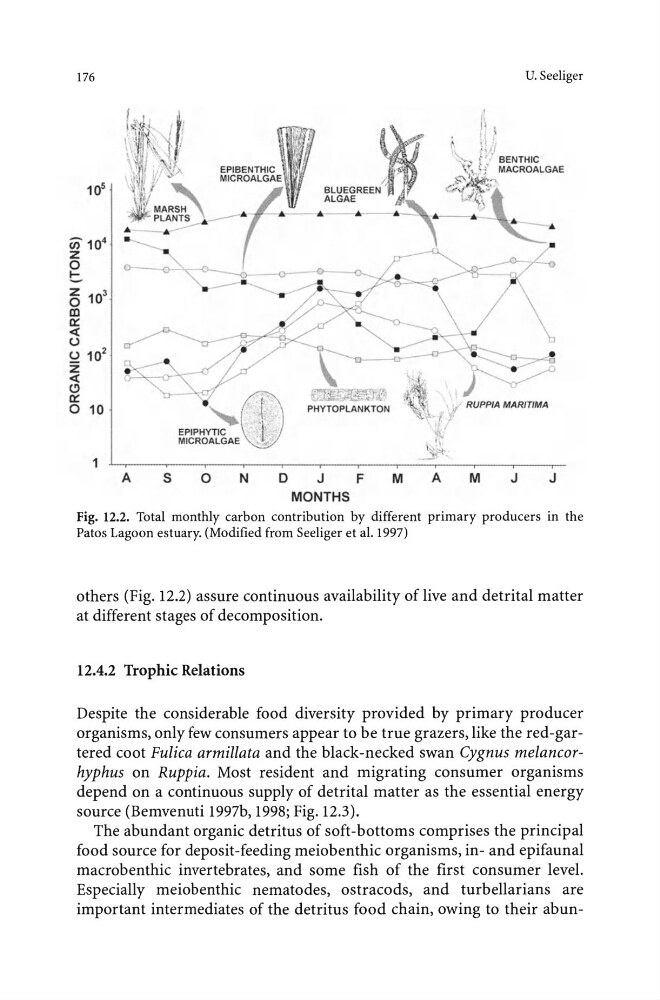
Fig. 12.2. Total monthly carbon contribution by different primary producers in the
Pates Lagoon estuary. (Modified from Seeliger et al. 1997)
others (Fig. 12.2) assure continuous availability of live and detrital matter
at different stages of decomposition.
12.4.2 Trophic Relations
Despite the considerable food diversity provided by primary producer
organisms, only few consumers appear to be true grazers, like the red-gartered coot Fulica armillata and the black-necked swan Cygnus melancorhyphus on Ruppia. Most resident and migrating consumer organisms
depend on a continuous supply of detrital matter as the essential energy
source (Bemvenuti 1997b, 1998; Fig. 12.3).
The abundant organic detritus of soft-bottoms comprises the principal
food source for deposit-feeding meiobenthic organisms, in- and epifaunal
macrobenthic invertebrates, and some fish of the first consumer level.
Especially meiobenthic nematodes, ostracods, and turbellarians are
important intermediates of the detritus food chain, owing to their abun-
U. Seeliger
10 5
' ' " ' G ' ' ' ' ~
ALGAE
~ il
(j) 10 4
z
0
!::.
z 10 3
0
m
a::
<
u
~ 10 2
z
< rJ
a::
0 10
' CDJ
EPIPHYTIC
MICROALGAE
1..
1
A
s 0
N
D
J
F
M
A
M
J
J
MONTHS
Fig. 12.2. Total monthly carbon contribution by different primary producers in the
Pates Lagoon estuary. (Modified from Seeliger et al. 1997)
others (Fig. 12.2) assure continuous availability of live and detrital matter
at different stages of decomposition.
12.4.2 Trophic Relations
Despite the considerable food diversity provided by primary producer
organisms, only few consumers appear to be true grazers, like the red-gartered coot Fulica armillata and the black-necked swan Cygnus melancorhyphus on Ruppia. Most resident and migrating consumer organisms
depend on a continuous supply of detrital matter as the essential energy
source (Bemvenuti 1997b, 1998; Fig. 12.3).
The abundant organic detritus of soft-bottoms comprises the principal
food source for deposit-feeding meiobenthic organisms, in- and epifaunal
macrobenthic invertebrates, and some fish of the first consumer level.
Especially meiobenthic nematodes, ostracods, and turbellarians are
important intermediates of the detritus food chain, owing to their abun-