

168
U. Seeliger
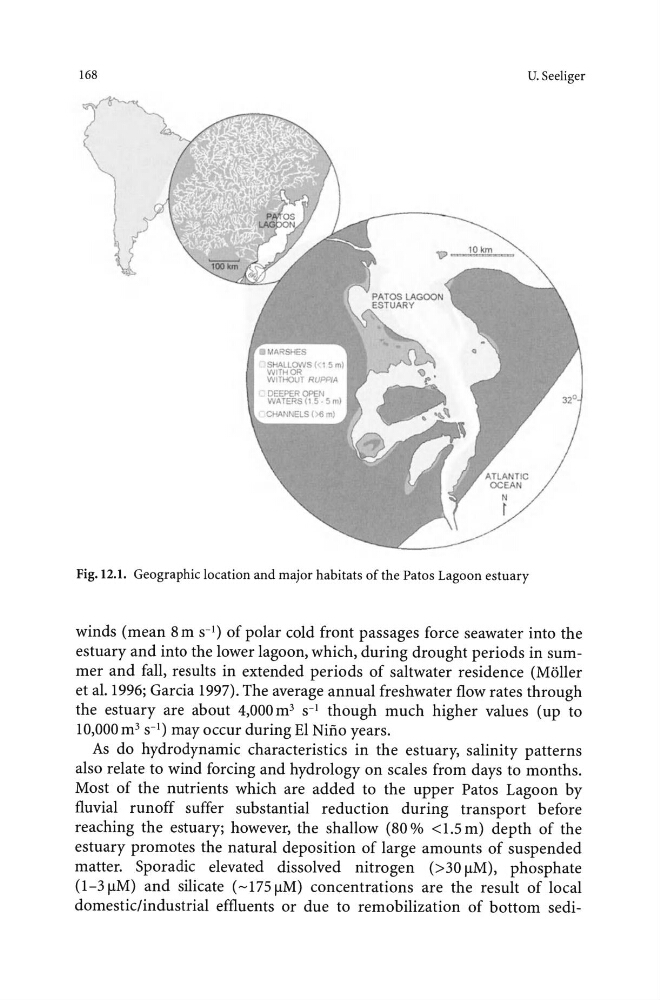
Fig. 12.1. Geographic location and major habitats of the Patos Lagoon estuary
winds (mean 8 m s- 1 ) of polar cold front passages force seawater into the
estuary and into the lower lagoon, which, during drought periods in summer and fall, results in extended periods of saltwater residence (Moller
et al. 1996; Garcia 1997). The average annual freshwater flow rates through
the estuary are about 4,000 m 3 s- 1 though much higher values (up to
10,000 m 3 s- 1 ) may occur during El Nino years.
As do hydrodynamic characteristics in the estuary, salinity patterns
also relate to wind forcing and hydrology on scales from days to months.
Most of the nutrients which are added to the upper Patos Lagoon by
fluvial runoff suffer substantial reduction during transport before
reaching the estuary; however, the shallow (80 o/o < 1.5 m) depth of the
estuary promotes the natural deposition of large amounts of suspended
matter. Sporadic elevated dissolved nitrogen (>30 flM), phosphate
(1-3 JlM) and silicate ( - 175 flM) concentrations are the result of local
domestic/industrial effluents or due to remobilization of bottom sedi-
U. Seeliger
Fig. 12.1. Geographic location and major habitats of the Patos Lagoon estuary
winds (mean 8 m s- 1 ) of polar cold front passages force seawater into the
estuary and into the lower lagoon, which, during drought periods in summer and fall, results in extended periods of saltwater residence (Moller
et al. 1996; Garcia 1997). The average annual freshwater flow rates through
the estuary are about 4,000 m 3 s- 1 though much higher values (up to
10,000 m 3 s- 1 ) may occur during El Nino years.
As do hydrodynamic characteristics in the estuary, salinity patterns
also relate to wind forcing and hydrology on scales from days to months.
Most of the nutrients which are added to the upper Patos Lagoon by
fluvial runoff suffer substantial reduction during transport before
reaching the estuary; however, the shallow (80 o/o < 1.5 m) depth of the
estuary promotes the natural deposition of large amounts of suspended
matter. Sporadic elevated dissolved nitrogen (>30 flM), phosphate
(1-3 JlM) and silicate ( - 175 flM) concentrations are the result of local
domestic/industrial effluents or due to remobilization of bottom sedi-