

The Convergence Ecosystem in the Southwest Atlantic
159
demersal sharks species), or depleted (i.e., Argentine croaker, black drum,
red porgy, marine catfish, school shark and guitarfish). Apart from Brazil,
Uruguay, and Argentina, other countries operate under license agreement
or in international waters outside the economic exclusive zone (EEZ).
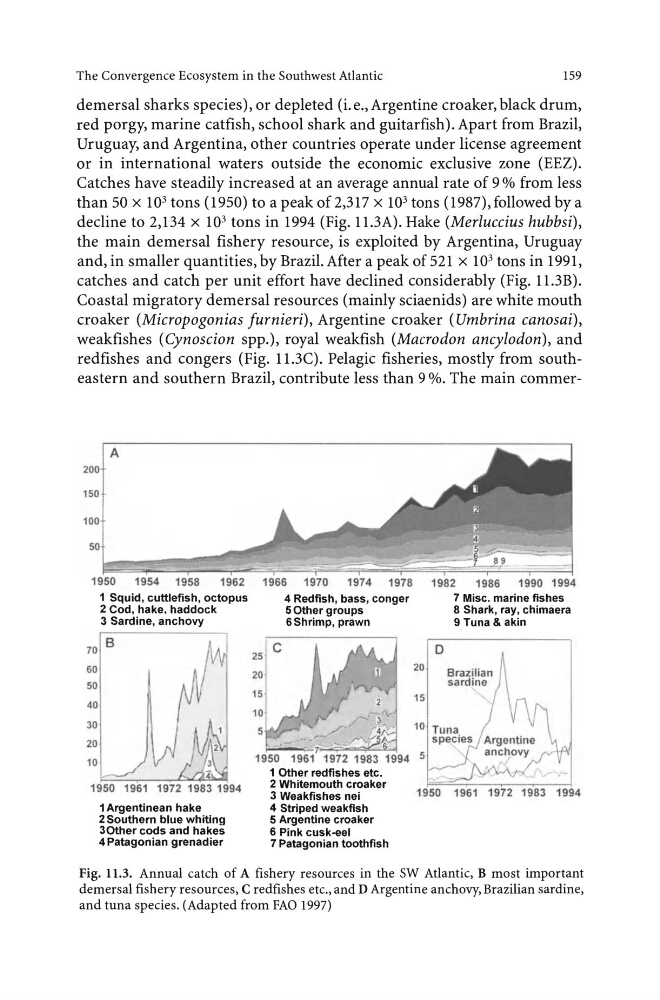
Catches have steadily increased at an average annual rate of 9 o/o from less
than 50 x 10 3 tons ( 1950) to a peak of 2,317 x 10 3 tons (1987), followed by a
decline to 2,134 x 10 3 tons in 1994 (Fig. 11.3A). Hake (Merluccius hubbsi),
the main demersal fishery resource, is exploited by Argentina, Uruguay
and, in smaller quantities, by Brazil. After a peak of 521 x 10 3 tons in 1991,
catches and catch per unit effort have declined considerably (Fig. 11.3B).
Coastal migratory demersal resources (mainly sciaenids) are white mouth
croaker (Micropogonias furnieri), Argentine croaker (Umbrina canosai),
weakfishes (Cynoscion spp.), royal weakfish (Macrodon ancylodon), and
redfishes and congers (Fig. 11.3C). Pelagic fisheries, mostly from southeastern and southern Brazil, contribute less than 9 %. The main commerA
1954 1958
1962
1966
1970
1974 1978
1982
1986
1990 1994
1 Squid, cuttlefish, octopus
2 Cod, hake, haddock
3 Sardine, anchovy
1961 1972 1983 1994
1 Argentinean hake
2 Southern blue whiting
30ther cods and hakes
4Patagonian grenadier
25 c
20
15
4 Redfish, bass, conger
5 Other groups
6Shrimp, prawn
20
15
1950 1961 1972 1983 1994 5
1 Other redfishes etc.
2 Whitemouth croaker
D
7 Misc. marine fishes
8 Shark, ray, chimaera
9 Tuna & akin
3 Weakfishes nei
1950 1961 1972 1983 1994
4 Striped weakfish
5 Argentine croaker
6 Pink cusk-eel
7 Patagonian toothfish
Fig. 11.3. Annual catch of A fishery resources in the SW Atlantic, B most important
demersal fishery resources, C redfishes etc., and D Argentine anchovy, Brazilian sardine,
and tuna species. (Adapted from FAO 1997)
159
demersal sharks species), or depleted (i.e., Argentine croaker, black drum,
red porgy, marine catfish, school shark and guitarfish). Apart from Brazil,
Uruguay, and Argentina, other countries operate under license agreement
or in international waters outside the economic exclusive zone (EEZ).
Catches have steadily increased at an average annual rate of 9 o/o from less
than 50 x 10 3 tons ( 1950) to a peak of 2,317 x 10 3 tons (1987), followed by a
decline to 2,134 x 10 3 tons in 1994 (Fig. 11.3A). Hake (Merluccius hubbsi),
the main demersal fishery resource, is exploited by Argentina, Uruguay
and, in smaller quantities, by Brazil. After a peak of 521 x 10 3 tons in 1991,
catches and catch per unit effort have declined considerably (Fig. 11.3B).
Coastal migratory demersal resources (mainly sciaenids) are white mouth
croaker (Micropogonias furnieri), Argentine croaker (Umbrina canosai),
weakfishes (Cynoscion spp.), royal weakfish (Macrodon ancylodon), and
redfishes and congers (Fig. 11.3C). Pelagic fisheries, mostly from southeastern and southern Brazil, contribute less than 9 %. The main commerA
1954 1958
1962
1966
1970
1974 1978
1982
1986
1990 1994
1 Squid, cuttlefish, octopus
2 Cod, hake, haddock
3 Sardine, anchovy
1961 1972 1983 1994
1 Argentinean hake
2 Southern blue whiting
30ther cods and hakes
4Patagonian grenadier
25 c
20
15
4 Redfish, bass, conger
5 Other groups
6Shrimp, prawn
20
15
1950 1961 1972 1983 1994 5
1 Other redfishes etc.
2 Whitemouth croaker
D
7 Misc. marine fishes
8 Shark, ray, chimaera
9 Tuna & akin
3 Weakfishes nei
1950 1961 1972 1983 1994
4 Striped weakfish
5 Argentine croaker
6 Pink cusk-eel
7 Patagonian toothfish
Fig. 11.3. Annual catch of A fishery resources in the SW Atlantic, B most important
demersal fishery resources, C redfishes etc., and D Argentine anchovy, Brazilian sardine,
and tuna species. (Adapted from FAO 1997)