

150
8
D
WINTER/SPRING
A
32 ' - 39 ' S
SUMMER
23 · - 40' S
!l't
TW
®
SACW
or
SAW
c
C. Odebrecht and J.P. Castello
• • ··).>
. _...,.,.
TW
Q
®
STSW=CW
0
TW
f sASW=CW}
TW
~-~
-- ....... , ..... , ' -,
\
\
WINTER
WINTER
\
Ell
24 ' - 31 ' S
E
31" - 35 "5
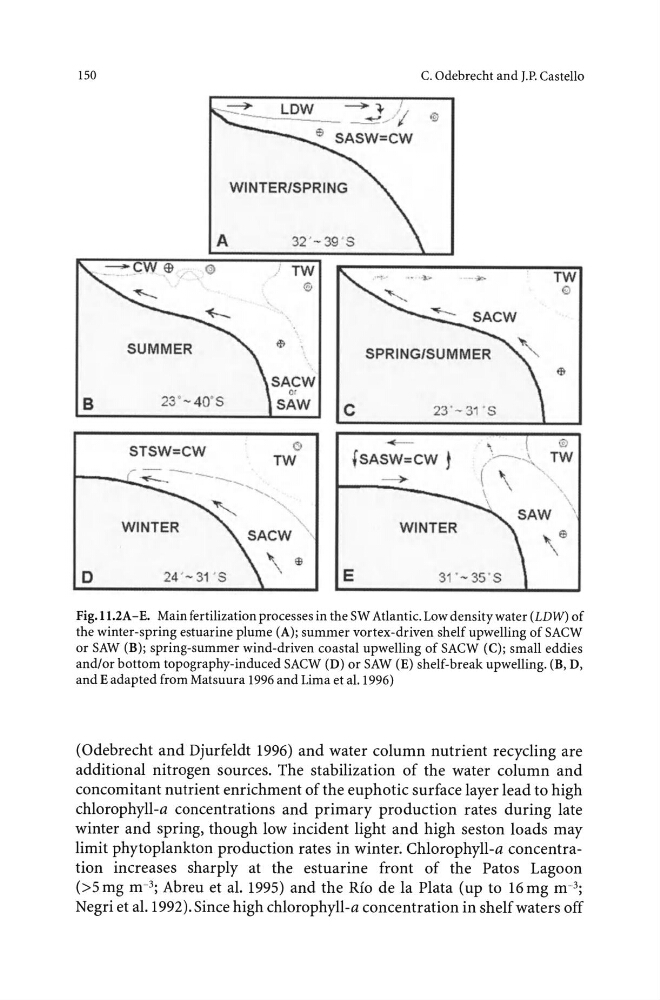
Fig.11.2A-E. Main fertilization processes in the SW Atlantic. Low density water (LDW) of
the winter-spring estuarine plume (A); summer vortex-driven shelf upwelling of SACW
or SAW (B); spring-summer wind-driven coastal upwelling of SACW (C); small eddies
and/or bottom topography-induced SACW (D) or SAW (E) shelf-break upwelling. (B, D,
and E adapted from Matsuura 1996 and Lima eta!. 1996)
(Odebrecht and Djurfeldt 1996) and water column nutrient recycling are
additional nitrogen sources. The stabilization of the water column and
concomitant nutrient enrichment of the euphotic surface layer lead to high
chlorophyll-a concentrations and primary production rates during late
winter and spring, though low incident light and high seston loads may
limit phytoplankton production rates in winter. Chlorophyll-a concentration increases sharply at the estuarine front of the Patos Lagoon
{>5 mg m- 3 ; Abreu et al. 1995) and the Rio de la Plata (up to 16 mg m- 3 ;
Negri et al. 1992). Since high chlorophyll-a concentration in shelf waters off
8
D
WINTER/SPRING
A
32 ' - 39 ' S
SUMMER
23 · - 40' S
!l't
TW
®
SACW
or
SAW
c
C. Odebrecht and J.P. Castello
• • ··).>
. _...,.,.
TW
Q
®
STSW=CW
0
TW
f sASW=CW}
TW
~-~
-- ....... , ..... , ' -,
\
\
WINTER
WINTER
\
Ell
24 ' - 31 ' S
E
31" - 35 "5
Fig.11.2A-E. Main fertilization processes in the SW Atlantic. Low density water (LDW) of
the winter-spring estuarine plume (A); summer vortex-driven shelf upwelling of SACW
or SAW (B); spring-summer wind-driven coastal upwelling of SACW (C); small eddies
and/or bottom topography-induced SACW (D) or SAW (E) shelf-break upwelling. (B, D,
and E adapted from Matsuura 1996 and Lima eta!. 1996)
(Odebrecht and Djurfeldt 1996) and water column nutrient recycling are
additional nitrogen sources. The stabilization of the water column and
concomitant nutrient enrichment of the euphotic surface layer lead to high
chlorophyll-a concentrations and primary production rates during late
winter and spring, though low incident light and high seston loads may
limit phytoplankton production rates in winter. Chlorophyll-a concentration increases sharply at the estuarine front of the Patos Lagoon
{>5 mg m- 3 ; Abreu et al. 1995) and the Rio de la Plata (up to 16 mg m- 3 ;
Negri et al. 1992). Since high chlorophyll-a concentration in shelf waters off