

148
C. Odebrecht and J.P. Castello
·,
·.
BRAZIL
',
25
•'·
/
..
· ·~.
.
200m
:
\
ARGENTINA
... ...
35
...
40
SOUTH ATLANTIC
OCEAN
' - '
500 km
55
50
45
40
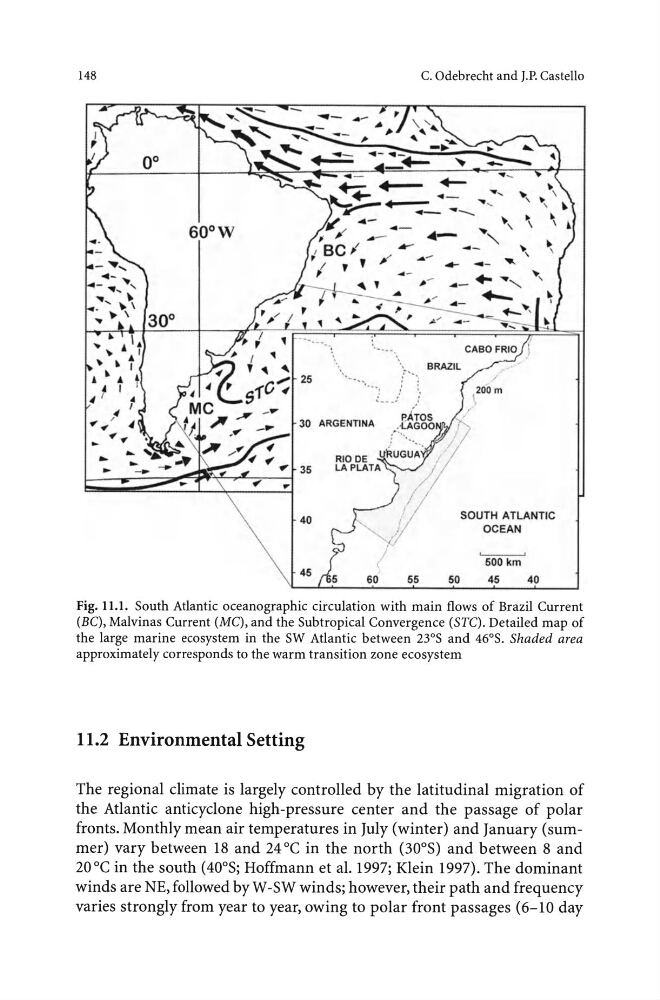
Fig. 11.1. South Atlantic oceanographic circulation with main flows of Brazil Current
(BC), Malvinas Current (MC), and the Subtropical Convergence (STC). Detailed map of
the large marine ecosystem in the SW Atlantic between 23°S and 46°S. Shaded area
approximately corresponds to the warm transition zone ecosystem
11.2 Environmental Setting
The regional climate is largely controlled by the latitudinal migration of
the Atlantic anticyclone high-pressure center and the passage of polar
fronts. Monthly mean air temperatures in July (winter) and January (summer) vary between 18 and 24 oc in the north (30°S) and between 8 and
20°C in the south (40°S; Hoffmann et al. 1997; Klein 1997). The dominant
winds are NE, followed by W-SW winds; however, their path and frequency
varies strongly from year to year, owing to polar front passages ( 6-10 day
C. Odebrecht and J.P. Castello
·,
·.
BRAZIL
',
25
•'·
/
..
· ·~.
.
200m
:
\
ARGENTINA
... ...
35
...
40
SOUTH ATLANTIC
OCEAN
' - '
500 km
55
50
45
40
Fig. 11.1. South Atlantic oceanographic circulation with main flows of Brazil Current
(BC), Malvinas Current (MC), and the Subtropical Convergence (STC). Detailed map of
the large marine ecosystem in the SW Atlantic between 23°S and 46°S. Shaded area
approximately corresponds to the warm transition zone ecosystem
11.2 Environmental Setting
The regional climate is largely controlled by the latitudinal migration of
the Atlantic anticyclone high-pressure center and the passage of polar
fronts. Monthly mean air temperatures in July (winter) and January (summer) vary between 18 and 24 oc in the north (30°S) and between 8 and
20°C in the south (40°S; Hoffmann et al. 1997; Klein 1997). The dominant
winds are NE, followed by W-SW winds; however, their path and frequency
varies strongly from year to year, owing to polar front passages ( 6-10 day