

132
P. Lana eta!.
48"20'
A TLANTIC OCEAN
N
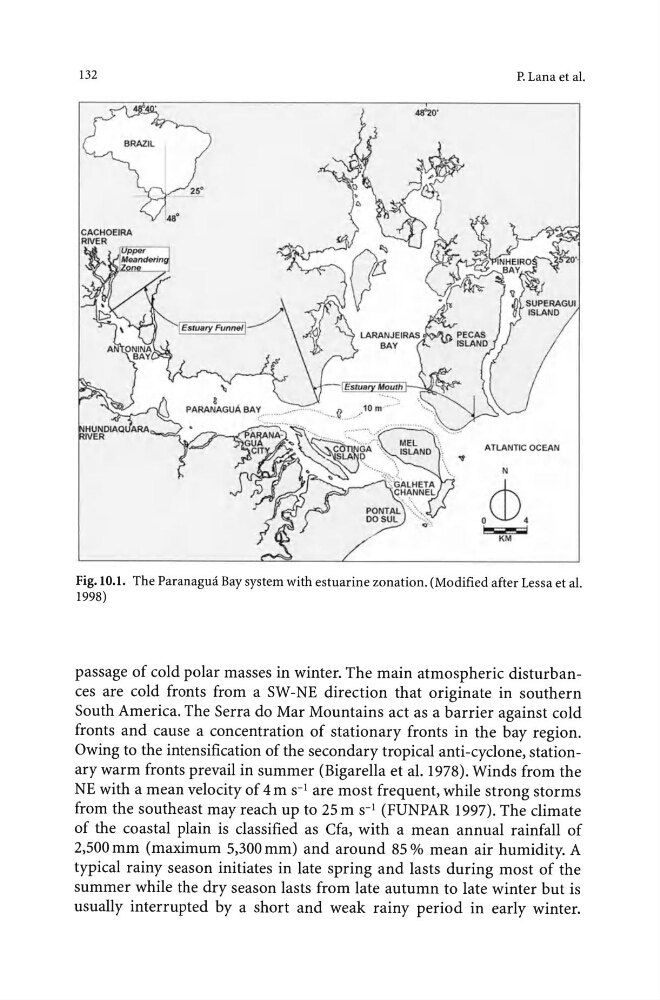
Fig.lO.l. The Paranagua Bay system with estuarine zonation. (Modified after Lessa eta!.
1998)
passage of cold polar masses in winter. The main atmospheric disturbances are cold fronts from a SW-NE direction that originate in southern
South America. The Serra do Mar Mountains act as a barrier against cold
fronts and cause a concentration of stationary fronts in the bay region.
Owing to the intensification of the secondary tropical anti-cyclone, stationary warm fronts prevail in summer (Bigarella et al. 1978). Winds from the
NE with a mean velocity of 4 m s- 1 are most frequent, while strong storms
from the southeast may reach up to 25m s- 1 (FUNPAR 1997). The climate
of the coastal plain is classified as Cfa, with a mean annual rainfall of
2,500 mm (maximum 5,300 mm) and around 85% mean air humidity. A
typical rainy season initiates in late spring and lasts during most of the
summer while the dry season lasts from late autumn to late winter but is
usually interrupted by a short and weak rainy period in early winter.
P. Lana eta!.
48"20'
A TLANTIC OCEAN
N
Fig.lO.l. The Paranagua Bay system with estuarine zonation. (Modified after Lessa eta!.
1998)
passage of cold polar masses in winter. The main atmospheric disturbances are cold fronts from a SW-NE direction that originate in southern
South America. The Serra do Mar Mountains act as a barrier against cold
fronts and cause a concentration of stationary fronts in the bay region.
Owing to the intensification of the secondary tropical anti-cyclone, stationary warm fronts prevail in summer (Bigarella et al. 1978). Winds from the
NE with a mean velocity of 4 m s- 1 are most frequent, while strong storms
from the southeast may reach up to 25m s- 1 (FUNPAR 1997). The climate
of the coastal plain is classified as Cfa, with a mean annual rainfall of
2,500 mm (maximum 5,300 mm) and around 85% mean air humidity. A
typical rainy season initiates in late spring and lasts during most of the
summer while the dry season lasts from late autumn to late winter but is
usually interrupted by a short and weak rainy period in early winter.