

100
!SEABIRDS I
Su/a /eucogaster
Sterna hlriundinacea
~
!CARNIVOROUS FISHES!
Coryphaena hlppurus
Euthynnus alleteratus
Katsuwonus pelamis
Scomber japonicus
Aux~~
IPLANKTIVOROUS FISHES!
J.L. Valentin
~
Lo/igo san au/ensis
r.-.;"'"..,...-i~~~ .... Ss
Oikopleura longicauda
I ZOOPLANKTON!
Thalia de\crstica
Ctenoca/anus vanus
Paracalanus parvus
Penilta~_ ;s _ _ _ _ _ _ _ _ _ M-IC r. R ~O -::-====--:-=-:=~=:;; N~A. . . ,
NO
IDET~
I SEDIMENT!
DOWNWELLING PERIOD
UPWELLING PERIOD
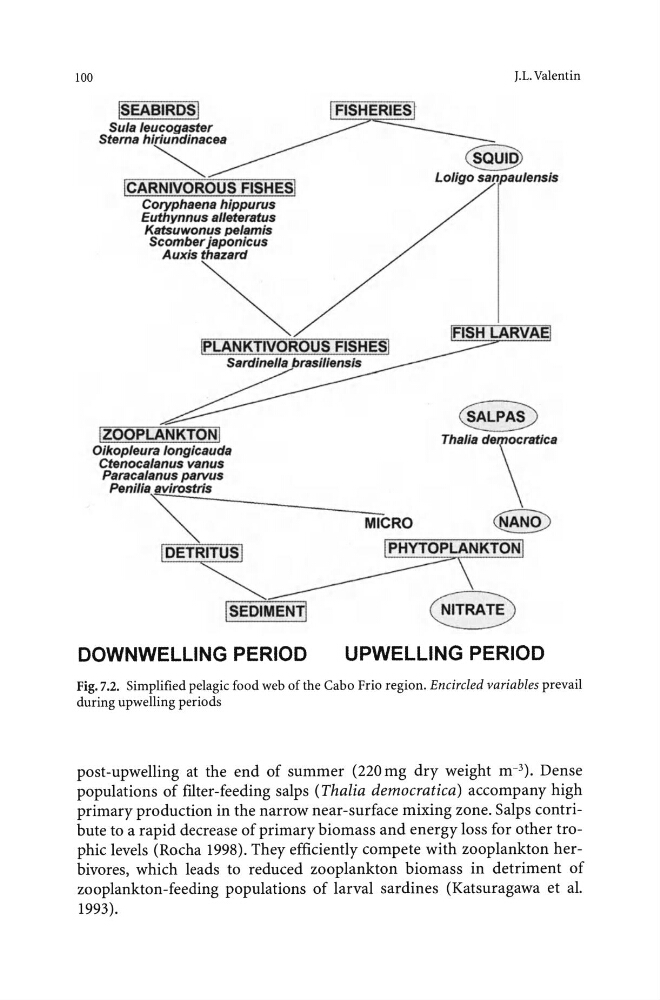
Fig. 7.2. Simplified pelagic food web of the Cabo Frio region. Encircled variables prevail
during upwelling periods
post-upwelling at the end of summer (220 mg dry weight m- 3 ). Dense
populations of filter-feeding salps (Thalia democratica) accompany high
primary production in the narrow near-surface mixing zone. Salps contribute to a rapid decrease of primary biomass and energy loss for other trophic levels (Rocha 1998). They efficiently compete with zooplankton herbivores, which leads to reduced zooplankton biomass in detriment of
zooplankton-feeding populations of larval sardines (Katsuragawa et al.
1993).
!SEABIRDS I
Su/a /eucogaster
Sterna hlriundinacea
~
!CARNIVOROUS FISHES!
Coryphaena hlppurus
Euthynnus alleteratus
Katsuwonus pelamis
Scomber japonicus
Aux~~
IPLANKTIVOROUS FISHES!
J.L. Valentin
~
Lo/igo san au/ensis
r.-.;"'"..,...-i~~~ .... Ss
Oikopleura longicauda
I ZOOPLANKTON!
Thalia de\crstica
Ctenoca/anus vanus
Paracalanus parvus
Penilta~_ ;s _ _ _ _ _ _ _ _ _ M-IC r. R ~O -::-====--:-=-:=~=:;; N~A. . . ,
NO
IDET~
I SEDIMENT!
DOWNWELLING PERIOD
UPWELLING PERIOD
Fig. 7.2. Simplified pelagic food web of the Cabo Frio region. Encircled variables prevail
during upwelling periods
post-upwelling at the end of summer (220 mg dry weight m- 3 ). Dense
populations of filter-feeding salps (Thalia democratica) accompany high
primary production in the narrow near-surface mixing zone. Salps contribute to a rapid decrease of primary biomass and energy loss for other trophic levels (Rocha 1998). They efficiently compete with zooplankton herbivores, which leads to reduced zooplankton biomass in detriment of
zooplankton-feeding populations of larval sardines (Katsuragawa et al.
1993).