

98
44•w
42•w
CABO
I
SAO TOME•\
RIODE
CAB:?
... J~RO.~ FR~
"'
~~-~ ~-";;!
ATLANTIC OCEAN
7.2 Climate and Hydrology
J.L. Valentin
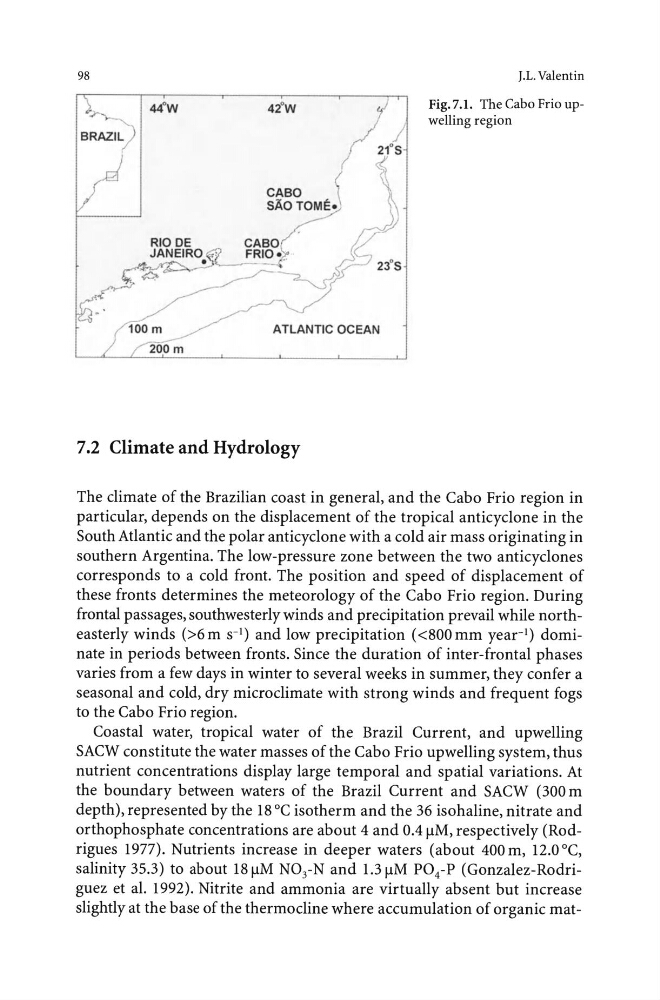
Fig. 7.1. The Cabo Frio upwelling region
The climate of the Brazilian coast in general, and the Cabo Frio region in
particular, depends on the displacement of the tropical anticyclone in the
South Atlantic and the polar anticyclone with a cold air mass originating in
southern Argentina. The low-pressure zone between the two anticyclones
corresponds to a cold front. The position and speed of displacement of
these fronts determines the meteorology of the Cabo Frio region. During
frontal passages, southwesterly winds and precipitation prevail while northeasterly winds (>6 m s- 1 ) and low precipitation ( <800 mm year- 1 ) dominate in periods between fronts. Since the duration of inter-frontal phases
varies from a few days in winter to several weeks in summer, they confer a
seasonal and cold, dry microclimate with strong winds and frequent fogs
to the Cabo Frio region.
Coastal water, tropical water of the Brazil Current, and upwelling
SACW constitute the water masses of the Cabo Frio upwelling system, thus
nutrient concentrations display large temporal and spatial variations. At
the boundary between waters of the Brazil Current and SACW ( 300 m
depth), represented by the 18 oc isotherm and the 36 isohaline, nitrate and
orthophosphate concentrations are about 4 and 0.4 JlM, respectively (Rodrigues 1977). Nutrients increase in deeper waters (about 400 m, 12.0 oc,
salinity 35.3) to about 18 JlM N0 3 -N and 1.3 JlM P0 4 -P (Gonzalez-Rodriguez et al. 1992). Nitrite and ammonia are virtually absent but increase
slightly at the base of the thermocline where accumulation of organic mat-
44•w
42•w
CABO
I
SAO TOME•\
RIODE
CAB:?
... J~RO.~ FR~
"'
~~-~ ~-";;!
ATLANTIC OCEAN
7.2 Climate and Hydrology
J.L. Valentin
Fig. 7.1. The Cabo Frio upwelling region
The climate of the Brazilian coast in general, and the Cabo Frio region in
particular, depends on the displacement of the tropical anticyclone in the
South Atlantic and the polar anticyclone with a cold air mass originating in
southern Argentina. The low-pressure zone between the two anticyclones
corresponds to a cold front. The position and speed of displacement of
these fronts determines the meteorology of the Cabo Frio region. During
frontal passages, southwesterly winds and precipitation prevail while northeasterly winds (>6 m s- 1 ) and low precipitation ( <800 mm year- 1 ) dominate in periods between fronts. Since the duration of inter-frontal phases
varies from a few days in winter to several weeks in summer, they confer a
seasonal and cold, dry microclimate with strong winds and frequent fogs
to the Cabo Frio region.
Coastal water, tropical water of the Brazil Current, and upwelling
SACW constitute the water masses of the Cabo Frio upwelling system, thus
nutrient concentrations display large temporal and spatial variations. At
the boundary between waters of the Brazil Current and SACW ( 300 m
depth), represented by the 18 oc isotherm and the 36 isohaline, nitrate and
orthophosphate concentrations are about 4 and 0.4 JlM, respectively (Rodrigues 1977). Nutrients increase in deeper waters (about 400 m, 12.0 oc,
salinity 35.3) to about 18 JlM N0 3 -N and 1.3 JlM P0 4 -P (Gonzalez-Rodriguez et al. 1992). Nitrite and ammonia are virtually absent but increase
slightly at the base of the thermocline where accumulation of organic mat-