

Winter Stress Syndrome and Selenium Toxicity
55
35
30
Col d+Se
a;
1::
0
Q)
::l
E
::l
U
20
15
10
Wann+Se
5
.~~----------~--~--~~--e Wanm-Se
o~~~~~::::~~::::::::::~==========~C~O~ld~-s~e~
o
60
120
180
Days of Exposure
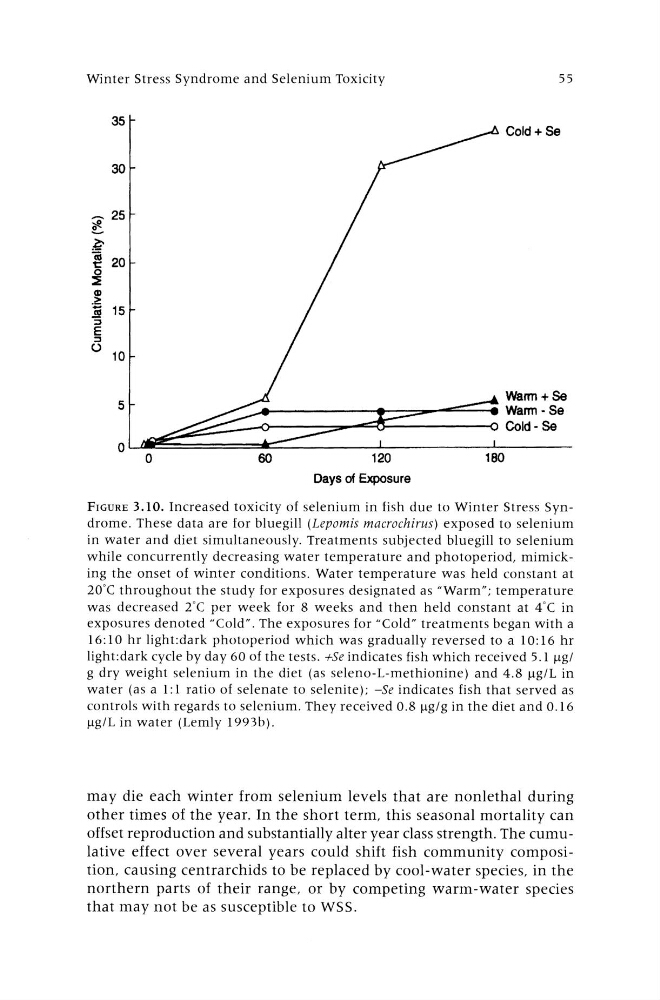
FIGURE 3.10. Increased toxicity of selenium in fish due to Winter Stress Syndrome. These data are for bluegill (Lepomis macrochirus) exposed to selenium
in water and diet simultaneously. Treatments subjected bluegill to selenium
while concurrently decreasing water temperature and photoperiod, mimicking the onset of winter conditions. Water temperature was held constant at
20'C throughout the study for exposures designated as "Warm"; temperature
was decreased 2'C per week for 8 weeks and then held constant at 4'C in
exposures denoted "Cold". The exposures for "Cold" treatments began with a
16: 1 0 hr light:dark photoperiod which was gradually reversed to a 10: 16 hr
light:dark cycle by day 60 of the tests. +Se indicates fish which received 5.1 Ilg/
g dry weight selenium in the diet (as seleno-L-methionine) and 4.8 Ilg/L in
water (as a 1:1 ratio of selenate to selenite); -Se indicates fish that served as
controls with regards to selenium. They received 0.8 !
lg/g in the diet and 0.16!lg/L in water (Lemly 1993b).
may die each winter from selenium levels that are nonlethal during
other times of the year. In the short term, this seasonal mortality can
offset reproduction and substantially alter year class strength. The cumulative effect over several years could shift fish community composition, causing centrarchids to be replaced by cool-water species, in the
northern parts of their range, or by competing warm-water species
that may not be as susceptible to WSS.
55
35
30
Col d+Se
a;
1::
0
Q)
::l
E
::l
U
20
15
10
Wann+Se
5
.~~----------~--~--~~--e Wanm-Se
o~~~~~::::~~::::::::::~==========~C~O~ld~-s~e~
o
60
120
180
Days of Exposure
FIGURE 3.10. Increased toxicity of selenium in fish due to Winter Stress Syndrome. These data are for bluegill (Lepomis macrochirus) exposed to selenium
in water and diet simultaneously. Treatments subjected bluegill to selenium
while concurrently decreasing water temperature and photoperiod, mimicking the onset of winter conditions. Water temperature was held constant at
20'C throughout the study for exposures designated as "Warm"; temperature
was decreased 2'C per week for 8 weeks and then held constant at 4'C in
exposures denoted "Cold". The exposures for "Cold" treatments began with a
16: 1 0 hr light:dark photoperiod which was gradually reversed to a 10: 16 hr
light:dark cycle by day 60 of the tests. +Se indicates fish which received 5.1 Ilg/
g dry weight selenium in the diet (as seleno-L-methionine) and 4.8 Ilg/L in
water (as a 1:1 ratio of selenate to selenite); -Se indicates fish that served as
controls with regards to selenium. They received 0.8 !
lg/g in the diet and 0.16!lg/L in water (Lemly 1993b).
may die each winter from selenium levels that are nonlethal during
other times of the year. In the short term, this seasonal mortality can
offset reproduction and substantially alter year class strength. The cumulative effect over several years could shift fish community composition, causing centrarchids to be replaced by cool-water species, in the
northern parts of their range, or by competing warm-water species
that may not be as susceptible to WSS.