

26
2. Interpreting Selenium Concentrations
diets are nearly identical (Woock et al. 1985, 1987; Hamilton et al. 1986,
1989), indicating that the results of dietary toxicity studies with seleno-Lmethionine in the laboratory can be used to accurately evaluate the hazard of food-chain residues in the field. Hilton, Hodson and Slinger (1980)
concluded that diets containing in excess of 3 Ilg Se/g may ultimately be
toxic to rainbow trout. Similar dietary effect levels have been found for
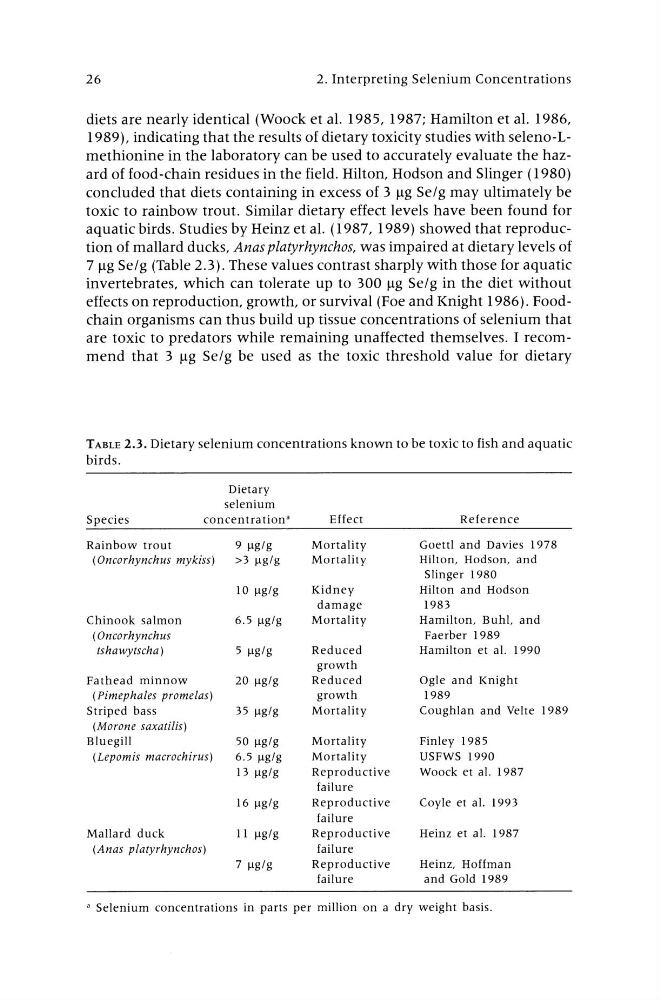
aquatic birds. Studies by Heinz et al. (1987, 1989) showed that reproduction of mallard ducks, Anas platyrhynchos, was impaired at dietary levels of
7 Ilg Se/g (Table 2.3). These values contrast sharply with those for aquatic
invertebrates, which can tolerate up to 300 Ilg Se/g in the diet without
effects on reproduction, growth, or survival (Foe and Knight 1986). Foodchain organisms can thus build up tissue concentrations of selenium that
are toxic to predators while remaining unaffected themselves. I recommend that 3 Ilg Se/g be used as the toxic threshold value for dietary
TABLE 2.3. Dietary selenium concentrations known to be toxic to fish and aquatic
birds.
Dietary
selenium
Species
concentration'
Rainbow trout
9 J.!g/g
>3 J.!g/g
(Oncorhynchus mykiss)
10 J.!g/g
Chinook salmon
( Oncorhynchus
tshawytscha)
6.5 J.!g/g
5 J.!g/g
Fathead minnow
(Pimephales promelas)
Striped bass
(Morone saxatilis)
Bluegill
(Lepomis macrochirus)
20 J.!g/g
35 J.!g/g
50 J.!g/g
6.5 J.!g/g
Effect
Mortality
Mortality
Kidney
damage
Mortality
Reduced
growth
Reduced
growth
Mortality
Mortality
Mortality
Reference
Goettl and Davies 1978
Hilton, Hodson, and
Slinger 1980
Hilton and Hodson
1983
Hamilton, Buhl, and
Faerber 1989
Hamilton et al. 1990
Ogle and Knight
1989
Coughlan and Velte 1989
Finley 1985
USFWS 1990
13 J.!g/g
16 J.!g/g
Reproductive
failure
Reproductive
failure
Woock et al. 1987
Coyle et al. 1993
Mallard duck
(Anas platyrhynchos)
11 J.!g/g
7 J.!g/g
Reproductive
failure
Reproductive
failure
Heinz et al. 1987
Heinz, Hoffman
and Gold 1989
, Selenium concentrations in parts per million on a dry weight basis.
2. Interpreting Selenium Concentrations
diets are nearly identical (Woock et al. 1985, 1987; Hamilton et al. 1986,
1989), indicating that the results of dietary toxicity studies with seleno-Lmethionine in the laboratory can be used to accurately evaluate the hazard of food-chain residues in the field. Hilton, Hodson and Slinger (1980)
concluded that diets containing in excess of 3 Ilg Se/g may ultimately be
toxic to rainbow trout. Similar dietary effect levels have been found for
aquatic birds. Studies by Heinz et al. (1987, 1989) showed that reproduction of mallard ducks, Anas platyrhynchos, was impaired at dietary levels of
7 Ilg Se/g (Table 2.3). These values contrast sharply with those for aquatic
invertebrates, which can tolerate up to 300 Ilg Se/g in the diet without
effects on reproduction, growth, or survival (Foe and Knight 1986). Foodchain organisms can thus build up tissue concentrations of selenium that
are toxic to predators while remaining unaffected themselves. I recommend that 3 Ilg Se/g be used as the toxic threshold value for dietary
TABLE 2.3. Dietary selenium concentrations known to be toxic to fish and aquatic
birds.
Dietary
selenium
Species
concentration'
Rainbow trout
9 J.!g/g
>3 J.!g/g
(Oncorhynchus mykiss)
10 J.!g/g
Chinook salmon
( Oncorhynchus
tshawytscha)
6.5 J.!g/g
5 J.!g/g
Fathead minnow
(Pimephales promelas)
Striped bass
(Morone saxatilis)
Bluegill
(Lepomis macrochirus)
20 J.!g/g
35 J.!g/g
50 J.!g/g
6.5 J.!g/g
Effect
Mortality
Mortality
Kidney
damage
Mortality
Reduced
growth
Reduced
growth
Mortality
Mortality
Mortality
Reference
Goettl and Davies 1978
Hilton, Hodson, and
Slinger 1980
Hilton and Hodson
1983
Hamilton, Buhl, and
Faerber 1989
Hamilton et al. 1990
Ogle and Knight
1989
Coughlan and Velte 1989
Finley 1985
USFWS 1990
13 J.!g/g
16 J.!g/g
Reproductive
failure
Reproductive
failure
Woock et al. 1987
Coyle et al. 1993
Mallard duck
(Anas platyrhynchos)
11 J.!g/g
7 J.!g/g
Reproductive
failure
Reproductive
failure
Heinz et al. 1987
Heinz, Hoffman
and Gold 1989
, Selenium concentrations in parts per million on a dry weight basis.