

22
2. Interpreting Selenium Concentrations
TABLE 2.1. Concentrations of selenium in sediments and associated benthic
macroinvertebrates of Belews Lake, NC, during precontamination (19701973), selenium discharge (1974-86), and recovery (1987-1996) periods.
Site and year
Littoral zone «1 m depth)
1970-1973
1974-1986
1987-1996
Bays (I-S m depth)
1970-1973
1974-1986
1987-1996
Open lake (>S m depth)
1970-1973
1974-1986
1987-1996
Selenium in sediment'
<1
8-12
1-2
<1
4-12
1-4
<1
6-11
I-S
Selenium in benthos'
<2
2S-S7
1-3
<2
IS-SI
2-10
<2
9-63
3-18
'Parts per million (Jlg Se/g), dry weight.
but rather the dietary source of selenium they provide to fish and wildlife species that feed on them.
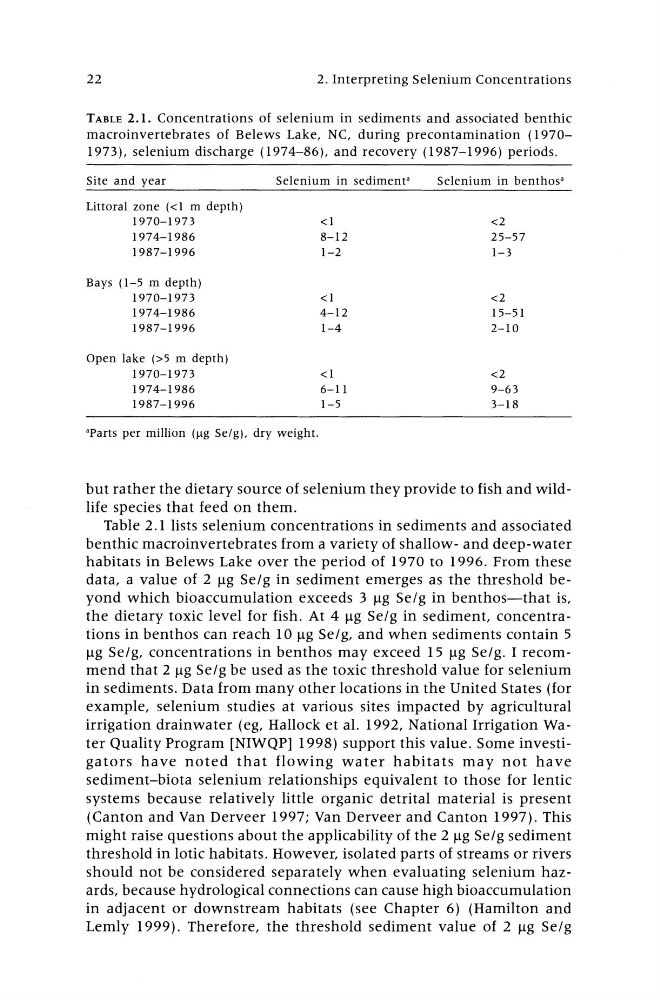
Table 2.1 lists selenium concentrations in sediments and associated
benthic macroinvertebrates from a variety of shallow- and deep-water
habitats in Belews Lake over the period of 1970 to 1996. From these
data, a value of 2 J.lg Se/g in sediment emerges as the threshold beyond which bioaccumulation exceeds 3 J.lg Se/g in benthos-that is,
the dietary toxic level for fish. At 4 J.lg Se/g in sediment, concentrations in benthos can reach 10 J.lg Se/g, and when sediments contain 5
J.lg Se/g, concentrations in benthos may exceed 15 J.lg Se/g. I recommend that 2 J.lg Se/g be used as the toxic threshold value for selenium
in sediments. Data from many other locations in the United States (for
example, selenium studies at various sites impacted by agricultural
irrigation drainwater (eg, Hallock et al. 1992, National Irrigation Water Quality Program [NIWQP] 1998) support this value. Some investigators have noted that flowing water habitats may not have
sediment-biota selenium relationships equivalent to those for lentic
systems because relatively little organic detrital material is present
(Canton and Van Derveer 1997; Van Derveer and Canton 1997). This
might raise questions about the applicability of the 2 J.lg Se/g sediment
threshold in lotic habitats. However, isolated parts of streams or rivers
should not be considered separately when evaluating selenium hazards, because hydrological connections can cause high bioaccumulation
in adjacent or downstream habitats (see Chapter 6) (Hamilton and
Lemly 1999). Therefore, the threshold sediment value of 2 J.lg Se/g
2. Interpreting Selenium Concentrations
TABLE 2.1. Concentrations of selenium in sediments and associated benthic
macroinvertebrates of Belews Lake, NC, during precontamination (19701973), selenium discharge (1974-86), and recovery (1987-1996) periods.
Site and year
Littoral zone «1 m depth)
1970-1973
1974-1986
1987-1996
Bays (I-S m depth)
1970-1973
1974-1986
1987-1996
Open lake (>S m depth)
1970-1973
1974-1986
1987-1996
Selenium in sediment'
<1
8-12
1-2
<1
4-12
1-4
<1
6-11
I-S
Selenium in benthos'
<2
2S-S7
1-3
<2
IS-SI
2-10
<2
9-63
3-18
'Parts per million (Jlg Se/g), dry weight.
but rather the dietary source of selenium they provide to fish and wildlife species that feed on them.
Table 2.1 lists selenium concentrations in sediments and associated
benthic macroinvertebrates from a variety of shallow- and deep-water
habitats in Belews Lake over the period of 1970 to 1996. From these
data, a value of 2 J.lg Se/g in sediment emerges as the threshold beyond which bioaccumulation exceeds 3 J.lg Se/g in benthos-that is,
the dietary toxic level for fish. At 4 J.lg Se/g in sediment, concentrations in benthos can reach 10 J.lg Se/g, and when sediments contain 5
J.lg Se/g, concentrations in benthos may exceed 15 J.lg Se/g. I recommend that 2 J.lg Se/g be used as the toxic threshold value for selenium
in sediments. Data from many other locations in the United States (for
example, selenium studies at various sites impacted by agricultural
irrigation drainwater (eg, Hallock et al. 1992, National Irrigation Water Quality Program [NIWQP] 1998) support this value. Some investigators have noted that flowing water habitats may not have
sediment-biota selenium relationships equivalent to those for lentic
systems because relatively little organic detrital material is present
(Canton and Van Derveer 1997; Van Derveer and Canton 1997). This
might raise questions about the applicability of the 2 J.lg Se/g sediment
threshold in lotic habitats. However, isolated parts of streams or rivers
should not be considered separately when evaluating selenium hazards, because hydrological connections can cause high bioaccumulation
in adjacent or downstream habitats (see Chapter 6) (Hamilton and
Lemly 1999). Therefore, the threshold sediment value of 2 J.lg Se/g