

Implementing Criteria
A. Current USEPA
Criteria
•
20flgIl
J\J\F\Tr /\ \
va C;(CCC)
Permi88l"ble ambient
• fV:..CMC)
A
A
C\
125
B. Sit&-Specific
Criteria
'I1Irnhold forUlllCCeptllbIe
in
I
toxic e&cca aquatic life
XXflg/l
~MV\7~""""V~CV:--~V.J-~\7~~'\iV"\--:- (CMC)
t
Permissible ambieot com:enIIaIiOIll
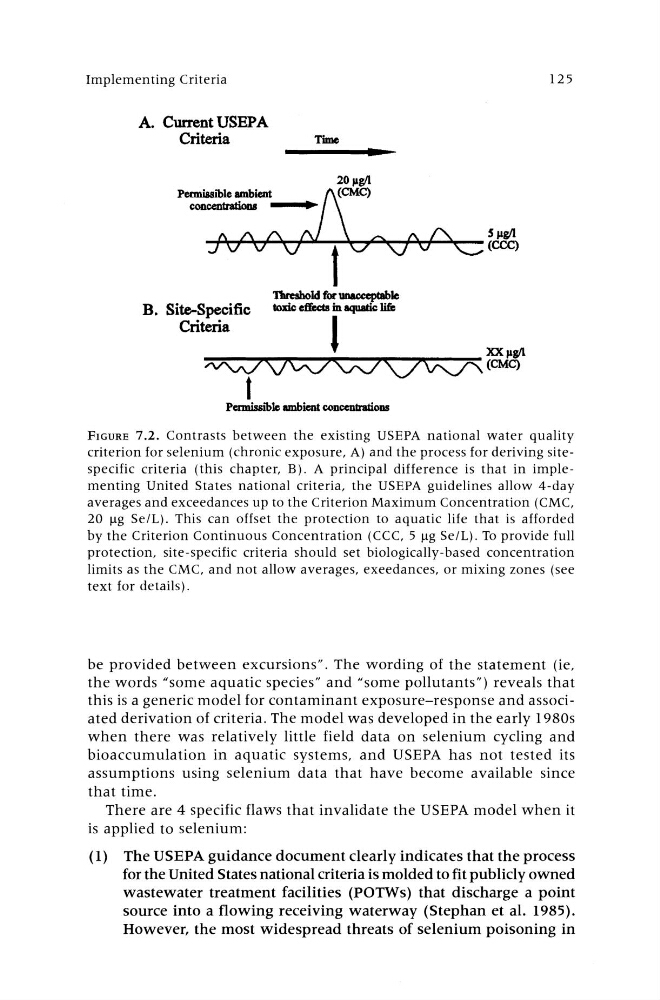
FIGURE 7.2. Contrasts between the existing USEPA national water quality
criterion for selenium (chronic exposure, A) and the process for deriving sitespecific criteria (this chapter, B). A principal difference is that in implementing United States national criteria, the USEPA guidelines allow 4-day
averages and exceedances up to the Criterion Maximum Concentration (CMC,
20 Ilg SelL). This can offset the protection to aquatic life that is afforded
by the Criterion Continuous Concentration (CCC, 5 Ilg SelL). To provide full
protection, site-specific criteria should set biologically-based concentration
limits as the CMC, and not allow averages, exeedances, or mixing zones (see
text for details).
be provided between excursions". The wording of the statement (ie,
the words "some aquatic species" and "some pollutants") reveals that
this is a generic model for contaminant exposure-response and associated derivation of criteria. The model was developed in the early 1980s
when there was relatively little field data on selenium cycling and
bioaccumulation in aquatic systems, and USEPA has not tested its
assumptions using selenium data that have become available since
that time.
There are 4 specific flaws that invalidate the USEPA model when it
is applied to selenium:
(1) The USEPA guidance document clearly indicates that the process
for the United States national criteria is molded to fit publicly owned
wastewater treatment facilities (POTWs) that discharge a point
source into a flowing receiving waterway (Stephan et a1. 1985).
However, the most widespread threats of selenium poisoning in
A. Current USEPA
Criteria
•
20flgIl
J\J\F\Tr /\ \
va C;(CCC)
Permi88l"ble ambient
• fV:..CMC)
A
A
C\
125
B. Sit&-Specific
Criteria
'I1Irnhold forUlllCCeptllbIe
in
I
toxic e&cca aquatic life
XXflg/l
~MV\7~""""V~CV:--~V.J-~\7~~'\iV"\--:- (CMC)
t
Permissible ambieot com:enIIaIiOIll
FIGURE 7.2. Contrasts between the existing USEPA national water quality
criterion for selenium (chronic exposure, A) and the process for deriving sitespecific criteria (this chapter, B). A principal difference is that in implementing United States national criteria, the USEPA guidelines allow 4-day
averages and exceedances up to the Criterion Maximum Concentration (CMC,
20 Ilg SelL). This can offset the protection to aquatic life that is afforded
by the Criterion Continuous Concentration (CCC, 5 Ilg SelL). To provide full
protection, site-specific criteria should set biologically-based concentration
limits as the CMC, and not allow averages, exeedances, or mixing zones (see
text for details).
be provided between excursions". The wording of the statement (ie,
the words "some aquatic species" and "some pollutants") reveals that
this is a generic model for contaminant exposure-response and associated derivation of criteria. The model was developed in the early 1980s
when there was relatively little field data on selenium cycling and
bioaccumulation in aquatic systems, and USEPA has not tested its
assumptions using selenium data that have become available since
that time.
There are 4 specific flaws that invalidate the USEPA model when it
is applied to selenium:
(1) The USEPA guidance document clearly indicates that the process
for the United States national criteria is molded to fit publicly owned
wastewater treatment facilities (POTWs) that discharge a point
source into a flowing receiving waterway (Stephan et a1. 1985).
However, the most widespread threats of selenium poisoning in