

106
6. Hydrological Units and Selenium Criteria
detritus, and over time, isolated through the process of sedimentation.
Some selenium, particularly certain organic forms , may be released
into the atmosphere through volatilization by chemical or microbial
activity in the water and sediments or through direct release by plants.
In totaL immobilization processes effectively remove selenium from
the soluble pool, especially in slow moving or still-water habitats and
wetlands. As much as 90% of the total selenium in an aquatic system
may be in the upper few centimeters of sediment and overlying detritus (Lemly and Smith 1987).
Mobilization Processes
Selenium in sediments is particularly important to long-term habitat
quality, because mechanisms present in most aquatic systems effectively mobilize this pool of selenium into food chains and thereby cause
long-term dietary exposure of fish and wildlife (Lemly 1993, 1997) .
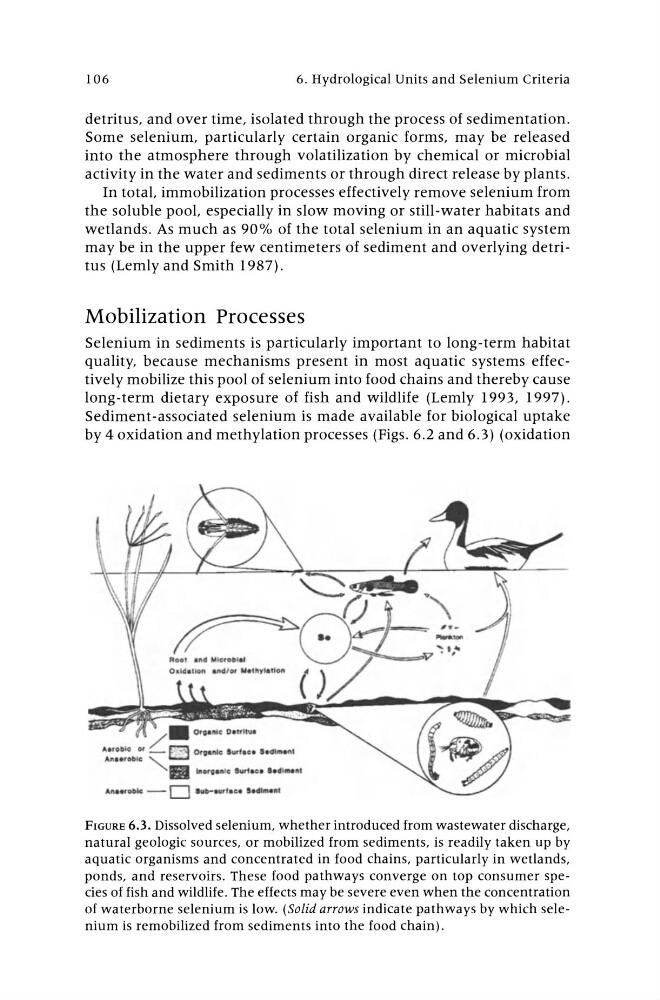
Sediment-associated selenium is made available for biological uptake
by 4 oxidation and methylation processes (Figs. 6.2 and 6.3) (oxidation
FIGURE 6.3. Dissolved selenium, whether introduced from wastewater discharge,
natural geologic sources, or mobilized from sediments, is readily taken up by
aquatic organisms and concentrated in food chains, particularly in wetlands,
ponds, and reservoirs . These food pathways converge on top consumer species of fish and wildlife. The effects may be severe even when the concentration
of waterborne selenium is low. (Solid arrows indicate pathways by which selenium is remobilized from sediments into the food chain).
6. Hydrological Units and Selenium Criteria
detritus, and over time, isolated through the process of sedimentation.
Some selenium, particularly certain organic forms , may be released
into the atmosphere through volatilization by chemical or microbial
activity in the water and sediments or through direct release by plants.
In totaL immobilization processes effectively remove selenium from
the soluble pool, especially in slow moving or still-water habitats and
wetlands. As much as 90% of the total selenium in an aquatic system
may be in the upper few centimeters of sediment and overlying detritus (Lemly and Smith 1987).
Mobilization Processes
Selenium in sediments is particularly important to long-term habitat
quality, because mechanisms present in most aquatic systems effectively mobilize this pool of selenium into food chains and thereby cause
long-term dietary exposure of fish and wildlife (Lemly 1993, 1997) .
Sediment-associated selenium is made available for biological uptake
by 4 oxidation and methylation processes (Figs. 6.2 and 6.3) (oxidation
FIGURE 6.3. Dissolved selenium, whether introduced from wastewater discharge,
natural geologic sources, or mobilized from sediments, is readily taken up by
aquatic organisms and concentrated in food chains, particularly in wetlands,
ponds, and reservoirs . These food pathways converge on top consumer species of fish and wildlife. The effects may be severe even when the concentration
of waterborne selenium is low. (Solid arrows indicate pathways by which selenium is remobilized from sediments into the food chain).