

68
r.,o. Hedin and E .D. Hetherington
Watershed
Ecosystem
Response
ENSO
~
Weather ~ Inland Flux of
Patterns L----..Y Elements and
Water
\ /
Marine
Processes
(e.g ., DMSO or NH 3 emissions)
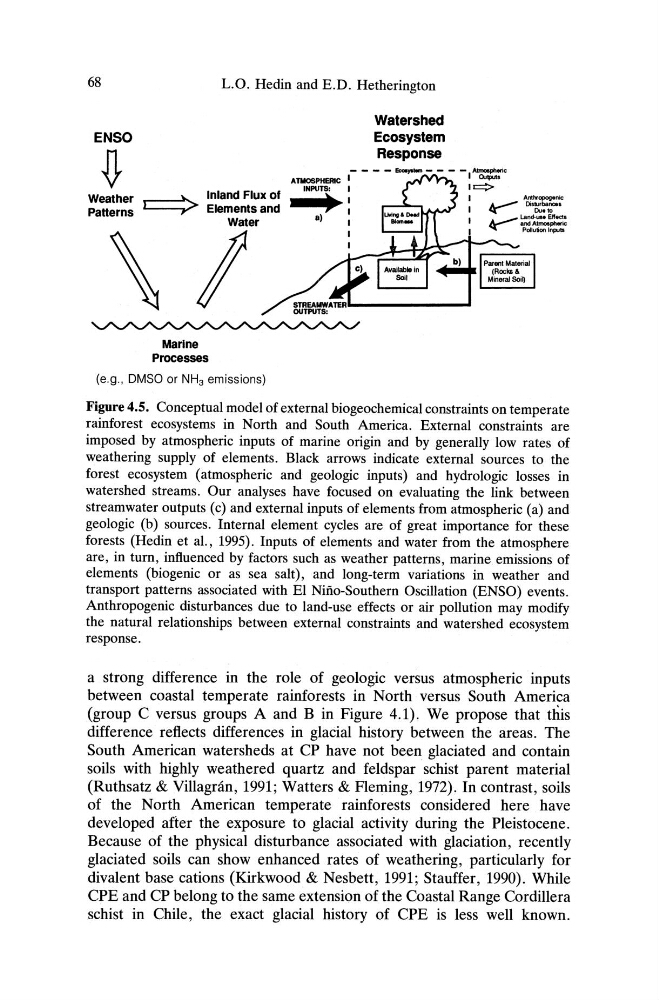
Figure 4.5. Conceptual model of external biogeochemica l constraints on temperate
rainforest ecosystems in North and South America. External constraints are
imposed by atmospheric inputs of marine origin and by generally low rates of
weathering supply of elements. Black arrows indicate external sources to the
forest ecosystem (atmospheric and geologic inputs) and hydrologic losses in
watershed streams . Our analyses have focused on evaluating the link between
streamwater outp uts (c) and external inputs of elements from atmospheric (a) and
geologic (b) sources. Internal element cycles are of great importance for these
forests (Hedin et aI., 1995). Inputs of elements and water from the atmosphere
are, in turn , influenced by factors such as weather patterns, marine emissions of
elemen ts (biogenic or as sea salt), and long-term variations in weather and
transport patterns associated with El Nino-Sout hern Oscillation (ENSO) events.
Anthropogenic disturbances due to land-use effects or air pollution may modify
the natural relationships between external constraints and watershed ecosystem
response .
a strong difference in the role of geo logic versus atmospheric inputs
between coastal temperate rainforests in North versus Sou th America
(gro up C vers us groups A and B in Figure 4.1). We propose that this
difference reflects differences in glacial history between the areas. The
Sou th American watersheds at CP have not been glaciated and contain
soils with highly weathered quartz and feldspar schist parent material
(Ruthsatz & Villagran, 1991; Watters & Fleming, 1972). In contrast, soils
of the North American temperate rainforests considered here have
developed after the exposure to glacial activity during the Pleistocene.
Because of the physical disturbance associated with glaciation, recently
glaciated soils can show enhanced rates of weathering, particularly for
divalent base cations (Kirkwood & Nesbett, 1991; Stauffer, 1990). While
CPE and CP belong to the same extension of the Coastal R ange Cordillera
schist in Chile , the exact glacia l history of CPE is less well known.
r.,o. Hedin and E .D. Hetherington
Watershed
Ecosystem
Response
ENSO
~
Weather ~ Inland Flux of
Patterns L----..Y Elements and
Water
\ /
Marine
Processes
(e.g ., DMSO or NH 3 emissions)
Figure 4.5. Conceptual model of external biogeochemica l constraints on temperate
rainforest ecosystems in North and South America. External constraints are
imposed by atmospheric inputs of marine origin and by generally low rates of
weathering supply of elements. Black arrows indicate external sources to the
forest ecosystem (atmospheric and geologic inputs) and hydrologic losses in
watershed streams . Our analyses have focused on evaluating the link between
streamwater outp uts (c) and external inputs of elements from atmospheric (a) and
geologic (b) sources. Internal element cycles are of great importance for these
forests (Hedin et aI., 1995). Inputs of elements and water from the atmosphere
are, in turn , influenced by factors such as weather patterns, marine emissions of
elemen ts (biogenic or as sea salt), and long-term variations in weather and
transport patterns associated with El Nino-Sout hern Oscillation (ENSO) events.
Anthropogenic disturbances due to land-use effects or air pollution may modify
the natural relationships between external constraints and watershed ecosystem
response .
a strong difference in the role of geo logic versus atmospheric inputs
between coastal temperate rainforests in North versus Sou th America
(gro up C vers us groups A and B in Figure 4.1). We propose that this
difference reflects differences in glacial history between the areas. The
Sou th American watersheds at CP have not been glaciated and contain
soils with highly weathered quartz and feldspar schist parent material
(Ruthsatz & Villagran, 1991; Watters & Fleming, 1972). In contrast, soils
of the North American temperate rainforests considered here have
developed after the exposure to glacial activity during the Pleistocene.
Because of the physical disturbance associated with glaciation, recently
glaciated soils can show enhanced rates of weathering, particularly for
divalent base cations (Kirkwood & Nesbett, 1991; Stauffer, 1990). While
CPE and CP belong to the same extension of the Coastal R ange Cordillera
schist in Chile , the exact glacia l history of CPE is less well known.