

16
R.G . Lawford
-5
5
15 25 35 45 55 65 75
Degrees of Latitude
3000mm, and MATs range from lOoC to soc. At these latitudes, there
seems to be little difference between North and South America. However,
these latitudes are dominated by spruce and boreal forest in North
America and by sandra deciduous trees in South America. This difference
indicates that the history of forests in the two hemispheres is different and
that the tree types that come into equilibrium with the regional climate
are dependent to some extent on their history and on the gene types
available regionally. It may also reflect the effects of different climatic
histories in the past. It is important to recognize that tree growth is also
dependent on other sources of moisture besides precipitation, such as fog
and cloud water, and the availability of photosynthetic active radiation.
Cloud-water measurements are not routinely available except for a few
research sites on specific mountains along the coasts of Chile; consequently, it is difficult to determine the role of cloud water in regional
water cycles and ecosystems.
The Energy Balance
As indicated by Equation 1.1, there should be a balance between the net
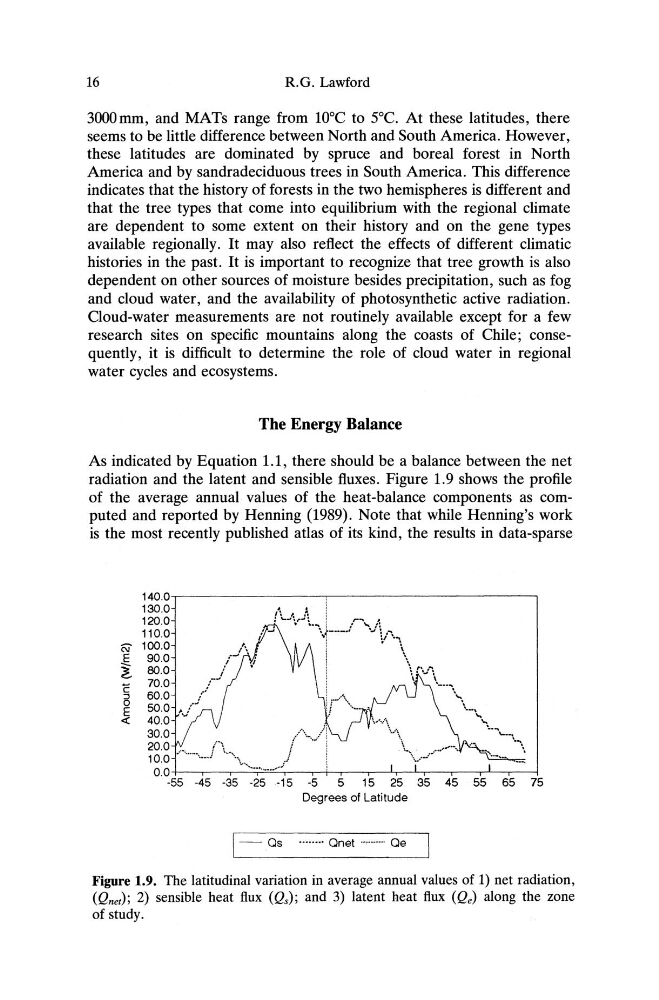
radiation and the latent and sensible fluxes. Figure 1.9 shows the profile
of the average annual values of the heat-balance components as computed and reported by Henning (1989). Note that while Henning's work
is the most recently published atlas of its kind, the results in data-sparse
140.0-.--- - -- - - - , - - - - - -- - - - - - - - - - - ,
130.0
120.0
110.0
N 100.0
§ 90.0
Go
80.0
70.0
60.0
50.0
40.0
30 .0
... ..
~g:g ,./\.> /
0.0 +-----,- --,------'.r==--r---.-f-T---,-----L,.---'-r--.-----,-'--,------i
-55 -45 -35 ·25·15
1- Os Onet Oe
Figure 1.9. The latitudinal variation in average annual values of 1) net radiation ,
(Qnet); 2) sensible heat flux (Qs); and 3) latent heat flux (Qe) along the zone
of study.
R.G . Lawford
-5
5
15 25 35 45 55 65 75
Degrees of Latitude
3000mm, and MATs range from lOoC to soc. At these latitudes, there
seems to be little difference between North and South America. However,
these latitudes are dominated by spruce and boreal forest in North
America and by sandra deciduous trees in South America. This difference
indicates that the history of forests in the two hemispheres is different and
that the tree types that come into equilibrium with the regional climate
are dependent to some extent on their history and on the gene types
available regionally. It may also reflect the effects of different climatic
histories in the past. It is important to recognize that tree growth is also
dependent on other sources of moisture besides precipitation, such as fog
and cloud water, and the availability of photosynthetic active radiation.
Cloud-water measurements are not routinely available except for a few
research sites on specific mountains along the coasts of Chile; consequently, it is difficult to determine the role of cloud water in regional
water cycles and ecosystems.
The Energy Balance
As indicated by Equation 1.1, there should be a balance between the net
radiation and the latent and sensible fluxes. Figure 1.9 shows the profile
of the average annual values of the heat-balance components as computed and reported by Henning (1989). Note that while Henning's work
is the most recently published atlas of its kind, the results in data-sparse
140.0-.--- - -- - - - , - - - - - -- - - - - - - - - - - ,
130.0
120.0
110.0
N 100.0
§ 90.0
Go
80.0
70.0
60.0
50.0
40.0
30 .0
... ..
~g:g ,./\.> /
0.0 +-----,- --,------'.r==--r---.-f-T---,-----L,.---'-r--.-----,-'--,------i
-55 -45 -35 ·25·15
1- Os Onet Oe
Figure 1.9. The latitudinal variation in average annual values of 1) net radiation ,
(Qnet); 2) sensible heat flux (Qs); and 3) latent heat flux (Qe) along the zone
of study.