

13. The Temperate Rainforest Lakes of Chile and Canada
275
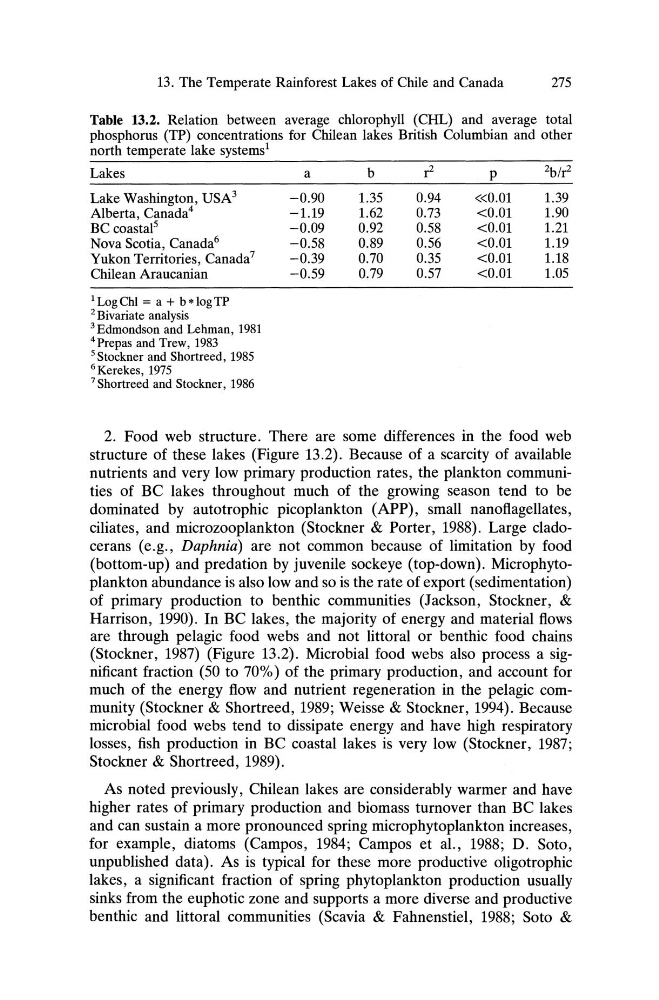
Table 13.2. Relation between average chlorophyll (CHL) and average total
phosphorus (TP) concentrations for Chilean lakes British Columbian and other
north temperate lake systems!
Lake Washington, USA
3
Alberta, Canada"
BC coastaf
Nova Scotia, Canada"
Yukon Territories, Canada?
Chilean Araucanian
1 Log ChI = a + b r logTl'
2 Bivariate analysis
3 Edmondson and Lehman, 1981
"Prepas and Trew, 1983
5 Stockner and Shortreed, 1985
6 Kerekes, 1975
7 Shortreed and Stockner , 1986
-0.90
-1.19
-0.09
-0.58
-0.39
-0.59
1.35
1.62
0.92
0.89
0.70
0.79
0.94
0.73
0.58
0.56
0.35
0.57
«0.01
<0.01
<0.01
<0.01
<0.01
<0.01
1.39
1.90
1.21
1.19
1.18
1.05
2. Food web structure. There are some differences in the food web
structure of these lakes (Figure 13.2). Because of a scarcity of available
nutrients and very low primary production rates, the plankton communities of BC lakes throughout much of the growing season tend to be
dominated by autotrophic picoplankton (APP) , small nanoflagellates,
ciliates, and microzooplankton (Stockner & Porter, 1988). Large dadocerans (e.g., Daphnia) are not common because of limitation by food
(bottom-up) and predation by juvenile sockeye (top-down). Microphytoplankton abundance is also low and so is the rate of export (sedimentation)
of primary production to benthic communities (Jackson, Stockner, &
Harrison, 1990). In BC lakes, the majority of energy and material flows
are through pelagic food webs and not littoral or benthic food chains
(Stockner, 1987) (Figure 13.2). Microbial food webs also process a significant fraction (50 to 70%) of the primary production, and account for
much of the energy flow and nutrient regeneration in the pelagic community (Stockner & Shortreed, 1989; Weisse & Stockner, 1994). Because
microbial food webs tend to dissipate energy and have high respiratory
losses, fish production in BC coastal lakes is very low (Stockner, 1987;
Stockner & Shortreed, 1989).
As noted previously, Chilean lakes are considerably warmer and have
higher rates of primary production and biomass turnover than BC lakes
and can sustain a more pronounced spring microphytoplankton increases,
for example, diatoms (Campos, 1984; Campos et al., 1988; D . Soto,
unpublished data). As is typical for these more productive oligotrophic
lakes, a significant fraction of spring phytoplankton production usually
sinks from the euphotic zone and supports a more diverse and productive
benthic and littoral communities (Scavia & Fahnenstiel, 1988; Soto &
275
Table 13.2. Relation between average chlorophyll (CHL) and average total
phosphorus (TP) concentrations for Chilean lakes British Columbian and other
north temperate lake systems!
Lake Washington, USA
3
Alberta, Canada"
BC coastaf
Nova Scotia, Canada"
Yukon Territories, Canada?
Chilean Araucanian
1 Log ChI = a + b r logTl'
2 Bivariate analysis
3 Edmondson and Lehman, 1981
"Prepas and Trew, 1983
5 Stockner and Shortreed, 1985
6 Kerekes, 1975
7 Shortreed and Stockner , 1986
-0.90
-1.19
-0.09
-0.58
-0.39
-0.59
1.35
1.62
0.92
0.89
0.70
0.79
0.94
0.73
0.58
0.56
0.35
0.57
«0.01
<0.01
<0.01
<0.01
<0.01
<0.01
1.39
1.90
1.21
1.19
1.18
1.05
2. Food web structure. There are some differences in the food web
structure of these lakes (Figure 13.2). Because of a scarcity of available
nutrients and very low primary production rates, the plankton communities of BC lakes throughout much of the growing season tend to be
dominated by autotrophic picoplankton (APP) , small nanoflagellates,
ciliates, and microzooplankton (Stockner & Porter, 1988). Large dadocerans (e.g., Daphnia) are not common because of limitation by food
(bottom-up) and predation by juvenile sockeye (top-down). Microphytoplankton abundance is also low and so is the rate of export (sedimentation)
of primary production to benthic communities (Jackson, Stockner, &
Harrison, 1990). In BC lakes, the majority of energy and material flows
are through pelagic food webs and not littoral or benthic food chains
(Stockner, 1987) (Figure 13.2). Microbial food webs also process a significant fraction (50 to 70%) of the primary production, and account for
much of the energy flow and nutrient regeneration in the pelagic community (Stockner & Shortreed, 1989; Weisse & Stockner, 1994). Because
microbial food webs tend to dissipate energy and have high respiratory
losses, fish production in BC coastal lakes is very low (Stockner, 1987;
Stockner & Shortreed, 1989).
As noted previously, Chilean lakes are considerably warmer and have
higher rates of primary production and biomass turnover than BC lakes
and can sustain a more pronounced spring microphytoplankton increases,
for example, diatoms (Campos, 1984; Campos et al., 1988; D . Soto,
unpublished data). As is typical for these more productive oligotrophic
lakes, a significant fraction of spring phytoplankton production usually
sinks from the euphotic zone and supports a more diverse and productive
benthic and littoral communities (Scavia & Fahnenstiel, 1988; Soto &