

260
J.J. Armesto et al.
Nectarivory seems to be infrequent in the avifaunas of North American
temperate forests as well (i.e., 3 or fewer species of hummingbirds are
reported for temperate areas in North America; Jaksic & Feinsinger,
1991); however, eastern deciduous or conifer-dominated northwestern
forests of North America seem to be very poor in hummingbird-pollinated
flowers as compared to southern Chile . Since we found no studies that
evaluated the importance of hummingbirds in the pollination of temperate
forest plants in North America, we utilized flower descriptions in published
local floras. In a survey of the flora of Mount Rainier National Park,
Washington (Franklin et al., 1988), only one species had ornithophilous
flowers (0.6% of the flora) .-In the flora of Glacier National Park, Montana
(Lesica, 1985), eight species had ornithophilous flowers (0.8% of the
flora) . In fact, the percentage of the flora pollinated by hummingbirds
in Chiloe may be quite high even when compared to some tropical
forests. Stiles (1985) reports that 2.4% of the woody flora (15 species) are
pollinated by hummingbirds in Guanacaste, Costa Rica; 3.1 % (29 species)
in Barro Colorado, Panama; and 2.9% (39 species) in La Selva , Costa
Rica.
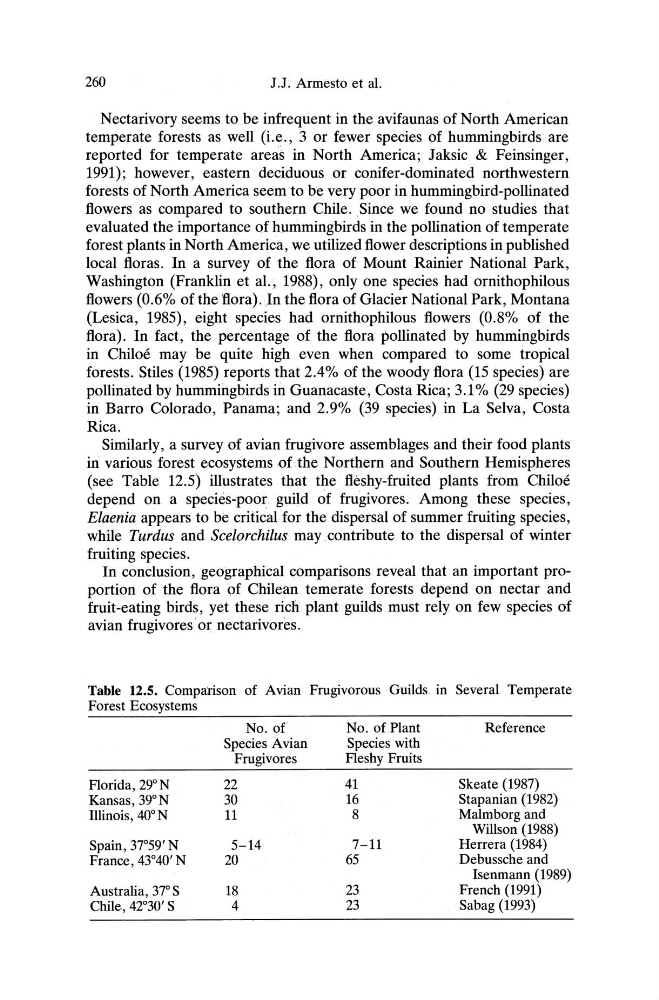
Similarly, a survey of avian frugivore assemblages and their food plants
in various forest ecosystems ofthe Northern and Southern Hemispheres
(see Table 12.5) illustrates that the fleshy-fruited plants from Chiloe
depend on a species-poor guild of frugivores . Among these species,
Elaenia appears to be critical for the dispersal of summer fruiting species,
while Turdus and Scelorchilus maycontribute to the dispersal of winter
fruiting species.
In conclusion, geographical comparisons reveal that an important proportion of the flora of Chilean .temerate forests depend on nectar and
fruit-eating birds, yet these rich plant guilds must rely on few species of
avian frugivores or nectarivores.
Table 12.5. Comparison of Avian Frugivorous Guilds in Several Temperate
Forest Ecosystems
No. of
No. of Plant
Reference
Species Avian
Species with
Frugivores
Fleshy Fruits
Florida, 29°N
22
41
Skeate (1987)
Kansas, 39°N
30
16
Stapanian (1982)
Illinois,40
0N
11
8
Malmborg and
Willson (1988)
Spain, 37°59' N
5-14
7-11
Herrera (1984)
France, 43°40' N
20
65
Debussche and
Isenmann (1989)
Australia, 37°S
18
23
French (1991)
Chile, 42°30'S
4
23
Sabag (1993)
J.J. Armesto et al.
Nectarivory seems to be infrequent in the avifaunas of North American
temperate forests as well (i.e., 3 or fewer species of hummingbirds are
reported for temperate areas in North America; Jaksic & Feinsinger,
1991); however, eastern deciduous or conifer-dominated northwestern
forests of North America seem to be very poor in hummingbird-pollinated
flowers as compared to southern Chile . Since we found no studies that
evaluated the importance of hummingbirds in the pollination of temperate
forest plants in North America, we utilized flower descriptions in published
local floras. In a survey of the flora of Mount Rainier National Park,
Washington (Franklin et al., 1988), only one species had ornithophilous
flowers (0.6% of the flora) .-In the flora of Glacier National Park, Montana
(Lesica, 1985), eight species had ornithophilous flowers (0.8% of the
flora) . In fact, the percentage of the flora pollinated by hummingbirds
in Chiloe may be quite high even when compared to some tropical
forests. Stiles (1985) reports that 2.4% of the woody flora (15 species) are
pollinated by hummingbirds in Guanacaste, Costa Rica; 3.1 % (29 species)
in Barro Colorado, Panama; and 2.9% (39 species) in La Selva , Costa
Rica.
Similarly, a survey of avian frugivore assemblages and their food plants
in various forest ecosystems ofthe Northern and Southern Hemispheres
(see Table 12.5) illustrates that the fleshy-fruited plants from Chiloe
depend on a species-poor guild of frugivores . Among these species,
Elaenia appears to be critical for the dispersal of summer fruiting species,
while Turdus and Scelorchilus maycontribute to the dispersal of winter
fruiting species.
In conclusion, geographical comparisons reveal that an important proportion of the flora of Chilean .temerate forests depend on nectar and
fruit-eating birds, yet these rich plant guilds must rely on few species of
avian frugivores or nectarivores.
Table 12.5. Comparison of Avian Frugivorous Guilds in Several Temperate
Forest Ecosystems
No. of
No. of Plant
Reference
Species Avian
Species with
Frugivores
Fleshy Fruits
Florida, 29°N
22
41
Skeate (1987)
Kansas, 39°N
30
16
Stapanian (1982)
Illinois,40
0N
11
8
Malmborg and
Willson (1988)
Spain, 37°59' N
5-14
7-11
Herrera (1984)
France, 43°40' N
20
65
Debussche and
Isenmann (1989)
Australia, 37°S
18
23
French (1991)
Chile, 42°30'S
4
23
Sabag (1993)