

12. The Importance of Plant-Bird Mutualisms
Results
The Birds
251
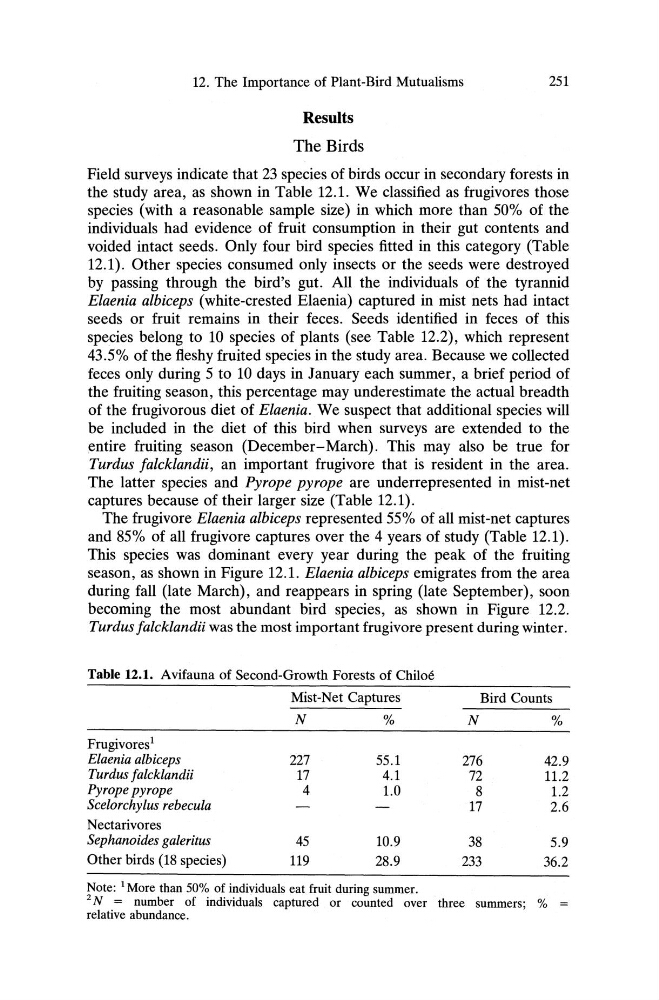
Field surveys indicate that 23 species of birds occur in secondary forests in
the study area, as shown in Table 12.1. We classified as frugivores those
species (with a reasonable sample size) in which more than 50% of the
individuals had evidence of fruit consumption in their gut contents and
voided intact seeds. Only four bird species fitted in this category (Table
12.1). Other species consumed only insects or the seeds were destroyed
by passing through the bird's gut. All the individuals of the tyrannid
Elaenia albiceps (white-crested Elaenia) captured in mist nets had intact
seeds or fruit remains in their feces. Seeds identified in feces of this
species belong to 10 species of plants (see Table 12.2), which represent
43.5% of the fleshy fruited species in the study area . Because we collected
feces only during 5 to 10 days in January each summer, a brief period of
the fruiting season, this percentage may underestimate the actual breadth
of the frugivorous diet of Elaenia . We suspect that additional species will
be included in the diet of this bird when surveys are extended to the
entire fruiting season (December-March). This may also be true for
Turdus falcklandii , an important frugivore that is resident in the area.
The latter species and Pyrope pyrope are underrepresented in mist-net
captures because of their larger size (Table 12.1).
The frugivore Elaenia albiceps represented 55% of all mist-net captures
and 85% of all frugivore captures over the 4 years of study (Table 12.1).
This species was dominant every year during the peak of the fruiting
season, as shown in Figure 12.1. Elaenia albiceps emigrates from the area
during fall (late March), and reappears in spring (late September), soon
becoming the most abundant bird species, as shown in Figure 12.2.
Turdus falcklandii was the most important frugivore present during winter.
Table 12.1. Avifauna of Second-Growth Forests of Chiloe
Mist-Net Captures
Bird Counts
N
%
N
%
Frugivores!
Elaenia albiceps
227
55.1
276
42.9
Turdus falcklandii
17
4.1
72
11.2
Pyrope pyrope
4
1.0
8
1.2
Scelorchylus rebecula
17
2.6
Nectarivores
Sephanoides galeritus
45
10.9
38
5.9
Other birds (18 species)
119
28.9
233
36.2
Note: I More than 50% of individuals eat fruit during summer.
2 N = number of individuals captured or counted over three summers; % =
relative abundance.
Results
The Birds
251
Field surveys indicate that 23 species of birds occur in secondary forests in
the study area, as shown in Table 12.1. We classified as frugivores those
species (with a reasonable sample size) in which more than 50% of the
individuals had evidence of fruit consumption in their gut contents and
voided intact seeds. Only four bird species fitted in this category (Table
12.1). Other species consumed only insects or the seeds were destroyed
by passing through the bird's gut. All the individuals of the tyrannid
Elaenia albiceps (white-crested Elaenia) captured in mist nets had intact
seeds or fruit remains in their feces. Seeds identified in feces of this
species belong to 10 species of plants (see Table 12.2), which represent
43.5% of the fleshy fruited species in the study area . Because we collected
feces only during 5 to 10 days in January each summer, a brief period of
the fruiting season, this percentage may underestimate the actual breadth
of the frugivorous diet of Elaenia . We suspect that additional species will
be included in the diet of this bird when surveys are extended to the
entire fruiting season (December-March). This may also be true for
Turdus falcklandii , an important frugivore that is resident in the area.
The latter species and Pyrope pyrope are underrepresented in mist-net
captures because of their larger size (Table 12.1).
The frugivore Elaenia albiceps represented 55% of all mist-net captures
and 85% of all frugivore captures over the 4 years of study (Table 12.1).
This species was dominant every year during the peak of the fruiting
season, as shown in Figure 12.1. Elaenia albiceps emigrates from the area
during fall (late March), and reappears in spring (late September), soon
becoming the most abundant bird species, as shown in Figure 12.2.
Turdus falcklandii was the most important frugivore present during winter.
Table 12.1. Avifauna of Second-Growth Forests of Chiloe
Mist-Net Captures
Bird Counts
N
%
N
%
Frugivores!
Elaenia albiceps
227
55.1
276
42.9
Turdus falcklandii
17
4.1
72
11.2
Pyrope pyrope
4
1.0
8
1.2
Scelorchylus rebecula
17
2.6
Nectarivores
Sephanoides galeritus
45
10.9
38
5.9
Other birds (18 species)
119
28.9
233
36.2
Note: I More than 50% of individuals eat fruit during summer.
2 N = number of individuals captured or counted over three summers; % =
relative abundance.