

194
T.T. Veblen and P.B. Alaback
North America
100
90
80
70
60
}/!. 50
0
40
30
20
10
0
;
Gl
1li
III
c
~
~
'a.
8
~
c:
;(
~
iil 0
w
~
en
c:
~
0
0
~
0
South America
l'II
~
~
0
'2
:c :E lir
0
0
0
~
01
~
Gl
~
c:
Gl
a.
III
"t:l
c:
l'II
E
0
8 ~
Gl
:::E
s:
~
1:
0
Z
Wi! Standing
o Snapped
•
Uprooted
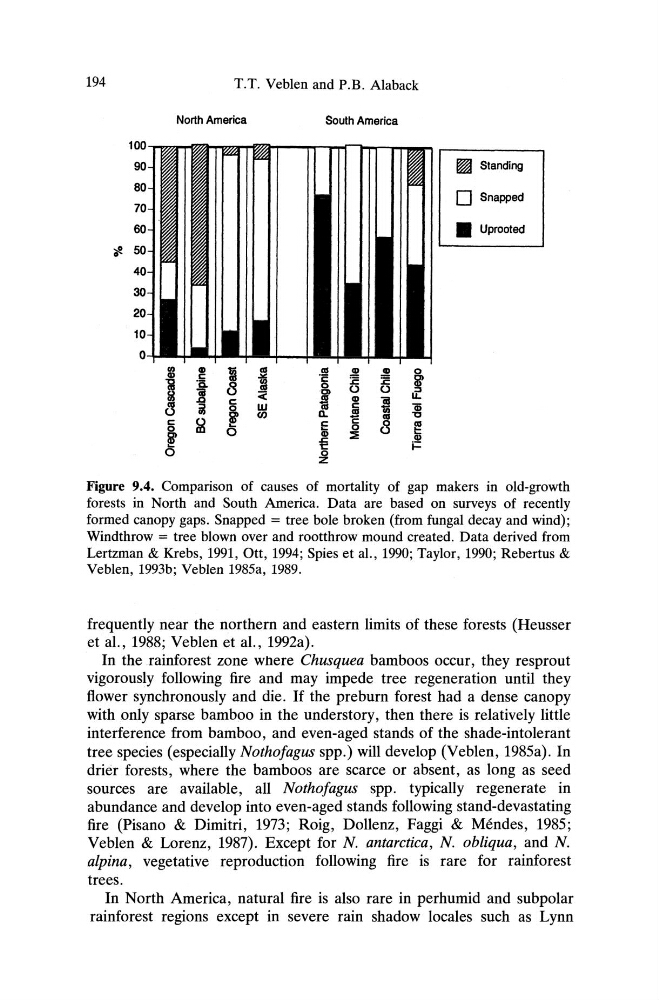
Figure 9.4. Comparison of causes of mortality of gap makers in old-growth
forests in North and South America. Data are based on surveys of recently
formed canopy gaps. Snapped = tree bole broken (from fungal decay and wind);
Windthrow = tree blown over and rootthrow mound created . Data derived from
Lertzman & Krebs, 1991, Ott, 1994; Spies et aI., 1990; Taylor, 1990; Rebertus &
Veblen, 1993b; Veblen 1985a, 1989.
frequently near the northern and eastern limits of these forests (Heusser
et aI., 1988; Veblen et aI., 1992a).
In the rainforest zone where Chusquea bamboos occur, they resprout
vigorously following fire and may impede tree regeneration until they
flower synchronously and die. If the preburn forest had a dense canopy
with only sparse bamboo in the understory, then there is relatively little
interference from bamboo, and even-aged stands of the shade-intolerant
tree species (especially Nothofagus spp.) will develop (Veblen, 1985a). In
drier forests, where the bamboos are scarce or absent, as long as seed
sources are available, all Nothofagus spp. typically regenerate in
abundance and develop into even-aged stands following stand-devastating
fire (Pisano & Dimitri, 1973; Roig, Dollenz, Faggi & Mendes, 1985;
Veblen & Lorenz, 1987). Except for N. antarctica, N. obliqua, and N.
alpina, vegetative reproduction following fire is rare for rainforest
trees .
In North America, natural fire is also rare in perhumid and subpolar
rainforest regions except in severe rain shadow locales such as Lynn
T.T. Veblen and P.B. Alaback
North America
100
90
80
70
60
}/!. 50
0
40
30
20
10
0
;
Gl
1li
III
c
~
~
'a.
8
~
c:
;(
~
iil 0
w
~
en
c:
~
0
0
~
0
South America
l'II
~
~
0
'2
:c :E lir
0
0
0
~
01
~
Gl
~
c:
Gl
a.
III
"t:l
c:
l'II
E
0
8 ~
Gl
:::E
s:
~
1:
0
Z
Wi! Standing
o Snapped
•
Uprooted
Figure 9.4. Comparison of causes of mortality of gap makers in old-growth
forests in North and South America. Data are based on surveys of recently
formed canopy gaps. Snapped = tree bole broken (from fungal decay and wind);
Windthrow = tree blown over and rootthrow mound created . Data derived from
Lertzman & Krebs, 1991, Ott, 1994; Spies et aI., 1990; Taylor, 1990; Rebertus &
Veblen, 1993b; Veblen 1985a, 1989.
frequently near the northern and eastern limits of these forests (Heusser
et aI., 1988; Veblen et aI., 1992a).
In the rainforest zone where Chusquea bamboos occur, they resprout
vigorously following fire and may impede tree regeneration until they
flower synchronously and die. If the preburn forest had a dense canopy
with only sparse bamboo in the understory, then there is relatively little
interference from bamboo, and even-aged stands of the shade-intolerant
tree species (especially Nothofagus spp.) will develop (Veblen, 1985a). In
drier forests, where the bamboos are scarce or absent, as long as seed
sources are available, all Nothofagus spp. typically regenerate in
abundance and develop into even-aged stands following stand-devastating
fire (Pisano & Dimitri, 1973; Roig, Dollenz, Faggi & Mendes, 1985;
Veblen & Lorenz, 1987). Except for N. antarctica, N. obliqua, and N.
alpina, vegetative reproduction following fire is rare for rainforest
trees .
In North America, natural fire is also rare in perhumid and subpolar
rainforest regions except in severe rain shadow locales such as Lynn