

9. A Comparative Review of Forest Dynamics
181
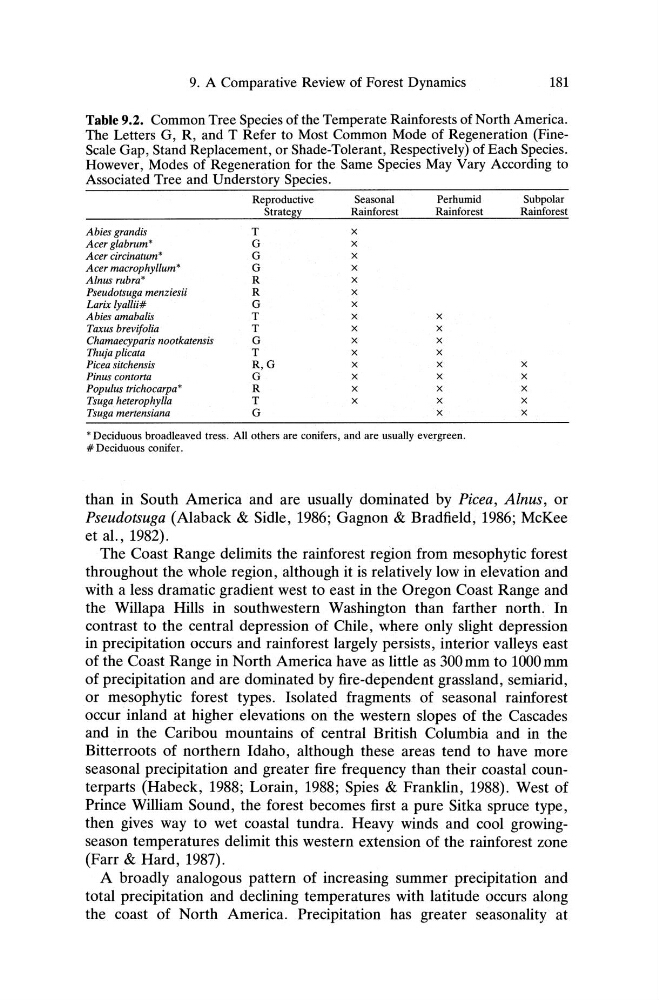
Table 9.2. Common Tree Species of the Temperate Rainforests of North America.
The Letters G , R , and T Refer to Most Common Mode of Regeneration (FineScale Gap, Stand Replacement, or Shade-Tolerant, Respectively) of Each Species .
However, Modes of Regeneration for the Same Species May Vary According to
Associated Tree and Understory Species .
Ab ies grandis
Acer glabrum*
Acer circinatum*
Acer macrophyllum*
Alnus rubra"
Pseudotsugamenziesii
Larix lyallii#
Ab ies amabalis
Taxus brevifolia
Chamaecyparis nootkatensis
Thuja plicata
Piceasitchensis
Pinus contorta
Populus trichocarpa*
Tsugaheterophylla
Tsugamertensiana
Reproductiv e
Strategy
T
G
G
G
R
R
G
T
T
G
T
R,G
G
R
T
G
Seasonal
Rainforest
x
x
x
x
x
x
x
x
x
x
x
x
x
x
x
Perhumid
Rainforest
x
x
x
x
x
x
x
x
x
Subpolar
Rainforest
x
x
x
x
x
* Deciduous broadleaved tress. All others are conifers, and are usually evergreen .
# Deciduous conifer.
than in South America and are usually dominated by Picea, Alnus, or
Pseudotsuga (Alaback & Sidle, 1986; Gagnon & Bradfield, 1986; McKee
et al., 1982).
The Coast Range delimits the rainforest region from mesophytic forest
throughout the whole region, although it is relatively low in elevation and
with a less dramatic gradient west to east in the Oregon Coast Range and
the Willapa Hills in southwestern Washington than farther north. . In
contrast to the central depression of Chile, where only slight depression
in precipitation occurs and rainforest largely persists, interior valleys east
of the Coast Range in North America have as little as 300 mm to 1000mm
of precipitation and are dominated by fire-dependent grassland, semiarid ,
or mesophytic forest types. Isolated fragments of seasonal rainforest
occur inland at higher elevations on the western slopes of the Cascades
and in the Caribou mountains of central British Columbia and in the
Bitterroots of northern Idaho, although these areas tend to have more
seasonal precipitation and greater fire frequency than their coastal counterparts (Habeck, 1988; Lorain, 1988; Spies & Franklin, 1988). West of
Prince William Sound, the forest becomes first a pure Sitka spruce type ,
then gives way to wet coastal tundra. Heavy winds and cool growingseason temperatures delimit this western extension of the rainforest zone
(Farr & Hard, 1987).
A broadly analogous pattern of increasing summer precipitation and
total precipitation and declining temperatures with latitude occurs along
the coast of North America. Precipitation has greater seasonality at
181
Table 9.2. Common Tree Species of the Temperate Rainforests of North America.
The Letters G , R , and T Refer to Most Common Mode of Regeneration (FineScale Gap, Stand Replacement, or Shade-Tolerant, Respectively) of Each Species .
However, Modes of Regeneration for the Same Species May Vary According to
Associated Tree and Understory Species .
Ab ies grandis
Acer glabrum*
Acer circinatum*
Acer macrophyllum*
Alnus rubra"
Pseudotsugamenziesii
Larix lyallii#
Ab ies amabalis
Taxus brevifolia
Chamaecyparis nootkatensis
Thuja plicata
Piceasitchensis
Pinus contorta
Populus trichocarpa*
Tsugaheterophylla
Tsugamertensiana
Reproductiv e
Strategy
T
G
G
G
R
R
G
T
T
G
T
R,G
G
R
T
G
Seasonal
Rainforest
x
x
x
x
x
x
x
x
x
x
x
x
x
x
x
Perhumid
Rainforest
x
x
x
x
x
x
x
x
x
Subpolar
Rainforest
x
x
x
x
x
* Deciduous broadleaved tress. All others are conifers, and are usually evergreen .
# Deciduous conifer.
than in South America and are usually dominated by Picea, Alnus, or
Pseudotsuga (Alaback & Sidle, 1986; Gagnon & Bradfield, 1986; McKee
et al., 1982).
The Coast Range delimits the rainforest region from mesophytic forest
throughout the whole region, although it is relatively low in elevation and
with a less dramatic gradient west to east in the Oregon Coast Range and
the Willapa Hills in southwestern Washington than farther north. . In
contrast to the central depression of Chile, where only slight depression
in precipitation occurs and rainforest largely persists, interior valleys east
of the Coast Range in North America have as little as 300 mm to 1000mm
of precipitation and are dominated by fire-dependent grassland, semiarid ,
or mesophytic forest types. Isolated fragments of seasonal rainforest
occur inland at higher elevations on the western slopes of the Cascades
and in the Caribou mountains of central British Columbia and in the
Bitterroots of northern Idaho, although these areas tend to have more
seasonal precipitation and greater fire frequency than their coastal counterparts (Habeck, 1988; Lorain, 1988; Spies & Franklin, 1988). West of
Prince William Sound, the forest becomes first a pure Sitka spruce type ,
then gives way to wet coastal tundra. Heavy winds and cool growingseason temperatures delimit this western extension of the rainforest zone
(Farr & Hard, 1987).
A broadly analogous pattern of increasing summer precipitation and
total precipitation and declining temperatures with latitude occurs along
the coast of North America. Precipitation has greater seasonality at