

9. A Comparative Review of Forest Dynamics
179
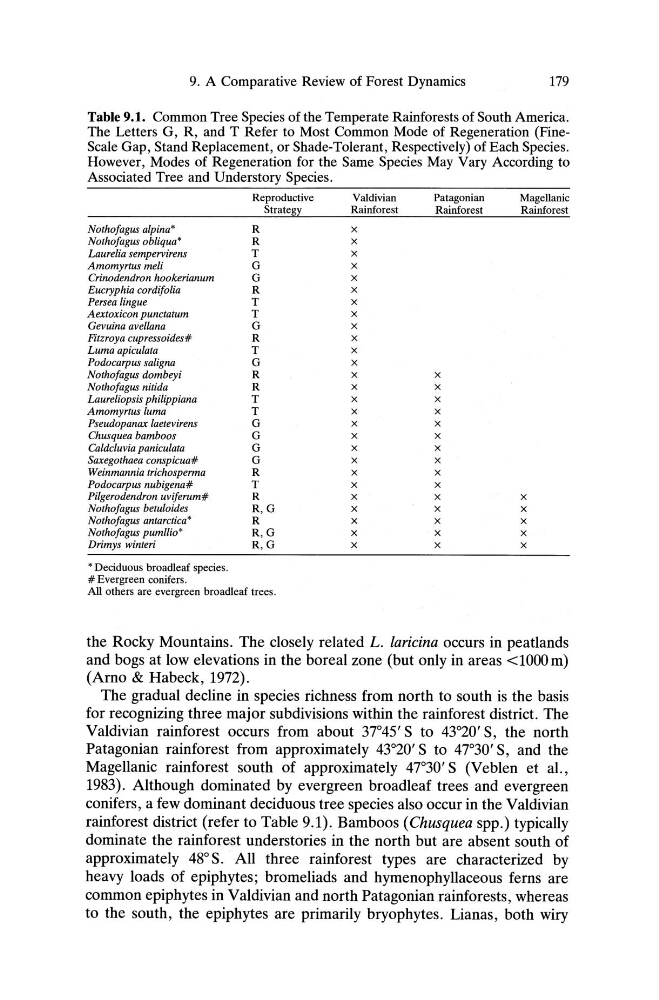
Table 9.1. Common Tree Species of the Temperate Rainforests of South America .
The Letters G, R, and T Refer to Most Common Mode of Regeneration (FineScale Gap , Stand Replacement, or Shade-Tolerant, Respectively) of Each Species.
However, Modes of Regeneration for the Same Species May Vary According to
Associated Tree and Understory Species.
Nothofagus alpina"
Nothofagus obliqua"
Laureliasempervirens
Am omyrtus meli
Crinodendron hookerianum
Eucryphiacordifolia
Persea lingue
A extoxicon punctatum
Gevuina avellana
Fitzroyacupressoides#
Luma apiculata
Podocarpussaligna
Nothofagus dombeyi
Nothofagus nitida
Laureliopsisphilippiana
Amomyrtus luma
Pseudopanax laetevirens
Chusqueabamboos
Caldcluvia paniculata
Saxegothaea conspicua#
Weinmannia trichosperma
Podocarpusnubigena#
Pilgerodendron uviferum#
Nothofagus betuloides
Nothofagus antarctica'
Nothofagus pumllio"
Drimys winteri
Reproductive
Strategy
R
R
T
G
G
R
T
T
G
R
T
G
R
R
T
T
G
G
G
G
R
T
R
R,G
R
R,G
R,G
Valdivian
Rainforest
x
x
x
x
x
x
x
x
x
x
x
x
x
x
x
x
x
x
x
x
x
x
x
x
x
x
x
Patagonian
Rainforest
x
x
x
x
x
x
x
x
x
x
x
x
x
x
x
Magellanic
Rainforest
x
x
x
x
x
'Deciduous broadleaf species.
# Evergr een conifers.
All others are evergreen broadleaf trees .
the Rocky Mountains . The closely related L. laricina occurs in peatlands
and bogs at low elevations in the boreal zone (but only in areas <1000 m)
(Arno & Habeck, 1972).
The gradual decline in species richness from north to south is the basis
for recognizing three major subdivisions within the rainforest district. The
Valdivian rainforest occurs from about 37°45'S to 43°20'S, the north
Patagonian rainforest from approximately 43°20'S to 47°30'S, and the
Magellanic rainforest south of approximately 47°30'S (Veblen et aI.,
1983). Although dominated by evergreen broadleaf trees and evergreen
conifers, a few dominant deciduous tree species also occur in the Valdivian
rainforest district (refer to Table 9.1). Bamboos (Chusquea spp.) typically
dominate the rainforest understories in the north but are absent south of
approximately 48°S. All three rainforest types are characterized by
heavy loads of epiphytes; bromeliads and hymenophyllaceous ferns are
common epiphytes in Valdivian and north Patagonian rainforests, whereas
to the south, the epiphytes are primarily bryophytes . Lianas, both wiry
179
Table 9.1. Common Tree Species of the Temperate Rainforests of South America .
The Letters G, R, and T Refer to Most Common Mode of Regeneration (FineScale Gap , Stand Replacement, or Shade-Tolerant, Respectively) of Each Species.
However, Modes of Regeneration for the Same Species May Vary According to
Associated Tree and Understory Species.
Nothofagus alpina"
Nothofagus obliqua"
Laureliasempervirens
Am omyrtus meli
Crinodendron hookerianum
Eucryphiacordifolia
Persea lingue
A extoxicon punctatum
Gevuina avellana
Fitzroyacupressoides#
Luma apiculata
Podocarpussaligna
Nothofagus dombeyi
Nothofagus nitida
Laureliopsisphilippiana
Amomyrtus luma
Pseudopanax laetevirens
Chusqueabamboos
Caldcluvia paniculata
Saxegothaea conspicua#
Weinmannia trichosperma
Podocarpusnubigena#
Pilgerodendron uviferum#
Nothofagus betuloides
Nothofagus antarctica'
Nothofagus pumllio"
Drimys winteri
Reproductive
Strategy
R
R
T
G
G
R
T
T
G
R
T
G
R
R
T
T
G
G
G
G
R
T
R
R,G
R
R,G
R,G
Valdivian
Rainforest
x
x
x
x
x
x
x
x
x
x
x
x
x
x
x
x
x
x
x
x
x
x
x
x
x
x
x
Patagonian
Rainforest
x
x
x
x
x
x
x
x
x
x
x
x
x
x
x
Magellanic
Rainforest
x
x
x
x
x
'Deciduous broadleaf species.
# Evergr een conifers.
All others are evergreen broadleaf trees .
the Rocky Mountains . The closely related L. laricina occurs in peatlands
and bogs at low elevations in the boreal zone (but only in areas <1000 m)
(Arno & Habeck, 1972).
The gradual decline in species richness from north to south is the basis
for recognizing three major subdivisions within the rainforest district. The
Valdivian rainforest occurs from about 37°45'S to 43°20'S, the north
Patagonian rainforest from approximately 43°20'S to 47°30'S, and the
Magellanic rainforest south of approximately 47°30'S (Veblen et aI.,
1983). Although dominated by evergreen broadleaf trees and evergreen
conifers, a few dominant deciduous tree species also occur in the Valdivian
rainforest district (refer to Table 9.1). Bamboos (Chusquea spp.) typically
dominate the rainforest understories in the north but are absent south of
approximately 48°S. All three rainforest types are characterized by
heavy loads of epiphytes; bromeliads and hymenophyllaceous ferns are
common epiphytes in Valdivian and north Patagonian rainforests, whereas
to the south, the epiphytes are primarily bryophytes . Lianas, both wiry