

162
M.T.K . Arroyo et al.
15 - - - . - - - - - - - - - - - - - - - - - - - - - - - ,
Il) 13
eo
l:
ca
~ 11
......
ca
l:
.....
]
9
....
..... .... ca
~ 7
5+---,-----,-----,-----,-----,-----,-----,-----,-----,-----4
36 38 40 42 44 46 48 50 52 54 56
Latitude eS)
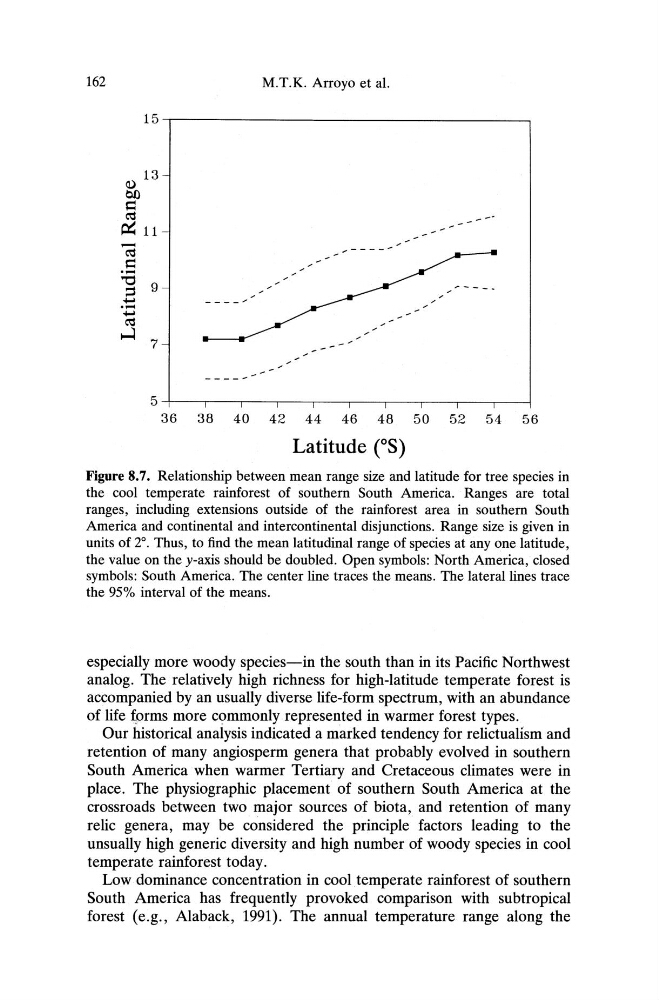
Figure 8.7. Relationship between mean range size and latitude for tree species in
the cool temperate rainforest of southern South America. Ranges are total
ranges, including extensions outside of the rainforest area in southern South
America and continental and intercontinental disjunctions. Range size is given in
units of 2°. Thus, to find the mean latitudinal range of species at anyone latitude,
the value on the y-axis should be doubled. Open symbols: North America, closed
symbols: South America . The center line traces the means. The lateral lines trace
the 95% interval of the means.
especially more woody species-in the south than in its Pacific Northwest
analog. The relatively high richness for high-latitude temperate forest is
accompanied by an usually diverse life-form spectrum, with an abundance
of life forms more commonly represented in warmer forest types.
Our historical analysis indicated a marked tendency for relictualism and
retention of many angiosperm genera that probably evolved in southern
South America when warmer Tertiary and Cretaceous climates were in
place. The physiographic placement of southern South America at the
crossroads between two major sources of biota, and retention of many
relic genera, may be considered the principle factors leading to the
unsually high generic diversity and high number of woody species in cool
temperate rainforest today.
Low dominance concentration in cool temperate rainforest of southern
South America has frequently provoked comparison with subtropical
forest (e.g ., Alaback, 1991). The annual temperature range along the
M.T.K . Arroyo et al.
15 - - - . - - - - - - - - - - - - - - - - - - - - - - - ,
Il) 13
eo
l:
ca
~ 11
......
ca
l:
.....
]
9
....
..... .... ca
~ 7
5+---,-----,-----,-----,-----,-----,-----,-----,-----,-----4
36 38 40 42 44 46 48 50 52 54 56
Latitude eS)
Figure 8.7. Relationship between mean range size and latitude for tree species in
the cool temperate rainforest of southern South America. Ranges are total
ranges, including extensions outside of the rainforest area in southern South
America and continental and intercontinental disjunctions. Range size is given in
units of 2°. Thus, to find the mean latitudinal range of species at anyone latitude,
the value on the y-axis should be doubled. Open symbols: North America, closed
symbols: South America . The center line traces the means. The lateral lines trace
the 95% interval of the means.
especially more woody species-in the south than in its Pacific Northwest
analog. The relatively high richness for high-latitude temperate forest is
accompanied by an usually diverse life-form spectrum, with an abundance
of life forms more commonly represented in warmer forest types.
Our historical analysis indicated a marked tendency for relictualism and
retention of many angiosperm genera that probably evolved in southern
South America when warmer Tertiary and Cretaceous climates were in
place. The physiographic placement of southern South America at the
crossroads between two major sources of biota, and retention of many
relic genera, may be considered the principle factors leading to the
unsually high generic diversity and high number of woody species in cool
temperate rainforest today.
Low dominance concentration in cool temperate rainforest of southern
South America has frequently provoked comparison with subtropical
forest (e.g ., Alaback, 1991). The annual temperature range along the