

8. Phytogeographic Relationships and Regional Richness Patterns
159
70 - - - . - - - - - - - - - - - - - - - - - - - - - - - - - ,
c
60 -
10
O---+----~-~-~-~----.----~-~-_,_-_,_-__r_
36 38 40 42 44 46 48 50 52 54 56
Latitude COS)
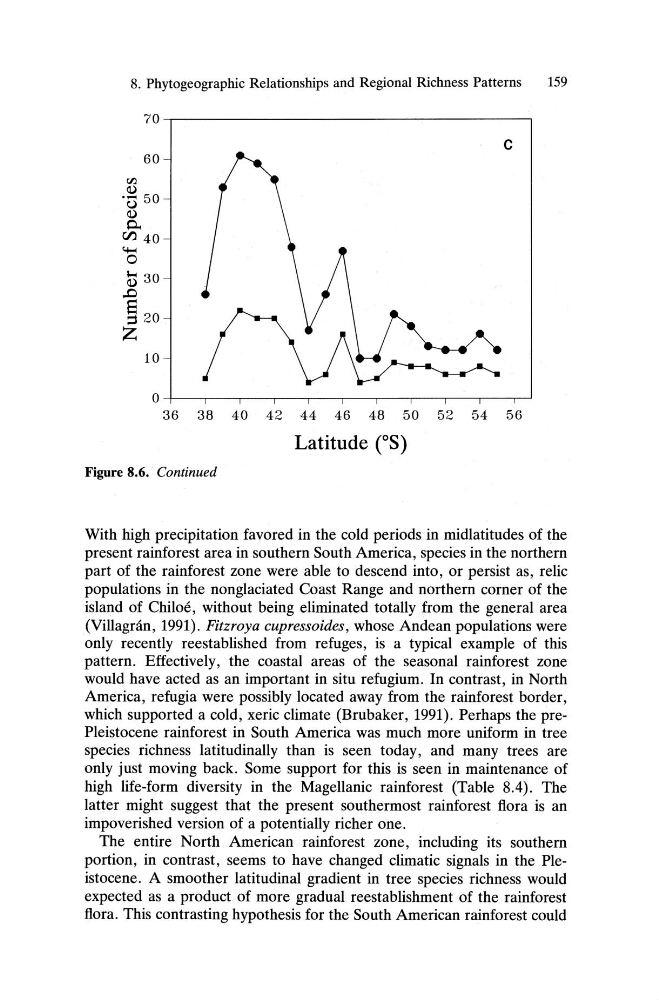
Figure 8.6. Continued
With high precipitation favored in the cold periods in midlatitudes of the
present rainforest area in southern South America, species in the northern
part of the rainforest zone were able to descend into, or persist as, relic
populations in the nonglaciated Coast Range and northern corner of the
island of Chiloe, without being eliminated totally from the general area
(Villagran, 1991). Fitzroya cupressoides, whose Andean populations were
only recently reestablished from refuges, is a typical example of this
pattern. Effectively, the coastal areas of the seasonal rainforest zone
would have acted as an important in situ refugium. In contrast, in North
America, refugia were possibly located away from the rainforest border,
which supported a cold, xeric climate (Brubaker, 1991). Perhaps the prePleistocene rainforest in South America was much more uniform in tree
species richness latitudinally than is seen today, and many trees are
only just moving back. Some support for this is seen in maintenance of
high life-form diversity in the Magellanic rainforest (Table 8.4). The
latter might suggest that the present southermost rainforest flora is an
impoverished version of a potentially richer one.
The entire North American rainforest zone, including its southern
portion, in contrast, seems to have changed climatic signals in the Pleistocene. A smoother latitudinal gradient in tree species richness would
expected as a product of more gradual reestablishment of the rainforest
flora. This contrasting hypothesis for the South American rainforest could
159
70 - - - . - - - - - - - - - - - - - - - - - - - - - - - - - ,
c
60 -
10
O---+----~-~-~-~----.----~-~-_,_-_,_-__r_
36 38 40 42 44 46 48 50 52 54 56
Latitude COS)
Figure 8.6. Continued
With high precipitation favored in the cold periods in midlatitudes of the
present rainforest area in southern South America, species in the northern
part of the rainforest zone were able to descend into, or persist as, relic
populations in the nonglaciated Coast Range and northern corner of the
island of Chiloe, without being eliminated totally from the general area
(Villagran, 1991). Fitzroya cupressoides, whose Andean populations were
only recently reestablished from refuges, is a typical example of this
pattern. Effectively, the coastal areas of the seasonal rainforest zone
would have acted as an important in situ refugium. In contrast, in North
America, refugia were possibly located away from the rainforest border,
which supported a cold, xeric climate (Brubaker, 1991). Perhaps the prePleistocene rainforest in South America was much more uniform in tree
species richness latitudinally than is seen today, and many trees are
only just moving back. Some support for this is seen in maintenance of
high life-form diversity in the Magellanic rainforest (Table 8.4). The
latter might suggest that the present southermost rainforest flora is an
impoverished version of a potentially richer one.
The entire North American rainforest zone, including its southern
portion, in contrast, seems to have changed climatic signals in the Pleistocene. A smoother latitudinal gradient in tree species richness would
expected as a product of more gradual reestablishment of the rainforest
flora. This contrasting hypothesis for the South American rainforest could