

-30 -20 -10 0 10 20 30 40 50 60 70
Degrees of Latitude
xvi
Introduction
4000
~
~lj!lj
- : c:
:.0: ~
;I ~i ll
c
~
0 ."
: ~:
3500
~ GI c
.2
GI
. .
I II iI
e
0 0 ·
~
.2
(;
0
'C
·
.D
U.
III U.
~
LL
:>
GI
i
GI
C
c:
1:
c
3000
'C
01
:> . :. :::1 .OJ
GI
~ ~ ...
GI
i~ ~n;!~1
CD
(J)
g
>
a: ~
~
O ' ~ , .. :
GI ~ ·
:: : re!:! GI '"
C)
~~! ' I !
2500 c:
·
c:
. . Q;
'a
:!
Fr
'C
";
GI
:>
IIJ
>
c:
<
..,
a:
GI
w
0
·
2000
·
-:; iii
~
~
'C
z
o
c:
..,
...J
.0.
E
>
III
:i
~
0
GI
Q)
1500 III
0
i=
(J)
iii
. .
...J
·r~ 1~!<
'C
1000
c:
?~ I- : ~1
500
c; l~i
O~r-r-,-.---.-..,......ro-,";-:"H~;--,..L,--,-l,..-!-,-..,......~~:.+--l
-60 ~50 -40
1- Elevation (m) I
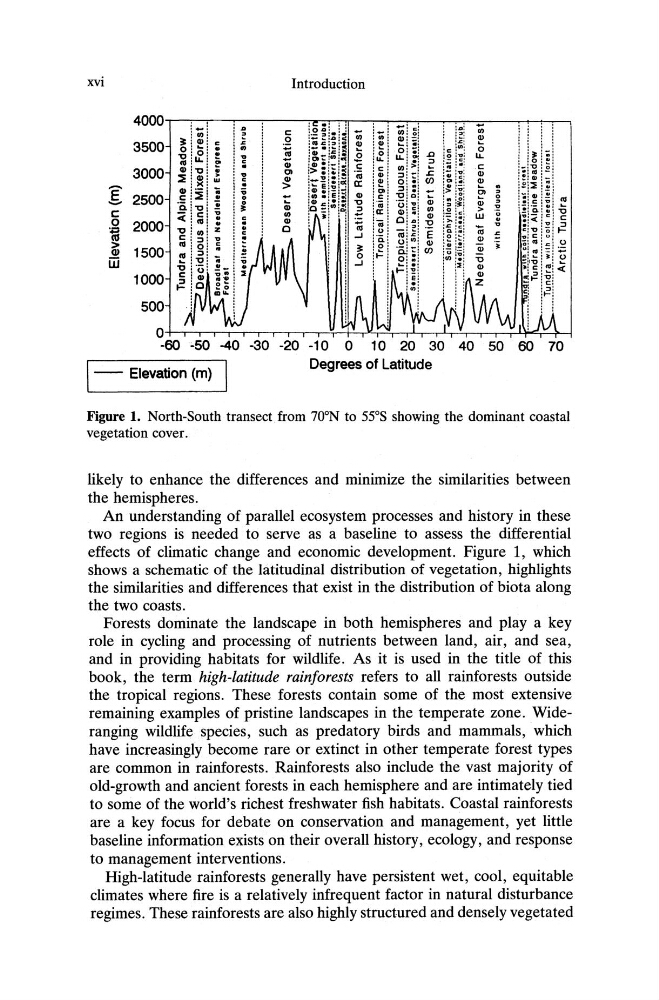
Figure 1. North-South transect from 70
0N
to 55°S showing the dominant coastal
vegetation cover..
likely to enhance the differences and minimize the similarities between
the hemispheres.
An understanding of parallel ecosystem processes and histor y in the se
two regions is needed to serve as a baseline to assess the differential
effects of climatic change and economic development . Figure 1, which
shows a schematic of the latitud inal distribution of vegetation, highlights
the similarities and differences that exist in the distribution of biota along
the two coasts.
Forests dominate the landscape in both hemispheres and play a key
role in cycling and processing of nutrients between land , air, and sea ,
and in providing habitats for wildlife. As it is used in the title of this
book , the term high-latitude rainf orests refer s to all rainforests outside
the tropical regions. These forests contain some of the most extensive
remain ing examples of pristine landscapes in the temperate zone. Wideranging wildlife species, such as predatory birds and mammals, which
have increasingly become rare or extinct in oth er temperate forest types
are common in rainforests. Rainfore sts also include the vast majority of
old-growth and ancient forests in each hemisphere and are intimately tied
to some of the world's richest freshwater fish habitats. Coastal rainforests
are a key focus for debate on conservation and management , yet little
baseline information exists on their overall history, ecology, and response
to management intervent ions.
High-latitude rainforests genera lly have persistent wet, cool, equitable
climates where fire is a relatively infrequent factor in natural disturbance
regimes. The se rainforests are also highly structured and densely vegetated
Degrees of Latitude
xvi
Introduction
4000
~
~lj!lj
- : c:
:.0: ~
;I ~i ll
c
~
0 ."
: ~:
3500
~ GI c
.2
GI
. .
I II iI
e
0 0 ·
~
.2
(;
0
'C
·
.D
U.
III U.
~
LL
:>
GI
i
GI
C
c:
1:
c
3000
'C
01
:> . :. :::1 .OJ
GI
~ ~ ...
GI
i~ ~n;!~1
CD
(J)
g
>
a: ~
~
O ' ~ , .. :
GI ~ ·
:: : re!:! GI '"
C)
~~! ' I !
2500 c:
·
c:
. . Q;
'a
:!
Fr
'C
";
GI
:>
IIJ
>
c:
<
..,
a:
GI
w
0
·
2000
·
-:; iii
~
~
'C
z
o
c:
..,
...J
.0.
E
>
III
:i
~
0
GI
Q)
1500 III
0
i=
(J)
iii
. .
...J
·r~ 1~!<
'C
1000
c:
?~ I- : ~1
500
c; l~i
O~r-r-,-.---.-..,......ro-,";-:"H~;--,..L,--,-l,..-!-,-..,......~~:.+--l
-60 ~50 -40
1- Elevation (m) I
Figure 1. North-South transect from 70
0N
to 55°S showing the dominant coastal
vegetation cover..
likely to enhance the differences and minimize the similarities between
the hemispheres.
An understanding of parallel ecosystem processes and histor y in the se
two regions is needed to serve as a baseline to assess the differential
effects of climatic change and economic development . Figure 1, which
shows a schematic of the latitud inal distribution of vegetation, highlights
the similarities and differences that exist in the distribution of biota along
the two coasts.
Forests dominate the landscape in both hemispheres and play a key
role in cycling and processing of nutrients between land , air, and sea ,
and in providing habitats for wildlife. As it is used in the title of this
book , the term high-latitude rainf orests refer s to all rainforests outside
the tropical regions. These forests contain some of the most extensive
remain ing examples of pristine landscapes in the temperate zone. Wideranging wildlife species, such as predatory birds and mammals, which
have increasingly become rare or extinct in oth er temperate forest types
are common in rainforests. Rainfore sts also include the vast majority of
old-growth and ancient forests in each hemisphere and are intimately tied
to some of the world's richest freshwater fish habitats. Coastal rainforests
are a key focus for debate on conservation and management , yet little
baseline information exists on their overall history, ecology, and response
to management intervent ions.
High-latitude rainforests genera lly have persistent wet, cool, equitable
climates where fire is a relatively infrequent factor in natural disturbance
regimes. The se rainforests are also highly structured and densely vegetated