

7. Biodiversity Patterns in Relation to Climate
125
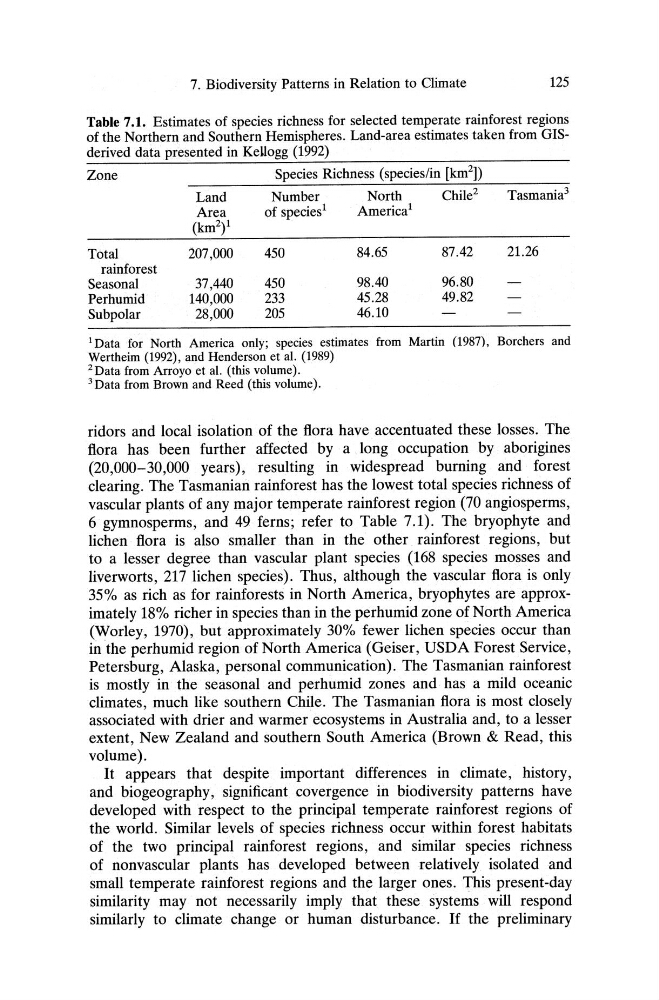
Table 7.1. Estimates of species richness for selected temperate rainforest regions
of the Northern and Southern Hemispheres. Land-area estimates taken from GISderived data presented in Kellogg (1992)
Zone
Species Richness (species/in [km
2 ])
Land
Number
North
Chile
2
Area
of species!
America!
(km 2 )!
Tasmania'
Total
rainforest
Seasonal
Perhumid
Subpolar
207,000
37,440
140,000
28,000
450
450
233
205
84.65
98.40
45.28
46.10
87.42
96.80
49.82
21.26
1 Data for North America only; species estimates from Martin (1987), Borchers and
Wertheim (1992), and Henderson et aI. (1989)
2Data from Arroyo et al. (this volume).
3Data from Brown and Reed (this volume).
ridors and local isolation of the flora have accentuated these losses. The
flora has been further affected by a long occupation by aborigines
(20,000-30,000 years) , resulting in widespread burning and forest
clearing. The Tasmanian rainforest has the lowest total species richness of
vascular plants of any major temperate rainforest region (70 angiosperms ,
6 gymnosperms, and 49 ferns ; refer to Table 7.1) . The bryophyte and
lichen flora is also smaller than in the other rainforest regions , but
to a lesser degree than vascular plant species (168 species mosses and
liverworts , 217 lichen species) . Thus , although the vascular flora is only
35% as rich as for rainforests in North America, bryophytes are approximately 18% richer in species than in the perhumid zone of North America
(Worley , 1970), but approximately 30% fewer lichen species occur than
in the perhumid region of North America (Geiser, USDA Forest Service,
Petersburg, Alaska, personal communication). The Tasmanian rainforest
is mostly in the seasonal and perhumid zones and has a mild oceanic
climates , much like southern Chile. The Tasmanian flora is most closely
associated with drier and warmer ecosystems in Australia and, to a lesser
extent, New Zealand and southern South America (Brown & Read, this
volume).
It appears that despite important differences in climate , history ,
and biogeography, significant covergence in biodiversity patterns have
developed with respect to the principal temperate rainforest regions of
the world . Similar levels of species richness occur within forest habitats
of the two principal rainforest regions, and similar species richness
of nonvascular plants has developed between relatively isolated and
small temperate rainforest regions and the larger ones . This present-day
similarity may not necessarily imply that these systems will respond
similarly to climate change or human disturbance. If the preliminary
125
Table 7.1. Estimates of species richness for selected temperate rainforest regions
of the Northern and Southern Hemispheres. Land-area estimates taken from GISderived data presented in Kellogg (1992)
Zone
Species Richness (species/in [km
2 ])
Land
Number
North
Chile
2
Area
of species!
America!
(km 2 )!
Tasmania'
Total
rainforest
Seasonal
Perhumid
Subpolar
207,000
37,440
140,000
28,000
450
450
233
205
84.65
98.40
45.28
46.10
87.42
96.80
49.82
21.26
1 Data for North America only; species estimates from Martin (1987), Borchers and
Wertheim (1992), and Henderson et aI. (1989)
2Data from Arroyo et al. (this volume).
3Data from Brown and Reed (this volume).
ridors and local isolation of the flora have accentuated these losses. The
flora has been further affected by a long occupation by aborigines
(20,000-30,000 years) , resulting in widespread burning and forest
clearing. The Tasmanian rainforest has the lowest total species richness of
vascular plants of any major temperate rainforest region (70 angiosperms ,
6 gymnosperms, and 49 ferns ; refer to Table 7.1) . The bryophyte and
lichen flora is also smaller than in the other rainforest regions , but
to a lesser degree than vascular plant species (168 species mosses and
liverworts , 217 lichen species) . Thus , although the vascular flora is only
35% as rich as for rainforests in North America, bryophytes are approximately 18% richer in species than in the perhumid zone of North America
(Worley , 1970), but approximately 30% fewer lichen species occur than
in the perhumid region of North America (Geiser, USDA Forest Service,
Petersburg, Alaska, personal communication). The Tasmanian rainforest
is mostly in the seasonal and perhumid zones and has a mild oceanic
climates , much like southern Chile. The Tasmanian flora is most closely
associated with drier and warmer ecosystems in Australia and, to a lesser
extent, New Zealand and southern South America (Brown & Read, this
volume).
It appears that despite important differences in climate , history ,
and biogeography, significant covergence in biodiversity patterns have
developed with respect to the principal temperate rainforest regions of
the world . Similar levels of species richness occur within forest habitats
of the two principal rainforest regions, and similar species richness
of nonvascular plants has developed between relatively isolated and
small temperate rainforest regions and the larger ones . This present-day
similarity may not necessarily imply that these systems will respond
similarly to climate change or human disturbance. If the preliminary