

120
Paul B. Alaback
1992; Martin, 1989). Less productive sites also have greater development
of a woody shrub stratum, whereas the more productive sites have
a better developed fern and herb flora. This pattern of the relative
abundance of shrub and herb species is also found in southern regions
where the primary enviro nmenta l gradient is a moisture gradient rather
than a nutrient availability gradient (Gagnon & Bradfield , 1987; Kojima
& Krajina, 1975; Zobel, McKee, & Hawk, 1976). It is important to note
however, that many of the species that occur in productive forests ,
especially riparian forests, are habitat specialists, particularl y the br yophytes and lichens, where as unproductive sites are dominated by
gen eralist species , many of which have circumpolar distributions. From a
regional biodiversity standpoint , these productive sites are therefore of
high value even though their species richness is often low.
Rainforest understory shrubs and herbs provide a more complex pattern
with latitude. Since these plants are responding as much to microclimatic
conditions created by overstory species structure as to macroclimate , high
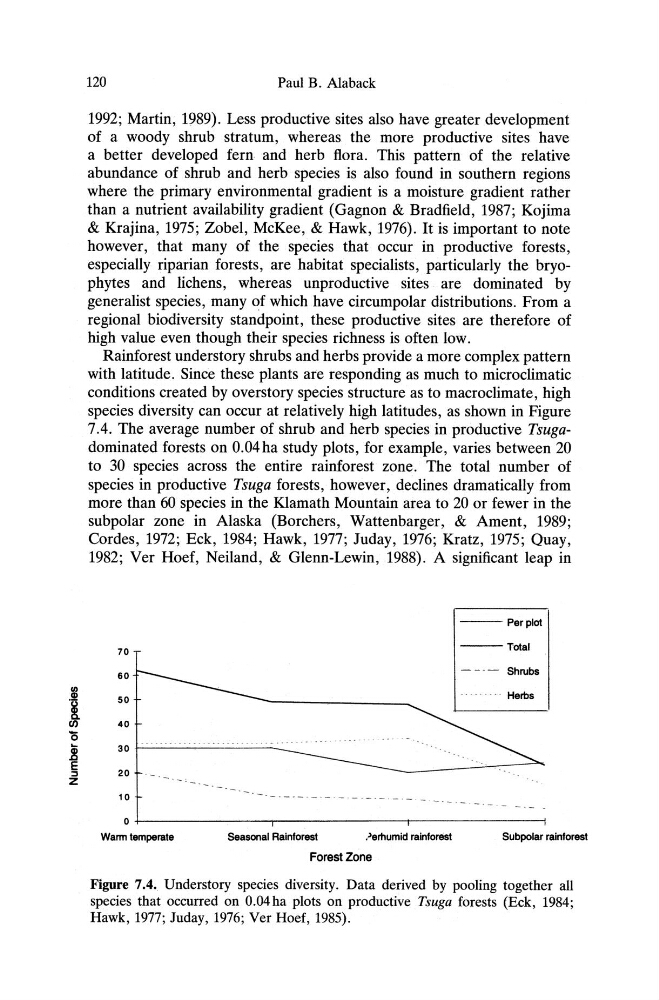
species diversity can occur at relatively high lat itudes, as shown in Figure
7.4. The average number of shrub and herb species in productive Tsugadominated forests on 0.04 ha study plots, for example , varies between 20
to 30 species across the entire rainforest zone. The total number of
species in productive Tsuga for ests, however , declines dr amatically from
more than 60 species in the Klam ath Mountain area to 20 or fewer in the
subpolar zone in Alaska (Borchers, Wattenb arger, & Ament, 1989;
Cordes, 1972; Eck, 1984; Hawk, 1977; Juday, 1976; Kr atz , 1975; Qu ay,
1982; Ver Hoef, Neiland, & Glenn-Lewin, 1988). A significant leap in
- -- Per plot
70
60
tJl
CD
50
l en 40
'0
~
30
E
20
::::I
Z
10
0
Wann temperate
. _-_
_ _
.
Seasonal Rainforest
?ertlum id rainforest
---Total
Shrubs
. . Herbs
Subpolar rainforest
ForestZone
Figure 7.4. Understory species diversity. Data derived by pooling together all
species that occurred on 0.04 ha plots on productive Tsuga forests (Eck, 1984;
Hawk, 1977; Juday, 1976; Ver Hoef, 1985).
Paul B. Alaback
1992; Martin, 1989). Less productive sites also have greater development
of a woody shrub stratum, whereas the more productive sites have
a better developed fern and herb flora. This pattern of the relative
abundance of shrub and herb species is also found in southern regions
where the primary enviro nmenta l gradient is a moisture gradient rather
than a nutrient availability gradient (Gagnon & Bradfield , 1987; Kojima
& Krajina, 1975; Zobel, McKee, & Hawk, 1976). It is important to note
however, that many of the species that occur in productive forests ,
especially riparian forests, are habitat specialists, particularl y the br yophytes and lichens, where as unproductive sites are dominated by
gen eralist species , many of which have circumpolar distributions. From a
regional biodiversity standpoint , these productive sites are therefore of
high value even though their species richness is often low.
Rainforest understory shrubs and herbs provide a more complex pattern
with latitude. Since these plants are responding as much to microclimatic
conditions created by overstory species structure as to macroclimate , high
species diversity can occur at relatively high lat itudes, as shown in Figure
7.4. The average number of shrub and herb species in productive Tsugadominated forests on 0.04 ha study plots, for example , varies between 20
to 30 species across the entire rainforest zone. The total number of
species in productive Tsuga for ests, however , declines dr amatically from
more than 60 species in the Klam ath Mountain area to 20 or fewer in the
subpolar zone in Alaska (Borchers, Wattenb arger, & Ament, 1989;
Cordes, 1972; Eck, 1984; Hawk, 1977; Juday, 1976; Kr atz , 1975; Qu ay,
1982; Ver Hoef, Neiland, & Glenn-Lewin, 1988). A significant leap in
- -- Per plot
70
60
tJl
CD
50
l en 40
'0
~
30
E
20
::::I
Z
10
0
Wann temperate
. _-_
_ _
.
Seasonal Rainforest
?ertlum id rainforest
---Total
Shrubs
. . Herbs
Subpolar rainforest
ForestZone
Figure 7.4. Understory species diversity. Data derived by pooling together all
species that occurred on 0.04 ha plots on productive Tsuga forests (Eck, 1984;
Hawk, 1977; Juday, 1976; Ver Hoef, 1985).