

Paul B. Alaback
Seasonal rainforest
Pertlumid rainforest
Sub-polar rainforest
Forest Zone
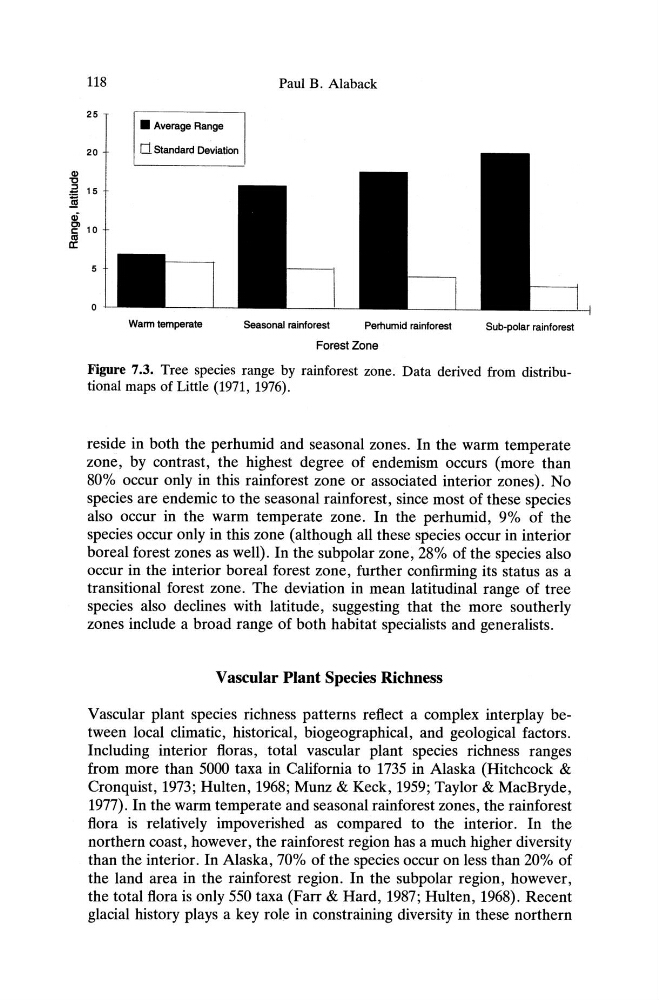
Figure 7.3. Tree species range by rainforest zone. Data derived from distributional maps of Little (1971 , 1976).
reside in both the perhumid and seasonal zones. In the warm temperate
zone , by contrast, the highest degree of endemism occurs (more than
80% occur only in this rainforest zone or associated interior zones). No
species are endemic to the seasonal rainforest , since most of these species
also occur in the warm temperate zone. In the perhumid, 9% of the
species occur only in this zone (although all these species occur in interior
boreal forest zones as well). In the subpolar zone , 28% of the species also
occur in the interior boreal forest zone , further confirming its status as a
transitional forest zone. The deviation in mean latitudinal range of tree
species also declines with latitude, suggesting that the more southerly
zones include a broad range of both habitat specialists and generalists.
Vascular Plant Species Richness
Vascular plant species richness patterns reflect a complex interplay between local climatic, historical, biogeographical, and geological factors.
Including interior floras, total vascular plant species richness ranges
from more than 5000 taxa in California to 1735 in Alaska (Hitchcock &
Cronquist, 1973; Hulten , 1968; Munz & Keck, 1959; Taylor & MacBryde,
1977). In the warm temperate and seasonal rainforest zones, the rainforest
flora is relatively impoverished as compared to the interior. In the
northern coast, however , the rainforest region has a much higher diversity
than the interior. In Alaska, 70% of the species occur on less than 20% of
the land area in the rainforest region. In the subpolar region, however,
the total flora is only 550 taxa (Farr & Hard, 1987; Hulten , 1968). Recent
glacial history plays a key role in constraining diversity in these northern
Seasonal rainforest
Pertlumid rainforest
Sub-polar rainforest
Forest Zone
Figure 7.3. Tree species range by rainforest zone. Data derived from distributional maps of Little (1971 , 1976).
reside in both the perhumid and seasonal zones. In the warm temperate
zone , by contrast, the highest degree of endemism occurs (more than
80% occur only in this rainforest zone or associated interior zones). No
species are endemic to the seasonal rainforest , since most of these species
also occur in the warm temperate zone. In the perhumid, 9% of the
species occur only in this zone (although all these species occur in interior
boreal forest zones as well). In the subpolar zone , 28% of the species also
occur in the interior boreal forest zone , further confirming its status as a
transitional forest zone. The deviation in mean latitudinal range of tree
species also declines with latitude, suggesting that the more southerly
zones include a broad range of both habitat specialists and generalists.
Vascular Plant Species Richness
Vascular plant species richness patterns reflect a complex interplay between local climatic, historical, biogeographical, and geological factors.
Including interior floras, total vascular plant species richness ranges
from more than 5000 taxa in California to 1735 in Alaska (Hitchcock &
Cronquist, 1973; Hulten , 1968; Munz & Keck, 1959; Taylor & MacBryde,
1977). In the warm temperate and seasonal rainforest zones, the rainforest
flora is relatively impoverished as compared to the interior. In the
northern coast, however , the rainforest region has a much higher diversity
than the interior. In Alaska, 70% of the species occur on less than 20% of
the land area in the rainforest region. In the subpolar region, however,
the total flora is only 550 taxa (Farr & Hard, 1987; Hulten , 1968). Recent
glacial history plays a key role in constraining diversity in these northern