

116
Paul B. Alaback
"evolutionary bottlenecks" during Pleistocene glaciations. Perhaps similar
evolutionary bottl enecks occurred for some of the North Am erican
Cupressid species. These less diverse species would be expected to have
less capability of adapting to rapid changes in climate as compared to
dominant and widespread conifers such as Tsuga heterophylla and Picea
sitchensis , both because of narrow er genetic variation and more restrictive
environmental requirement s.
Tree Species Distributions
The northern Pacific coast, because of its cool temperatur es and influence
of nearby cold contin ental climates, provides ideal growing conditions for
conifers. Conifer s are overwhelmingly domin ant throughout the Pacific
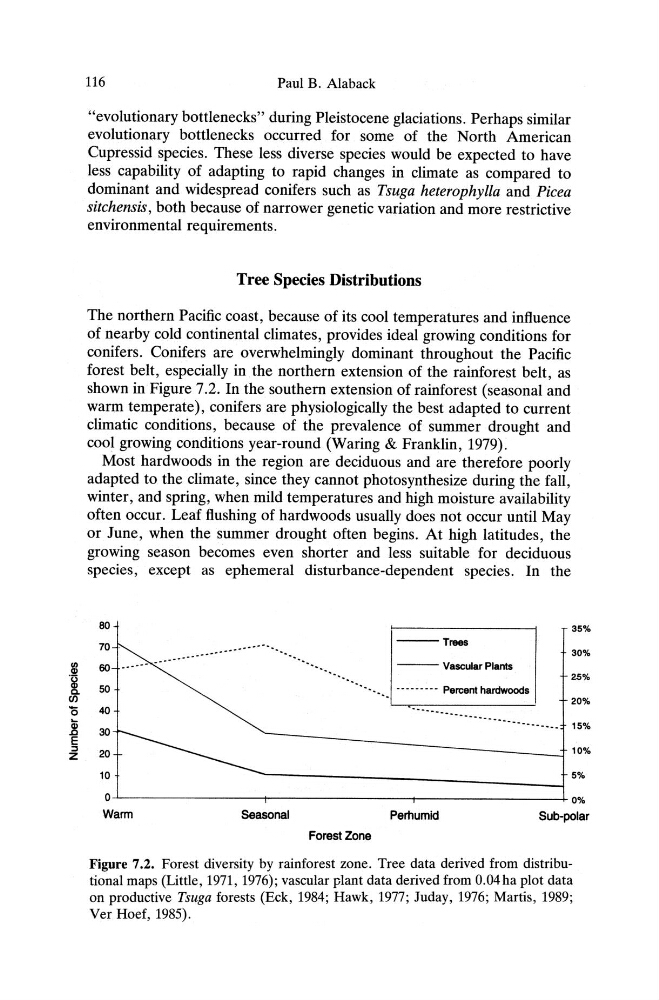
forest belt , especially in the northern extension of the rainforest belt, as
shown in Figure 7.2. In the southern extension of rainforest (seasonal and
warm temperate), conifers are physiologically the best adapted to current
climatic conditions, because of the pre valence of summer drou ght and
cool growing conditions year-round (Waring & Franklin, 1979).
Most hardwood s in the region are deciduous and are therefore poorl y
adapted to the climate, since they cannot photosynthesize during the fall,
winter , and spring, when mild temperatures and high moisture availability
often occur. Leaf flushing of hardwoods usually does not occur until May
or Jun e , when the summer drought often begins. At high latitudes, the
growing season becomes even shorter and less suitable for deciduous
species, except as epheme ral disturbance-dependent species. In the
80
35 %
70
---Trees
.... .
30 %
< ,
- -- Vascular Plants
'"
60
Q)
25 %
-g 50
-••-- --- - Percent hardwoods
c<,
en
20 %
'0
40
... _-- -.
CD
15 %
D
30
E
::::l
20
10 %
Z
10
5%
0
0%
Warm
Seasonal
Perhumid
Sub-polar
ForestZone
Figure 7.2. Forest diversity by rainforest zone. Tree data derived from distributional maps (Little , 1971, 1976); vascular plant data derived from O.04h a plot data
on produ ctive Tsuga forests (Eck , 1984; Hawk, 1977; Jud ay, 1976; Martis, 1989;
Ver Hoef, 1985).
Paul B. Alaback
"evolutionary bottlenecks" during Pleistocene glaciations. Perhaps similar
evolutionary bottl enecks occurred for some of the North Am erican
Cupressid species. These less diverse species would be expected to have
less capability of adapting to rapid changes in climate as compared to
dominant and widespread conifers such as Tsuga heterophylla and Picea
sitchensis , both because of narrow er genetic variation and more restrictive
environmental requirement s.
Tree Species Distributions
The northern Pacific coast, because of its cool temperatur es and influence
of nearby cold contin ental climates, provides ideal growing conditions for
conifers. Conifer s are overwhelmingly domin ant throughout the Pacific
forest belt , especially in the northern extension of the rainforest belt, as
shown in Figure 7.2. In the southern extension of rainforest (seasonal and
warm temperate), conifers are physiologically the best adapted to current
climatic conditions, because of the pre valence of summer drou ght and
cool growing conditions year-round (Waring & Franklin, 1979).
Most hardwood s in the region are deciduous and are therefore poorl y
adapted to the climate, since they cannot photosynthesize during the fall,
winter , and spring, when mild temperatures and high moisture availability
often occur. Leaf flushing of hardwoods usually does not occur until May
or Jun e , when the summer drought often begins. At high latitudes, the
growing season becomes even shorter and less suitable for deciduous
species, except as epheme ral disturbance-dependent species. In the
80
35 %
70
---Trees
.... .
30 %
< ,
- -- Vascular Plants
'"
60
Q)
25 %
-g 50
-••-- --- - Percent hardwoods
c<,
en
20 %
'0
40
... _-- -.
CD
15 %
D
30
E
::::l
20
10 %
Z
10
5%
0
0%
Warm
Seasonal
Perhumid
Sub-polar
ForestZone
Figure 7.2. Forest diversity by rainforest zone. Tree data derived from distributional maps (Little , 1971, 1976); vascular plant data derived from O.04h a plot data
on produ ctive Tsuga forests (Eck , 1984; Hawk, 1977; Jud ay, 1976; Martis, 1989;
Ver Hoef, 1985).