

6. Constraints on Terrestrial Primary Productivity
91
rate of transport through the vascular system. Under cloudy and cool
conditions, plants have little difficulty in maintaining good water relations.
Increasing transpiration beyond certain rates, however, causes some
portions of a plant's vascular system to fail and lose hydraulic efficiency.
When this happens, stomata begin to close, limiting both transpiration
and photosynthesis (Tyree & Sperry, 1988). The threshold when stomata
begin to close differs among species. Most temperate forest species in
the Pacific Northwest close their stomata completely when the humidity
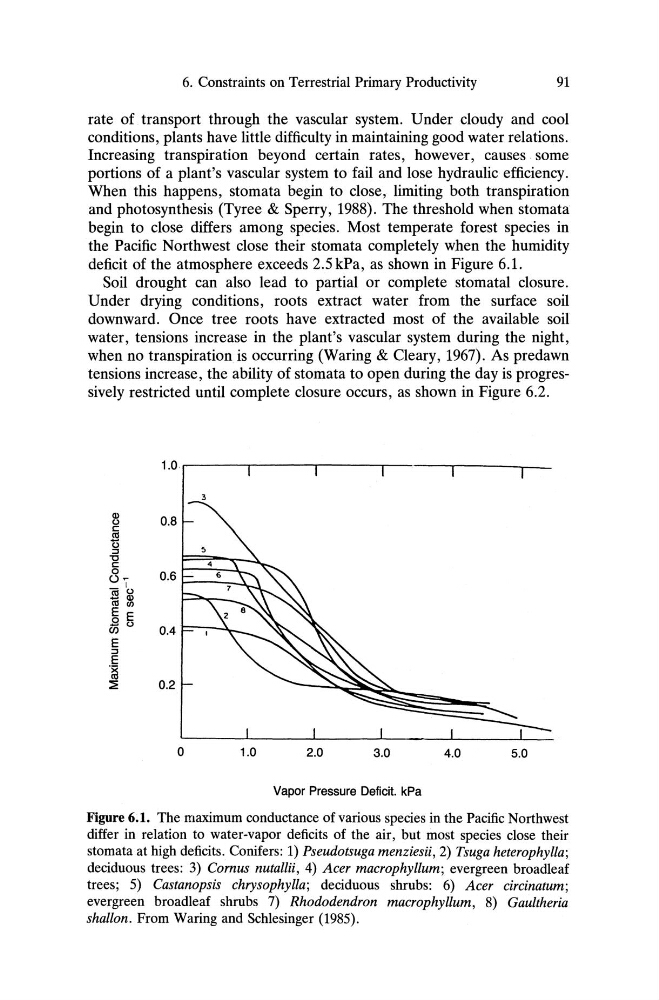
deficit of the atmosphere exceeds 2.5 kPa, as shown in Figure 6.1.
Soil drought can also lead to partial or complete stomatal closure.
Under drying conditions, roots extract water from the surface soil
downward. Once tree roots have extracted most of the available soil
water, tensions increase in the plant's vascular system during the night,
when no transpirationis occurring (Waring & Cleary, 1967). As predawn
tensions increase, the ability of stomata to open during the day is progressively restricted until complete closure occurs, as shown in Figure 6.2.
1.0
Q)
0.8
0
c
as
'0 :)
'0
C
0
0.6
()~
I
rqg
as Ul
E E
. 9 0
0.4
en
E
:)
E
.~
~
0.2
o
1.0
2.0
3.0
4.0
5.0
Vapor Pressure Deficit. kPa
Figure 6.1. The maximum conductance of various species in the Pacific Northwest
differ in relation to water-vapor deficits of the air, but most species close their
stomata at high deficits. Conifers: 1) Pseudotsuga menziesii , 2) Tsuga heterophylla;
deciduous trees: 3) Comus nutallii, 4) Acer macrophyllum ; evergreen broadleaf
trees; 5) Castanopsis chrysophylla; deciduous shrubs: 6) Acer circinatum;
evergreen broadleaf shrubs 7) Rhododendron macrophyllum, 8) Gaultheria
shallon. From Waring and Schlesinger (1985).
91
rate of transport through the vascular system. Under cloudy and cool
conditions, plants have little difficulty in maintaining good water relations.
Increasing transpiration beyond certain rates, however, causes some
portions of a plant's vascular system to fail and lose hydraulic efficiency.
When this happens, stomata begin to close, limiting both transpiration
and photosynthesis (Tyree & Sperry, 1988). The threshold when stomata
begin to close differs among species. Most temperate forest species in
the Pacific Northwest close their stomata completely when the humidity
deficit of the atmosphere exceeds 2.5 kPa, as shown in Figure 6.1.
Soil drought can also lead to partial or complete stomatal closure.
Under drying conditions, roots extract water from the surface soil
downward. Once tree roots have extracted most of the available soil
water, tensions increase in the plant's vascular system during the night,
when no transpirationis occurring (Waring & Cleary, 1967). As predawn
tensions increase, the ability of stomata to open during the day is progressively restricted until complete closure occurs, as shown in Figure 6.2.
1.0
Q)
0.8
0
c
as
'0 :)
'0
C
0
0.6
()~
I
rqg
as Ul
E E
. 9 0
0.4
en
E
:)
E
.~
~
0.2
o
1.0
2.0
3.0
4.0
5.0
Vapor Pressure Deficit. kPa
Figure 6.1. The maximum conductance of various species in the Pacific Northwest
differ in relation to water-vapor deficits of the air, but most species close their
stomata at high deficits. Conifers: 1) Pseudotsuga menziesii , 2) Tsuga heterophylla;
deciduous trees: 3) Comus nutallii, 4) Acer macrophyllum ; evergreen broadleaf
trees; 5) Castanopsis chrysophylla; deciduous shrubs: 6) Acer circinatum;
evergreen broadleaf shrubs 7) Rhododendron macrophyllum, 8) Gaultheria
shallon. From Waring and Schlesinger (1985).