

89
only 8.5% of the total biomass. There are several possible reasons for the large
variation in reported belowground biomass values: (i) the mangrove root mass percentage may truly vary among sites and species; (ii) belowground biomass has been
examined by few studies; (iii) aerial root systems may be reported as belowground
or aboveground biomass, depending on the study; and (iv) it can be difficult to
distinguish between live and dead roots, depending on the measurement procedure
used.
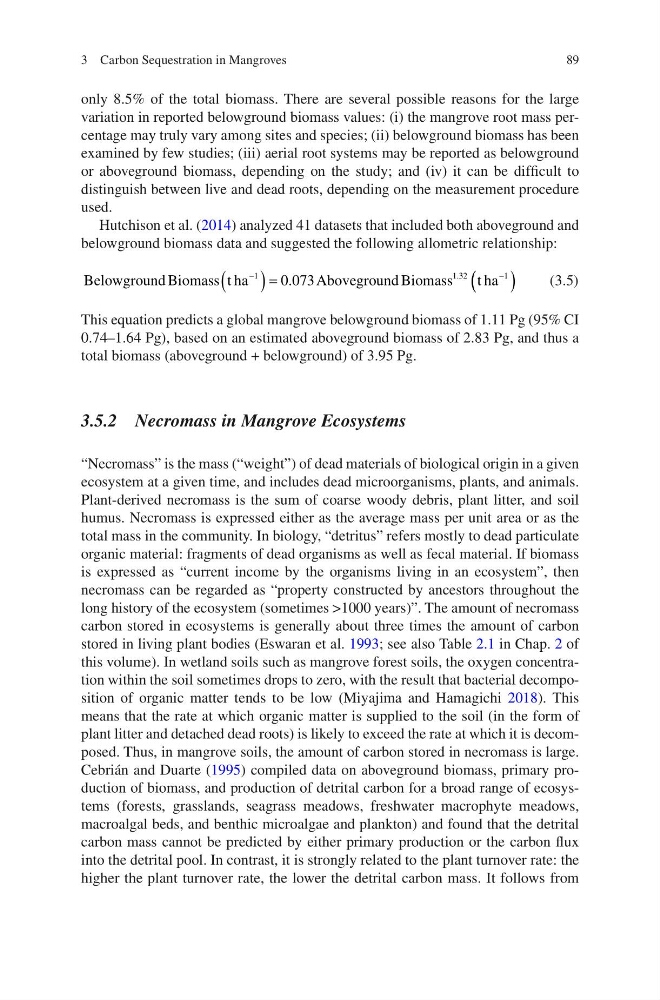
Hutchison et al. (2014) analyzed 41 datasets that included both aboveground and
belowground biomass data and suggested the following allometric relationship:
Belowground Biomass t ha
Aboveground Biomass
tha
-
-
( ) =
1
1 32
1
0 073
.
.
( ( ) (3.5)
This equation predicts a global mangrove belowground biomass of 1.11 Pg (95% CI
0.74–1.64 Pg), based on an estimated aboveground biomass of 2.83 Pg, and thus a
total biomass (aboveground + belowground) of 3.95 Pg.
3.5.2 Necromass in Mangrove Ecosystems
“Necromass” is the mass (“weight”) of dead materials of biological origin in a given
ecosystem at a given time, and includes dead microorganisms, plants, and animals.
Plant-derived necromass is the sum of coarse woody debris, plant litter, and soil
humus. Necromass is expressed either as the average mass per unit area or as the
total mass in the community. In biology, “detritus” refers mostly to dead particulate
organic material: fragments of dead organisms as well as fecal material. If biomass
is expressed as “current income by the organisms living in an ecosystem”, then
necromass can be regarded as “property constructed by ancestors throughout the
long history of the ecosystem (sometimes >1000 years)”. The amount of necromass
carbon stored in ecosystems is generally about three times the amount of carbon
stored in living plant bodies (Eswaran et al. 1993; see also Table 2.1 in Chap. 2 of
this volume). In wetland soils such as mangrove forest soils, the oxygen concentration within the soil sometimes drops to zero, with the result that bacterial decomposition of organic matter tends to be low (Miyajima and Hamagichi 2018). This
means that the rate at which organic matter is supplied to the soil (in the form of
plant litter and detached dead roots) is likely to exceed the rate at which it is decomposed. Thus, in mangrove soils, the amount of carbon stored in necromass is large.
Cebrián and Duarte (1995) compiled data on aboveground biomass, primary production of biomass, and production of detrital carbon for a broad range of ecosystems (forests, grasslands, seagrass meadows, freshwater macrophyte meadows,
macroalgal beds, and benthic microalgae and plankton) and found that the detrital
carbon mass cannot be predicted by either primary production or the carbon flux
into the detrital pool. In contrast, it is strongly related to the plant turnover rate: the
higher the plant turnover rate, the lower the detrital carbon mass. It follows from
3 Carbon Sequestration in Mangroves
only 8.5% of the total biomass. There are several possible reasons for the large
variation in reported belowground biomass values: (i) the mangrove root mass percentage may truly vary among sites and species; (ii) belowground biomass has been
examined by few studies; (iii) aerial root systems may be reported as belowground
or aboveground biomass, depending on the study; and (iv) it can be difficult to
distinguish between live and dead roots, depending on the measurement procedure
used.
Hutchison et al. (2014) analyzed 41 datasets that included both aboveground and
belowground biomass data and suggested the following allometric relationship:
Belowground Biomass t ha
Aboveground Biomass
tha
-
-
( ) =
1
1 32
1
0 073
.
.
( ( ) (3.5)
This equation predicts a global mangrove belowground biomass of 1.11 Pg (95% CI
0.74–1.64 Pg), based on an estimated aboveground biomass of 2.83 Pg, and thus a
total biomass (aboveground + belowground) of 3.95 Pg.
3.5.2 Necromass in Mangrove Ecosystems
“Necromass” is the mass (“weight”) of dead materials of biological origin in a given
ecosystem at a given time, and includes dead microorganisms, plants, and animals.
Plant-derived necromass is the sum of coarse woody debris, plant litter, and soil
humus. Necromass is expressed either as the average mass per unit area or as the
total mass in the community. In biology, “detritus” refers mostly to dead particulate
organic material: fragments of dead organisms as well as fecal material. If biomass
is expressed as “current income by the organisms living in an ecosystem”, then
necromass can be regarded as “property constructed by ancestors throughout the
long history of the ecosystem (sometimes >1000 years)”. The amount of necromass
carbon stored in ecosystems is generally about three times the amount of carbon
stored in living plant bodies (Eswaran et al. 1993; see also Table 2.1 in Chap. 2 of
this volume). In wetland soils such as mangrove forest soils, the oxygen concentration within the soil sometimes drops to zero, with the result that bacterial decomposition of organic matter tends to be low (Miyajima and Hamagichi 2018). This
means that the rate at which organic matter is supplied to the soil (in the form of
plant litter and detached dead roots) is likely to exceed the rate at which it is decomposed. Thus, in mangrove soils, the amount of carbon stored in necromass is large.
Cebrián and Duarte (1995) compiled data on aboveground biomass, primary production of biomass, and production of detrital carbon for a broad range of ecosystems (forests, grasslands, seagrass meadows, freshwater macrophyte meadows,
macroalgal beds, and benthic microalgae and plankton) and found that the detrital
carbon mass cannot be predicted by either primary production or the carbon flux
into the detrital pool. In contrast, it is strongly related to the plant turnover rate: the
higher the plant turnover rate, the lower the detrital carbon mass. It follows from
3 Carbon Sequestration in Mangroves