

62
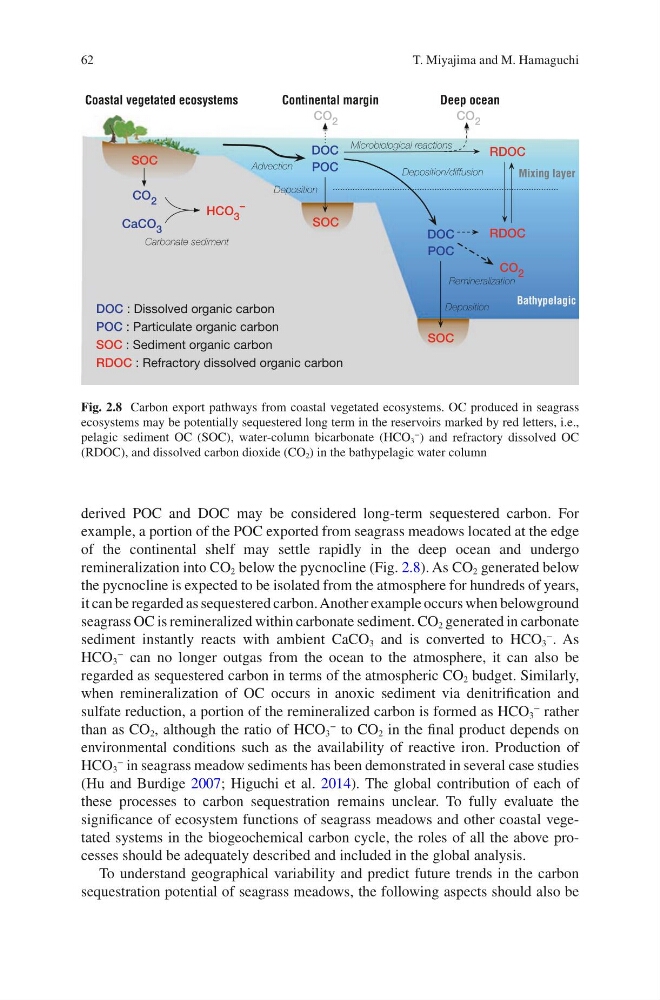
derived POC and DOC may be considered long-term sequestered carbon. For
example, a portion of the POC exported from seagrass meadows located at the edge
of the continental shelf may settle rapidly in the deep ocean and undergo
remineralization into CO 2 below the pycnocline (Fig. 2.8). As CO 2 generated below
the pycnocline is expected to be isolated from the atmosphere for hundreds of years,
it can be regarded as sequestered carbon. Another example occurs when belowground
seagrass OC is remineralized within carbonate sediment. CO 2 generated in carbonate
sediment instantly reacts with ambient CaCO 3 and is converted to HCO 3
−
. As
HCO 3
−
can no longer outgas from the ocean to the atmosphere, it can also be
regarded as sequestered carbon in terms of the atmospheric CO 2 budget. Similarly,
when remineralization of OC occurs in anoxic sediment via denitrification and
sulfate reduction, a portion of the remineralized carbon is formed as HCO 3
−
rather
than as CO 2 , although the ratio of HCO 3
−
to CO 2 in the final product depends on
environmental conditions such as the availability of reactive iron. Production of
HCO 3
−
in seagrass meadow sediments has been demonstrated in several case studies
(Hu and Burdige 2007; Higuchi et al. 2014). The global contribution of each of
these processes to carbon sequestration remains unclear. To fully evaluate the
significance of ecosystem functions of seagrass meadows and other coastal vegetated systems in the biogeochemical carbon cycle, the roles of all the above processes should be adequately described and included in the global analysis.
To understand geographical variability and predict future trends in the carbon
sequestration potential of seagrass meadows, the following aspects should also be
POC
DOC
Coastal vegetated ecosystems
POC
DOC
Mixing layer
Bathypelagic
RDOC
CO 2
Microbiological reactions
Remineralization
Deposition/diffusion
Deposition
Deposition
Advection
Continental margin
Deep ocean
CO 2
CO 2
DOC : Dissolved organic carbon
POC : Particulate organic carbon
SOC : Sediment organic carbon
RDOC : Refractory dissolved organic carbon
SOC
CaCO 3
HCO 3
SOC
SOC
RDOC
CO 2
Carbonate sediment
Fig. 2.8 Carbon export pathways from coastal vegetated ecosystems. OC produced in seagrass
ecosystems may be potentially sequestered long term in the reservoirs marked by red letters, i.e.,
pelagic sediment OC (SOC), water-column bicarbonate (HCO 3
−
) and refractory dissolved OC
(RDOC), and dissolved carbon dioxide (CO 2 ) in the bathypelagic water column
T. Miyajima and M. Hamaguchi
derived POC and DOC may be considered long-term sequestered carbon. For
example, a portion of the POC exported from seagrass meadows located at the edge
of the continental shelf may settle rapidly in the deep ocean and undergo
remineralization into CO 2 below the pycnocline (Fig. 2.8). As CO 2 generated below
the pycnocline is expected to be isolated from the atmosphere for hundreds of years,
it can be regarded as sequestered carbon. Another example occurs when belowground
seagrass OC is remineralized within carbonate sediment. CO 2 generated in carbonate
sediment instantly reacts with ambient CaCO 3 and is converted to HCO 3
−
. As
HCO 3
−
can no longer outgas from the ocean to the atmosphere, it can also be
regarded as sequestered carbon in terms of the atmospheric CO 2 budget. Similarly,
when remineralization of OC occurs in anoxic sediment via denitrification and
sulfate reduction, a portion of the remineralized carbon is formed as HCO 3
−
rather
than as CO 2 , although the ratio of HCO 3
−
to CO 2 in the final product depends on
environmental conditions such as the availability of reactive iron. Production of
HCO 3
−
in seagrass meadow sediments has been demonstrated in several case studies
(Hu and Burdige 2007; Higuchi et al. 2014). The global contribution of each of
these processes to carbon sequestration remains unclear. To fully evaluate the
significance of ecosystem functions of seagrass meadows and other coastal vegetated systems in the biogeochemical carbon cycle, the roles of all the above processes should be adequately described and included in the global analysis.
To understand geographical variability and predict future trends in the carbon
sequestration potential of seagrass meadows, the following aspects should also be
POC
DOC
Coastal vegetated ecosystems
POC
DOC
Mixing layer
Bathypelagic
RDOC
CO 2
Microbiological reactions
Remineralization
Deposition/diffusion
Deposition
Deposition
Advection
Continental margin
Deep ocean
CO 2
CO 2
DOC : Dissolved organic carbon
POC : Particulate organic carbon
SOC : Sediment organic carbon
RDOC : Refractory dissolved organic carbon
SOC
CaCO 3
HCO 3
SOC
SOC
RDOC
CO 2
Carbonate sediment
Fig. 2.8 Carbon export pathways from coastal vegetated ecosystems. OC produced in seagrass
ecosystems may be potentially sequestered long term in the reservoirs marked by red letters, i.e.,
pelagic sediment OC (SOC), water-column bicarbonate (HCO 3
−
) and refractory dissolved OC
(RDOC), and dissolved carbon dioxide (CO 2 ) in the bathypelagic water column
T. Miyajima and M. Hamaguchi