

36
trends. In this chapter, we review the distribution pattern and chemical characteristics of sedimentary OC and the major factors that control OC accumulation and
burial rates in marine sediments, with a particular emphasis on seagrass meadows.
2.2 Sedimentary Environment of Seagrass Meadows
Seagrass meadows are undersea grassland ecosystems that consist of submerged,
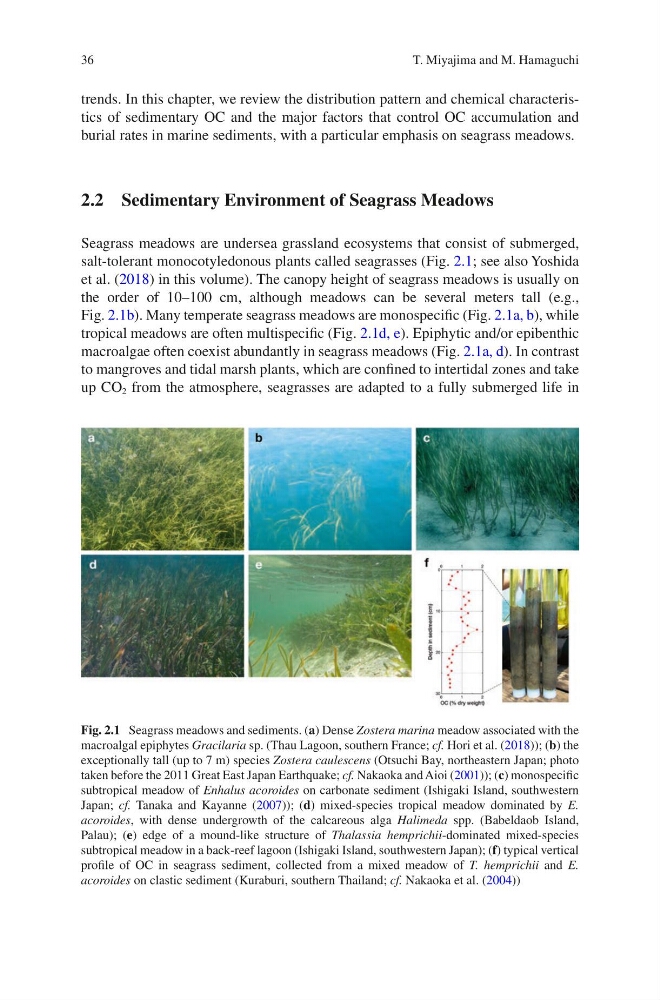
salt-tolerant monocotyledonous plants called seagrasses (Fig. 2.1; see also Yoshida
et al. (2018) in this volume). The canopy height of seagrass meadows is usually on
the order of 10–100 cm, although meadows can be several meters tall (e.g.,
Fig. 2.1b). Many temperate seagrass meadows are monospecific (Fig. 2.1a, b), while
tropical meadows are often multispecific (Fig. 2.1d, e). Epiphytic and/or epibenthic
macroalgae often coexist abundantly in seagrass meadows (Fig. 2.1a, d). In contrast
to mangroves and tidal marsh plants, which are confined to intertidal zones and take
up CO 2 from the atmosphere, seagrasses are adapted to a fully submerged life in
Fig. 2.1 Seagrass meadows and sediments. (a) Dense Zostera marina meadow associated with the
macroalgal epiphytes Gracilaria sp. (Thau Lagoon, southern France; cf. Hori et al. (2018)); (b) the
exceptionally tall (up to 7 m) species Zostera caulescens (Otsuchi Bay, northeastern Japan; photo
taken before the 2011 Great East Japan Earthquake; cf. Nakaoka and Aioi (2001)); (c) monospecific
subtropical meadow of Enhalus acoroides on carbonate sediment (Ishigaki Island, southwestern
Japan; cf. Tanaka and Kayanne (2007)); (d) mixed-species tropical meadow dominated by E.
acoroides, with dense undergrowth of the calcareous alga Halimeda spp. (Babeldaob Island,
Palau); (e) edge of a mound-like structure of Thalassia hemprichii-dominated mixed-species
subtropical meadow in a back-reef lagoon (Ishigaki Island, southwestern Japan); (f) typical vertical
profile of OC in seagrass sediment, collected from a mixed meadow of T. hemprichii and E.
acoroides on clastic sediment (Kuraburi, southern Thailand; cf. Nakaoka et al. (2004))
T. Miyajima and M. Hamaguchi
trends. In this chapter, we review the distribution pattern and chemical characteristics of sedimentary OC and the major factors that control OC accumulation and
burial rates in marine sediments, with a particular emphasis on seagrass meadows.
2.2 Sedimentary Environment of Seagrass Meadows
Seagrass meadows are undersea grassland ecosystems that consist of submerged,
salt-tolerant monocotyledonous plants called seagrasses (Fig. 2.1; see also Yoshida
et al. (2018) in this volume). The canopy height of seagrass meadows is usually on
the order of 10–100 cm, although meadows can be several meters tall (e.g.,
Fig. 2.1b). Many temperate seagrass meadows are monospecific (Fig. 2.1a, b), while
tropical meadows are often multispecific (Fig. 2.1d, e). Epiphytic and/or epibenthic
macroalgae often coexist abundantly in seagrass meadows (Fig. 2.1a, d). In contrast
to mangroves and tidal marsh plants, which are confined to intertidal zones and take
up CO 2 from the atmosphere, seagrasses are adapted to a fully submerged life in
Fig. 2.1 Seagrass meadows and sediments. (a) Dense Zostera marina meadow associated with the
macroalgal epiphytes Gracilaria sp. (Thau Lagoon, southern France; cf. Hori et al. (2018)); (b) the
exceptionally tall (up to 7 m) species Zostera caulescens (Otsuchi Bay, northeastern Japan; photo
taken before the 2011 Great East Japan Earthquake; cf. Nakaoka and Aioi (2001)); (c) monospecific
subtropical meadow of Enhalus acoroides on carbonate sediment (Ishigaki Island, southwestern
Japan; cf. Tanaka and Kayanne (2007)); (d) mixed-species tropical meadow dominated by E.
acoroides, with dense undergrowth of the calcareous alga Halimeda spp. (Babeldaob Island,
Palau); (e) edge of a mound-like structure of Thalassia hemprichii-dominated mixed-species
subtropical meadow in a back-reef lagoon (Ishigaki Island, southwestern Japan); (f) typical vertical
profile of OC in seagrass sediment, collected from a mixed meadow of T. hemprichii and E.
acoroides on clastic sediment (Kuraburi, southern Thailand; cf. Nakaoka et al. (2004))
T. Miyajima and M. Hamaguchi