

358
(1) Conserve and enhance, as appropriate, sinks and reservoirs of greenhouse gases
(Article 5.1);
(2) Implement and support, including through results-based payments, the existing
framework as set out in related guidance and decisions already agreed under the
Convention for policy approaches and positive incentives for activities relating
to Reducing Emissions from Deforestation and forest Degradation (REDD), the
role of conservation, sustainable management of forests, and enhancement of
forest carbon stocks in developing countries (REDD+), and alternative policy
approaches, such as joint mitigation (Article 5.2);
(3) Reaffirm the importance of incentivizing, as appropriate, non-carbon benefits
(Article 5.2);
(4) Recognize the fundamental priority of safeguarding food security (Preamble);
(5) Note the importance of ensuring the integrity of all ecosystems, including
oceans, and the protection of biodiversity (Preamble);
(6) Uphold and promote regional and international cooperation to mobilize stronger and more ambitious climate action by all Parties and non-Party stakeholders, including civil society, the private sector, financial institutions, cities and
other subnational authorities, local communities, and indigenous peoples
(Preamble of COP 21).
With regard to item (1), restoring and conserving SCEs that are major atmospheric
CO 2 sinks and carbon reservoirs promote conservation and strengthen CO 2 absorption and carbon storage, which reconcile very well with the contents of the Paris
Agreement. Next, utilizing the mechanism and concept of REDD+ noted in item (2),
making agreements with the Coalition of Rainforest Nations that stores large amounts
of blue carbon in mangroves, seagrass meadows, and coastal peatlands, and promoting the restoration and conservation of blue carbon resources are all activities in line
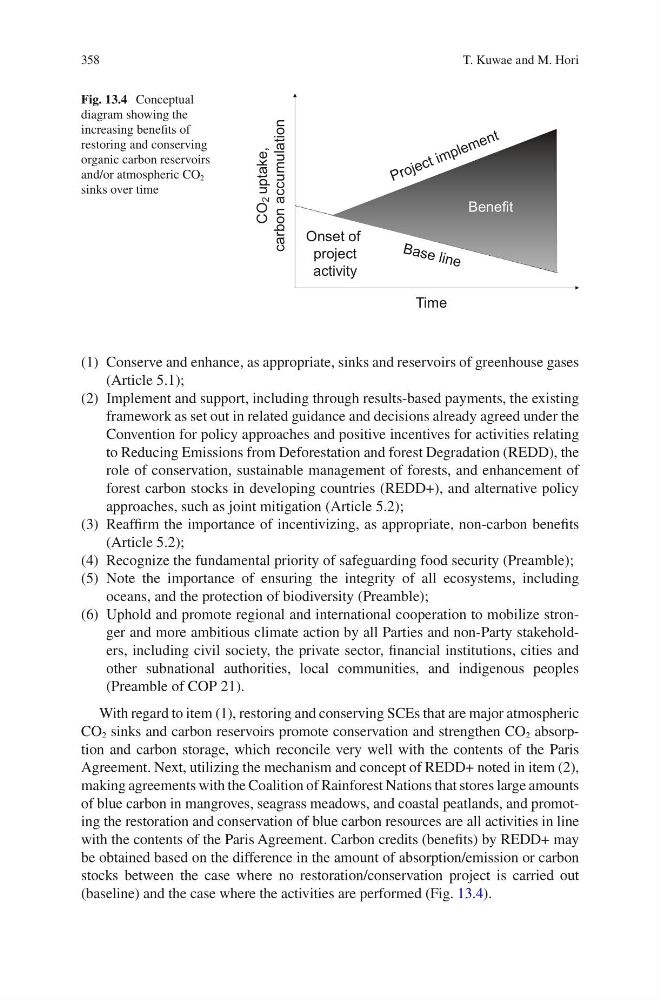
with the contents of the Paris Agreement. Carbon credits (benefits) by REDD+ may
be obtained based on the difference in the amount of absorption/emission or carbon
stocks between the case where no restoration/conservation project is carried out
(baseline) and the case where the activities are performed (Fig. 13.4).
Time
Benefit
Onset of
project
activity
CO
2 uptake,
carbon accumulation
Fig. 13.4 Conceptual
diagram showing the
increasing benefits of
restoring and conserving
organic carbon reservoirs
and/or atmospheric CO 2
sinks over time
T. Kuwae and M. Hori
(1) Conserve and enhance, as appropriate, sinks and reservoirs of greenhouse gases
(Article 5.1);
(2) Implement and support, including through results-based payments, the existing
framework as set out in related guidance and decisions already agreed under the
Convention for policy approaches and positive incentives for activities relating
to Reducing Emissions from Deforestation and forest Degradation (REDD), the
role of conservation, sustainable management of forests, and enhancement of
forest carbon stocks in developing countries (REDD+), and alternative policy
approaches, such as joint mitigation (Article 5.2);
(3) Reaffirm the importance of incentivizing, as appropriate, non-carbon benefits
(Article 5.2);
(4) Recognize the fundamental priority of safeguarding food security (Preamble);
(5) Note the importance of ensuring the integrity of all ecosystems, including
oceans, and the protection of biodiversity (Preamble);
(6) Uphold and promote regional and international cooperation to mobilize stronger and more ambitious climate action by all Parties and non-Party stakeholders, including civil society, the private sector, financial institutions, cities and
other subnational authorities, local communities, and indigenous peoples
(Preamble of COP 21).
With regard to item (1), restoring and conserving SCEs that are major atmospheric
CO 2 sinks and carbon reservoirs promote conservation and strengthen CO 2 absorption and carbon storage, which reconcile very well with the contents of the Paris
Agreement. Next, utilizing the mechanism and concept of REDD+ noted in item (2),
making agreements with the Coalition of Rainforest Nations that stores large amounts
of blue carbon in mangroves, seagrass meadows, and coastal peatlands, and promoting the restoration and conservation of blue carbon resources are all activities in line
with the contents of the Paris Agreement. Carbon credits (benefits) by REDD+ may
be obtained based on the difference in the amount of absorption/emission or carbon
stocks between the case where no restoration/conservation project is carried out
(baseline) and the case where the activities are performed (Fig. 13.4).
Time
Benefit
Onset of
project
activity
CO
2 uptake,
carbon accumulation
Fig. 13.4 Conceptual
diagram showing the
increasing benefits of
restoring and conserving
organic carbon reservoirs
and/or atmospheric CO 2
sinks over time
T. Kuwae and M. Hori