

25
1.4.1 Biodiversity and Community Structure of Eelgrass Beds
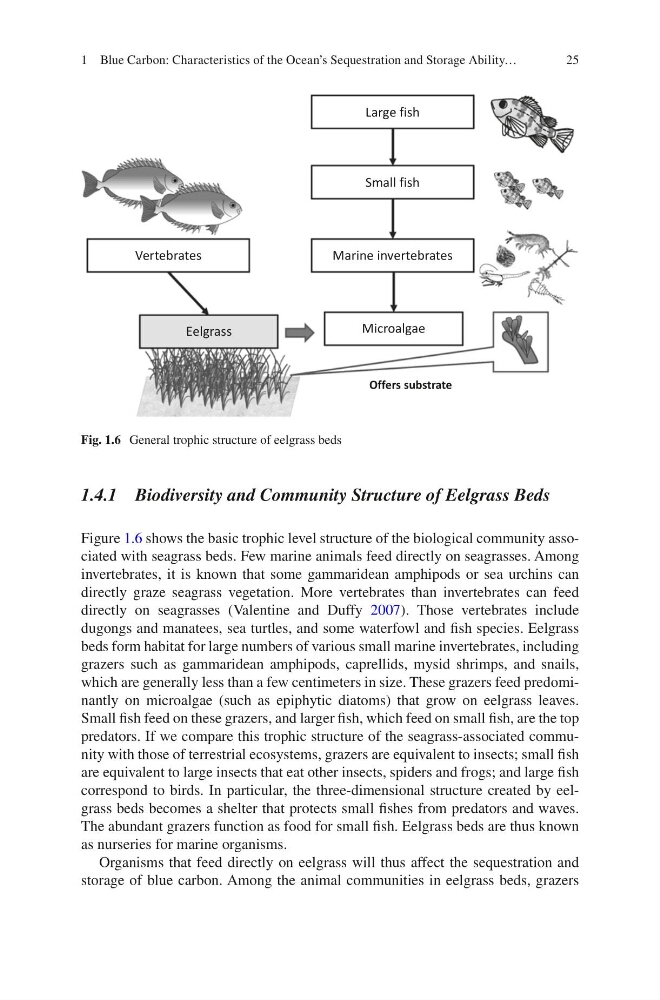
Figure 1.6 shows the basic trophic level structure of the biological community associated with seagrass beds. Few marine animals feed directly on seagrasses. Among
invertebrates, it is known that some gammaridean amphipods or sea urchins can
directly graze seagrass vegetation. More vertebrates than invertebrates can feed
directly on seagrasses (Valentine and Duffy 2007). Those vertebrates include
dugongs and manatees, sea turtles, and some waterfowl and fish species. Eelgrass
beds form habitat for large numbers of various small marine invertebrates, including
grazers such as gammaridean amphipods, caprellids, mysid shrimps, and snails,
which are generally less than a few centimeters in size. These grazers feed predominantly on microalgae (such as epiphytic diatoms) that grow on eelgrass leaves.
Small fish feed on these grazers, and larger fish, which feed on small fish, are the top
predators. If we compare this trophic structure of the seagrass-associated community with those of terrestrial ecosystems, grazers are equivalent to insects; small fish
are equivalent to large insects that eat other insects, spiders and frogs; and large fish
correspond to birds. In particular, the three-dimensional structure created by eelgrass beds becomes a shelter that protects small fishes from predators and waves.
The abundant grazers function as food for small fish. Eelgrass beds are thus known
as nurseries for marine organisms.
Organisms that feed directly on eelgrass will thus affect the sequestration and
storage of blue carbon. Among the animal communities in eelgrass beds, grazers
Offers substrate
Eelgrass
Microalgae
Marine invertebrates
Vertebrates
Small fish
Large fish
Fig. 1.6 General trophic structure of eelgrass beds
1 Blue Carbon: Characteristics of the Ocean’s Sequestration and Storage Ability…
1.4.1 Biodiversity and Community Structure of Eelgrass Beds
Figure 1.6 shows the basic trophic level structure of the biological community associated with seagrass beds. Few marine animals feed directly on seagrasses. Among
invertebrates, it is known that some gammaridean amphipods or sea urchins can
directly graze seagrass vegetation. More vertebrates than invertebrates can feed
directly on seagrasses (Valentine and Duffy 2007). Those vertebrates include
dugongs and manatees, sea turtles, and some waterfowl and fish species. Eelgrass
beds form habitat for large numbers of various small marine invertebrates, including
grazers such as gammaridean amphipods, caprellids, mysid shrimps, and snails,
which are generally less than a few centimeters in size. These grazers feed predominantly on microalgae (such as epiphytic diatoms) that grow on eelgrass leaves.
Small fish feed on these grazers, and larger fish, which feed on small fish, are the top
predators. If we compare this trophic structure of the seagrass-associated community with those of terrestrial ecosystems, grazers are equivalent to insects; small fish
are equivalent to large insects that eat other insects, spiders and frogs; and large fish
correspond to birds. In particular, the three-dimensional structure created by eelgrass beds becomes a shelter that protects small fishes from predators and waves.
The abundant grazers function as food for small fish. Eelgrass beds are thus known
as nurseries for marine organisms.
Organisms that feed directly on eelgrass will thus affect the sequestration and
storage of blue carbon. Among the animal communities in eelgrass beds, grazers
Offers substrate
Eelgrass
Microalgae
Marine invertebrates
Vertebrates
Small fish
Large fish
Fig. 1.6 General trophic structure of eelgrass beds
1 Blue Carbon: Characteristics of the Ocean’s Sequestration and Storage Ability…