

356
Marine Science Organization and the International Council for the Exploration of
the Sea, whereas global research networks led by intergovernmental bodies are rare
(cf. the Argo project). Some frameworks are being formed to strengthen the connection between scientific researchers and policy-makers. This movement is explained
in detail in the next section.
13.4 International Frameworks for Blue Carbon
13.4.1 The United Nations Framework Convention on Climate
Change and IPCC
Because the term “blue carbon” is used in the context of climate change, the most
relevant international initiative is, of course, the United Nations Framework
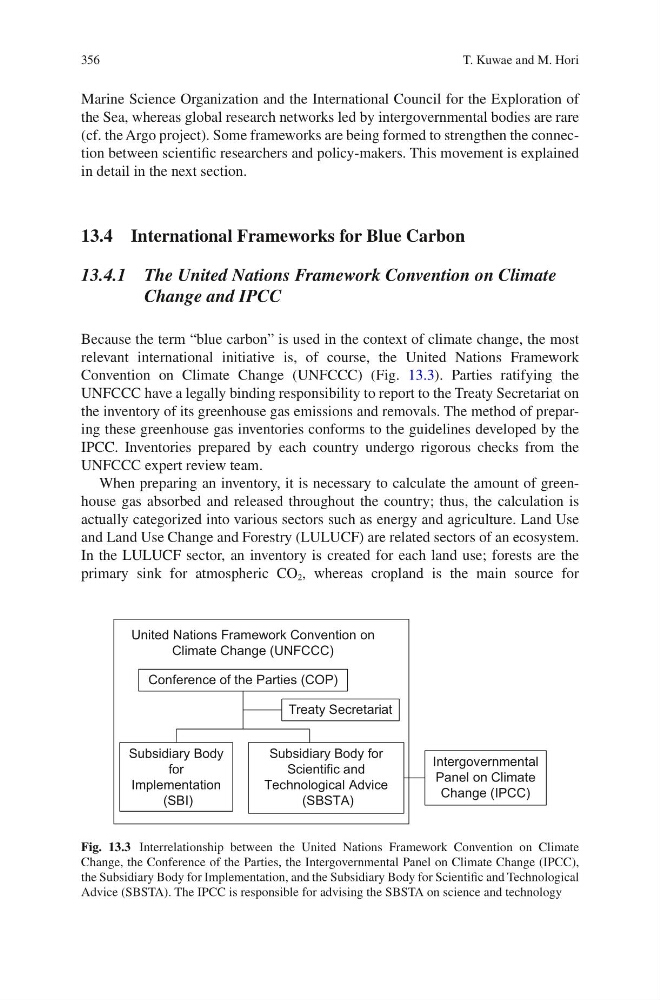
Convention on Climate Change (UNFCCC) (Fig. 13.3). Parties ratifying the
UNFCCC have a legally binding responsibility to report to the Treaty Secretariat on
the inventory of its greenhouse gas emissions and removals. The method of preparing these greenhouse gas inventories conforms to the guidelines developed by the
IPCC. Inventories prepared by each country undergo rigorous checks from the
UNFCCC expert review team.
When preparing an inventory, it is necessary to calculate the amount of greenhouse gas absorbed and released throughout the country; thus, the calculation is
actually categorized into various sectors such as energy and agriculture. Land Use
and Land Use Change and Forestry (LULUCF) are related sectors of an ecosystem.
In the LULUCF sector, an inventory is created for each land use; forests are the
primary sink for atmospheric CO 2 , whereas cropland is the main source for
United Nations Framework Convention on
Climate Change (UNFCCC)
Conference of the Parties (COP)
Treaty Secretariat
Intergovernmental
Panel on Climate
Change (IPCC)
Subsidiary Body for
Scientific and
Technological Advice
(SBSTA)
Subsidiary Body
for
Implementation
(SBI)
Fig. 13.3 Interrelationship between the United Nations Framework Convention on Climate
Change, the Conference of the Parties, the Intergovernmental Panel on Climate Change (IPCC),
the Subsidiary Body for Implementation, and the Subsidiary Body for Scientific and Technological
Advice (SBSTA). The IPCC is responsible for advising the SBSTA on science and technology
T. Kuwae and M. Hori
Marine Science Organization and the International Council for the Exploration of
the Sea, whereas global research networks led by intergovernmental bodies are rare
(cf. the Argo project). Some frameworks are being formed to strengthen the connection between scientific researchers and policy-makers. This movement is explained
in detail in the next section.
13.4 International Frameworks for Blue Carbon
13.4.1 The United Nations Framework Convention on Climate
Change and IPCC
Because the term “blue carbon” is used in the context of climate change, the most
relevant international initiative is, of course, the United Nations Framework
Convention on Climate Change (UNFCCC) (Fig. 13.3). Parties ratifying the
UNFCCC have a legally binding responsibility to report to the Treaty Secretariat on
the inventory of its greenhouse gas emissions and removals. The method of preparing these greenhouse gas inventories conforms to the guidelines developed by the
IPCC. Inventories prepared by each country undergo rigorous checks from the
UNFCCC expert review team.
When preparing an inventory, it is necessary to calculate the amount of greenhouse gas absorbed and released throughout the country; thus, the calculation is
actually categorized into various sectors such as energy and agriculture. Land Use
and Land Use Change and Forestry (LULUCF) are related sectors of an ecosystem.
In the LULUCF sector, an inventory is created for each land use; forests are the
primary sink for atmospheric CO 2 , whereas cropland is the main source for
United Nations Framework Convention on
Climate Change (UNFCCC)
Conference of the Parties (COP)
Treaty Secretariat
Intergovernmental
Panel on Climate
Change (IPCC)
Subsidiary Body for
Scientific and
Technological Advice
(SBSTA)
Subsidiary Body
for
Implementation
(SBI)
Fig. 13.3 Interrelationship between the United Nations Framework Convention on Climate
Change, the Conference of the Parties, the Intergovernmental Panel on Climate Change (IPCC),
the Subsidiary Body for Implementation, and the Subsidiary Body for Scientific and Technological
Advice (SBSTA). The IPCC is responsible for advising the SBSTA on science and technology
T. Kuwae and M. Hori