

337
ELC BL : baseline power consumption (kWh)
ELC PJ : project power consumption (kWh)
CEF: CO 2 emission coefficient of power (kg CO 2 /kWh) in 2014
OT SSHP : monthly operation time (h) of seawater-source heat pump
ELP SSHP : monthly power consumption of seawater-source heat pump (kW)
ELP HSWP : monthly power consumption of heat-source water pump (kW)
COP SSHP : monthly COP (coefficient of performance) of seawater-source heat pump
COP ASHP : monthly COP of air-source heat pump
The operating time and power consumption of the seawater-source heat pump
were not monitored, so they were estimated from the air temperature and the seawater temperature, respectively. As noted above, the baseline power consumption (i.e.,
power consumption when running an existing air-source heat pump) was calculated
as EM BL = Σ (ELC PJ × COP SSHP /COP ASHP ), so it was possible to ignore the difference
in climatic conditions before and after the equipment update by obtaining the power
consumption when the air-source heat pump was assumed to be in use in 2013.
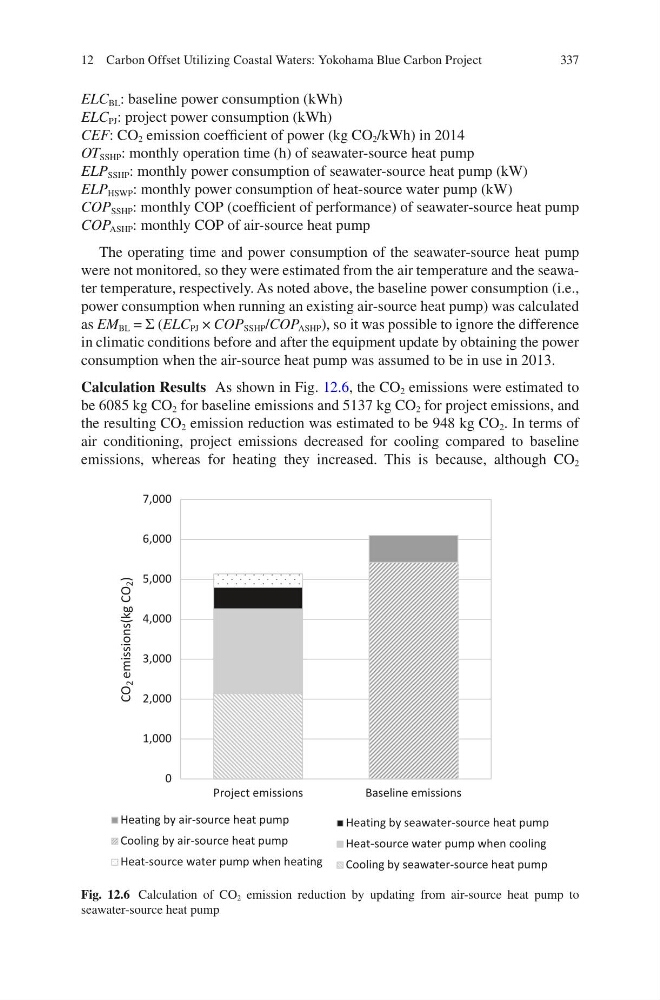
Calculation Results As shown in Fig. 12.6, the CO 2 emissions were estimated to
be 6085 kg CO 2 for baseline emissions and 5137 kg CO 2 for project emissions, and
the resulting CO 2 emission reduction was estimated to be 948 kg CO 2 . In terms of
air conditioning, project emissions decreased for cooling compared to baseline
emissions, whereas for heating they increased. This is because, although CO 2
0
1,000
2,000
3,000
4,000
5,000
6,000
7,000
Project emissions
Baseline emissions
CO
2 emissions(kg CO
2 )
Heating by air-source heat pump
Cooling by air-source heat pump
Heat-source water pump when heating
Heating by seawater-source heat pump
Heat-source water pump when cooling
Cooling by seawater-source heat pump
Fig. 12.6 Calculation of CO 2 emission reduction by updating from air-source heat pump to
seawater- source heat pump
12 Carbon Offset Utilizing Coastal Waters: Yokohama Blue Carbon Project
ELC BL : baseline power consumption (kWh)
ELC PJ : project power consumption (kWh)
CEF: CO 2 emission coefficient of power (kg CO 2 /kWh) in 2014
OT SSHP : monthly operation time (h) of seawater-source heat pump
ELP SSHP : monthly power consumption of seawater-source heat pump (kW)
ELP HSWP : monthly power consumption of heat-source water pump (kW)
COP SSHP : monthly COP (coefficient of performance) of seawater-source heat pump
COP ASHP : monthly COP of air-source heat pump
The operating time and power consumption of the seawater-source heat pump
were not monitored, so they were estimated from the air temperature and the seawater temperature, respectively. As noted above, the baseline power consumption (i.e.,
power consumption when running an existing air-source heat pump) was calculated
as EM BL = Σ (ELC PJ × COP SSHP /COP ASHP ), so it was possible to ignore the difference
in climatic conditions before and after the equipment update by obtaining the power
consumption when the air-source heat pump was assumed to be in use in 2013.
Calculation Results As shown in Fig. 12.6, the CO 2 emissions were estimated to
be 6085 kg CO 2 for baseline emissions and 5137 kg CO 2 for project emissions, and
the resulting CO 2 emission reduction was estimated to be 948 kg CO 2 . In terms of
air conditioning, project emissions decreased for cooling compared to baseline
emissions, whereas for heating they increased. This is because, although CO 2
0
1,000
2,000
3,000
4,000
5,000
6,000
7,000
Project emissions
Baseline emissions
CO
2 emissions(kg CO
2 )
Heating by air-source heat pump
Cooling by air-source heat pump
Heat-source water pump when heating
Heating by seawater-source heat pump
Heat-source water pump when cooling
Cooling by seawater-source heat pump
Fig. 12.6 Calculation of CO 2 emission reduction by updating from air-source heat pump to
seawater- source heat pump
12 Carbon Offset Utilizing Coastal Waters: Yokohama Blue Carbon Project