

22
sures against global warming. This consideration is also one of the main reasons
why several chapters in this book focus on eelgrass.
Among the 60 seagrass species, three families comprising 15 marine species
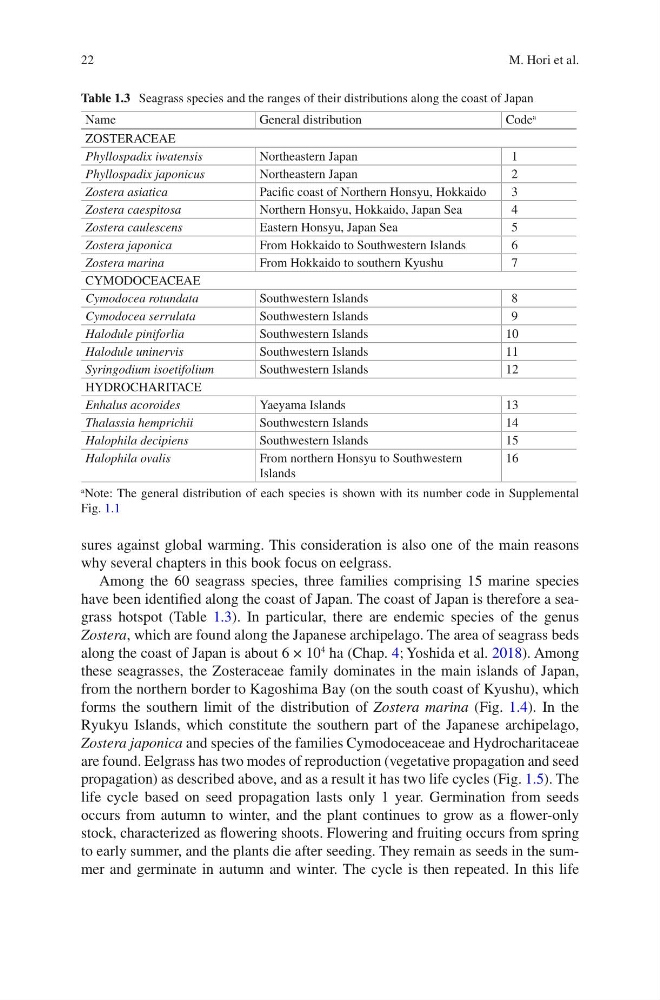
have been identified along the coast of Japan. The coast of Japan is therefore a seagrass hotspot (Table 1.3). In particular, there are endemic species of the genus
Zostera, which are found along the Japanese archipelago. The area of seagrass beds
along the coast of Japan is about 6 × 10
4
ha (Chap. 4; Yoshida et al. 2018). Among
these seagrasses, the Zosteraceae family dominates in the main islands of Japan,
from the northern border to Kagoshima Bay (on the south coast of Kyushu), which
forms the southern limit of the distribution of Zostera marina (Fig. 1.4). In the
Ryukyu Islands, which constitute the southern part of the Japanese archipelago,
Zostera japonica and species of the families Cymodoceaceae and Hydrocharitaceae
are found. Eelgrass has two modes of reproduction (vegetative propagation and seed
propagation) as described above, and as a result it has two life cycles (Fig. 1.5). The
life cycle based on seed propagation lasts only 1 year. Germination from seeds
occurs from autumn to winter, and the plant continues to grow as a flower-only
stock, characterized as flowering shoots. Flowering and fruiting occurs from spring
to early summer, and the plants die after seeding. They remain as seeds in the summer and germinate in autumn and winter. The cycle is then repeated. In this life
Table 1.3 Seagrass species and the ranges of their distributions along the coast of Japan
Name
General distribution
Code
a
ZOSTERACEAE
Phyllospadix iwatensis
Northeastern Japan
1
Phyllospadix japonicus
Northeastern Japan
2
Zostera asiatica
Pacific coast of Northern Honsyu, Hokkaido
3
Zostera caespitosa
Northern Honsyu, Hokkaido, Japan Sea
4
Zostera caulescens
Eastern Honsyu, Japan Sea
5
Zostera japonica
From Hokkaido to Southwestern Islands
6
Zostera marina
From Hokkaido to southern Kyushu
7
CYMODOCEACEAE
Cymodocea rotundata
Southwestern Islands
8
Cymodocea serrulata
Southwestern Islands
9
Halodule piniforlia
Southwestern Islands
10
Halodule uninervis
Southwestern Islands
11
Syringodium isoetifolium
Southwestern Islands
12
HYDROCHARITACE
Enhalus acoroides
Yaeyama Islands
13
Thalassia hemprichii
Southwestern Islands
14
Halophila decipiens
Southwestern Islands
15
Halophila ovalis
From northern Honsyu to Southwestern
Islands
16
a
Note: The general distribution of each species is shown with its number code in Supplemental
Fig. 1.1
M. Hori et al.
sures against global warming. This consideration is also one of the main reasons
why several chapters in this book focus on eelgrass.
Among the 60 seagrass species, three families comprising 15 marine species
have been identified along the coast of Japan. The coast of Japan is therefore a seagrass hotspot (Table 1.3). In particular, there are endemic species of the genus
Zostera, which are found along the Japanese archipelago. The area of seagrass beds
along the coast of Japan is about 6 × 10
4
ha (Chap. 4; Yoshida et al. 2018). Among
these seagrasses, the Zosteraceae family dominates in the main islands of Japan,
from the northern border to Kagoshima Bay (on the south coast of Kyushu), which
forms the southern limit of the distribution of Zostera marina (Fig. 1.4). In the
Ryukyu Islands, which constitute the southern part of the Japanese archipelago,
Zostera japonica and species of the families Cymodoceaceae and Hydrocharitaceae
are found. Eelgrass has two modes of reproduction (vegetative propagation and seed
propagation) as described above, and as a result it has two life cycles (Fig. 1.5). The
life cycle based on seed propagation lasts only 1 year. Germination from seeds
occurs from autumn to winter, and the plant continues to grow as a flower-only
stock, characterized as flowering shoots. Flowering and fruiting occurs from spring
to early summer, and the plants die after seeding. They remain as seeds in the summer and germinate in autumn and winter. The cycle is then repeated. In this life
Table 1.3 Seagrass species and the ranges of their distributions along the coast of Japan
Name
General distribution
Code
a
ZOSTERACEAE
Phyllospadix iwatensis
Northeastern Japan
1
Phyllospadix japonicus
Northeastern Japan
2
Zostera asiatica
Pacific coast of Northern Honsyu, Hokkaido
3
Zostera caespitosa
Northern Honsyu, Hokkaido, Japan Sea
4
Zostera caulescens
Eastern Honsyu, Japan Sea
5
Zostera japonica
From Hokkaido to Southwestern Islands
6
Zostera marina
From Hokkaido to southern Kyushu
7
CYMODOCEACEAE
Cymodocea rotundata
Southwestern Islands
8
Cymodocea serrulata
Southwestern Islands
9
Halodule piniforlia
Southwestern Islands
10
Halodule uninervis
Southwestern Islands
11
Syringodium isoetifolium
Southwestern Islands
12
HYDROCHARITACE
Enhalus acoroides
Yaeyama Islands
13
Thalassia hemprichii
Southwestern Islands
14
Halophila decipiens
Southwestern Islands
15
Halophila ovalis
From northern Honsyu to Southwestern
Islands
16
a
Note: The general distribution of each species is shown with its number code in Supplemental
Fig. 1.1
M. Hori et al.