

327
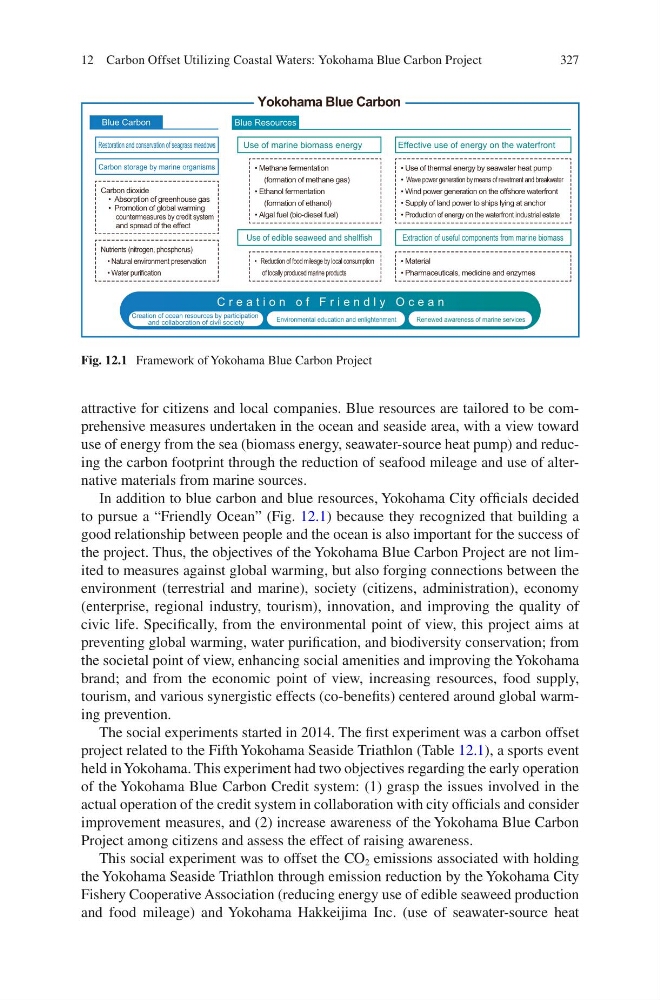
attractive for citizens and local companies. Blue resources are tailored to be comprehensive measures undertaken in the ocean and seaside area, with a view toward
use of energy from the sea (biomass energy, seawater-source heat pump) and reducing the carbon footprint through the reduction of seafood mileage and use of alternative materials from marine sources.
In addition to blue carbon and blue resources, Yokohama City officials decided
to pursue a “Friendly Ocean” (Fig. 12.1) because they recognized that building a
good relationship between people and the ocean is also important for the success of
the project. Thus, the objectives of the Yokohama Blue Carbon Project are not limited to measures against global warming, but also forging connections between the
environment (terrestrial and marine), society (citizens, administration), economy
(enterprise, regional industry, tourism), innovation, and improving the quality of
civic life. Specifically, from the environmental point of view, this project aims at
preventing global warming, water purification, and biodiversity conservation; from
the societal point of view, enhancing social amenities and improving the Yokohama
brand; and from the economic point of view, increasing resources, food supply,
tourism, and various synergistic effects (co-benefits) centered around global warming prevention.
The social experiments started in 2014. The first experiment was a carbon offset
project related to the Fifth Yokohama Seaside Triathlon (Table 12.1), a sports event
held in Yokohama. This experiment had two objectives regarding the early operation
of the Yokohama Blue Carbon Credit system: (1) grasp the issues involved in the
actual operation of the credit system in collaboration with city officials and consider
improvement measures, and (2) increase awareness of the Yokohama Blue Carbon
Project among citizens and assess the effect of raising awareness.
This social experiment was to offset the CO 2 emissions associated with holding
the Yokohama Seaside Triathlon through emission reduction by the Yokohama City
Fishery Cooperative Association (reducing energy use of edible seaweed production
and food mileage) and Yokohama Hakkeijima Inc. (use of seawater-source heat
Blue Carbon
C r e a t i o n o f F r i e n d l y O c e a n
Blue Resources
Restoration and conservation of seagrass meadows
Carbon storage by marine organisms
Carbon dioxide
• Absorption of greenhouse gas
• Promotion of global warming
countermeasures by credit system
and spread of the effect
Nutrients (nitrogen, phosphorus)
• Natural environment preservation
• Water purification
• Methane fermentation
(formation of methane gas)
• Ethanol fermentation
(formation of ethanol)
• Algal fuel (bio-diesel fuel)
• Use of thermal energy by seawater heat pump
• Wave power generation by means of revetment and breakwater
• Wind power generation on the offshore waterfront
• Supply of land power to ships lying at anchor
• Production of energy on the waterfront industrial estate
Effective use of energy on the waterfront
Use of marine biomass energy
Use of edible seaweed and shellfish
Extraction of useful components from marine biomass
• Material
• Pharmaceuticals, medicine and enzymes
• Reduction of food mileage by local consumption
of locally produced marine products
Creation of ocean resources by participation
and collaboration of civil society
Environmental education and enlightenment
Renewed awareness of marine services
Yokohama Blue Carbon
Fig. 12.1 Framework of Yokohama Blue Carbon Project
12 Carbon Offset Utilizing Coastal Waters: Yokohama Blue Carbon Project
attractive for citizens and local companies. Blue resources are tailored to be comprehensive measures undertaken in the ocean and seaside area, with a view toward
use of energy from the sea (biomass energy, seawater-source heat pump) and reducing the carbon footprint through the reduction of seafood mileage and use of alternative materials from marine sources.
In addition to blue carbon and blue resources, Yokohama City officials decided
to pursue a “Friendly Ocean” (Fig. 12.1) because they recognized that building a
good relationship between people and the ocean is also important for the success of
the project. Thus, the objectives of the Yokohama Blue Carbon Project are not limited to measures against global warming, but also forging connections between the
environment (terrestrial and marine), society (citizens, administration), economy
(enterprise, regional industry, tourism), innovation, and improving the quality of
civic life. Specifically, from the environmental point of view, this project aims at
preventing global warming, water purification, and biodiversity conservation; from
the societal point of view, enhancing social amenities and improving the Yokohama
brand; and from the economic point of view, increasing resources, food supply,
tourism, and various synergistic effects (co-benefits) centered around global warming prevention.
The social experiments started in 2014. The first experiment was a carbon offset
project related to the Fifth Yokohama Seaside Triathlon (Table 12.1), a sports event
held in Yokohama. This experiment had two objectives regarding the early operation
of the Yokohama Blue Carbon Credit system: (1) grasp the issues involved in the
actual operation of the credit system in collaboration with city officials and consider
improvement measures, and (2) increase awareness of the Yokohama Blue Carbon
Project among citizens and assess the effect of raising awareness.
This social experiment was to offset the CO 2 emissions associated with holding
the Yokohama Seaside Triathlon through emission reduction by the Yokohama City
Fishery Cooperative Association (reducing energy use of edible seaweed production
and food mileage) and Yokohama Hakkeijima Inc. (use of seawater-source heat
Blue Carbon
C r e a t i o n o f F r i e n d l y O c e a n
Blue Resources
Restoration and conservation of seagrass meadows
Carbon storage by marine organisms
Carbon dioxide
• Absorption of greenhouse gas
• Promotion of global warming
countermeasures by credit system
and spread of the effect
Nutrients (nitrogen, phosphorus)
• Natural environment preservation
• Water purification
• Methane fermentation
(formation of methane gas)
• Ethanol fermentation
(formation of ethanol)
• Algal fuel (bio-diesel fuel)
• Use of thermal energy by seawater heat pump
• Wave power generation by means of revetment and breakwater
• Wind power generation on the offshore waterfront
• Supply of land power to ships lying at anchor
• Production of energy on the waterfront industrial estate
Effective use of energy on the waterfront
Use of marine biomass energy
Use of edible seaweed and shellfish
Extraction of useful components from marine biomass
• Material
• Pharmaceuticals, medicine and enzymes
• Reduction of food mileage by local consumption
of locally produced marine products
Creation of ocean resources by participation
and collaboration of civil society
Environmental education and enlightenment
Renewed awareness of marine services
Yokohama Blue Carbon
Fig. 12.1 Framework of Yokohama Blue Carbon Project
12 Carbon Offset Utilizing Coastal Waters: Yokohama Blue Carbon Project