

301
concentrations are the main ions that determine total alkalinity), and net uptake of
CO 2 by organisms (Tokoro et al. 2018).
The environmental conditions that result in the uptake of CO 2 are not continuous
in the natural world. In reality, as environmental conditions such as light, temperature, and salinity change from moment to moment, cycles of uptake and emission
occur frequently (Tokoro et al. 2014, 2018). In other words, it is critical to take a
long-term view of the balance of uptake and emission as we discuss an ecosystem
contributing to the mitigation of climate change. The requirements for SCEs serving
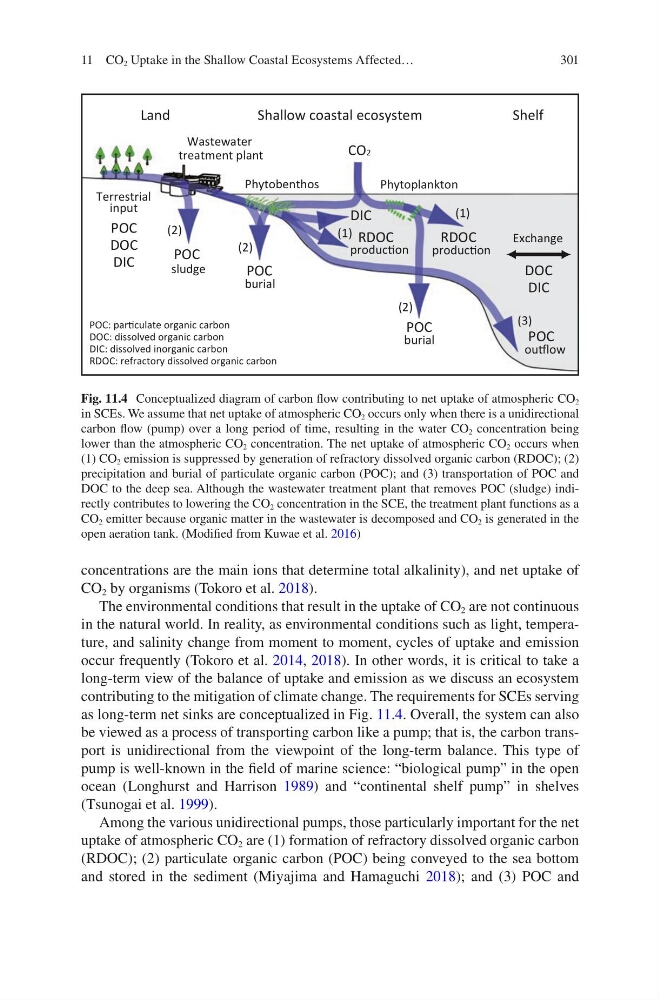
as long-term net sinks are conceptualized in Fig. 11.4. Overall, the system can also
be viewed as a process of transporting carbon like a pump; that is, the carbon transport is unidirectional from the viewpoint of the long-term balance. This type of
pump is well-known in the field of marine science: “biological pump” in the open
ocean (Longhurst and Harrison 1989) and “continental shelf pump” in shelves
(Tsunogai et al. 1999).
Among the various unidirectional pumps, those particularly important for the net
uptake of atmospheric CO 2 are (1) formation of refractory dissolved organic carbon
(RDOC); (2) particulate organic carbon (POC) being conveyed to the sea bottom
and stored in the sediment (Miyajima and Hamaguchi 2018); and (3) POC and
Shelf
DOC
DIC
Exchange
Shallow coastal ecosystem
Land
Wastewater
treatment plant
Terrestrial
input
POC
DOC
DIC
CO2
POC
sludge
POC
burial
RDOC
POC
burial
RDOC
DIC
POC
Phytoplankton
Phytobenthos
DOC: dissolved organic carbon
DIC: dissolved inorganic carbon
RDOC: refractory dissolved organic carbon
(1)
(1)
(2)
(2)
(2)
(3)
Fig. 11.4 Conceptualized diagram of carbon flow contributing to net uptake of atmospheric CO 2
in SCEs. We assume that net uptake of atmospheric CO 2 occurs only when there is a unidirectional
carbon flow (pump) over a long period of time, resulting in the water CO 2 concentration being
lower than the atmospheric CO 2 concentration. The net uptake of atmospheric CO 2 occurs when
(1) CO 2 emission is suppressed by generation of refractory dissolved organic carbon (RDOC); (2)
precipitation and burial of particulate organic carbon (POC); and (3) transportation of POC and
DOC to the deep sea. Although the wastewater treatment plant that removes POC (sludge) indirectly contributes to lowering the CO 2 concentration in the SCE, the treatment plant functions as a
CO 2 emitter because organic matter in the wastewater is decomposed and CO 2 is generated in the
open aeration tank. (Modified from Kuwae et al. 2016)
11 CO 2 Uptake in the Shallow Coastal Ecosystems Affected…
concentrations are the main ions that determine total alkalinity), and net uptake of
CO 2 by organisms (Tokoro et al. 2018).
The environmental conditions that result in the uptake of CO 2 are not continuous
in the natural world. In reality, as environmental conditions such as light, temperature, and salinity change from moment to moment, cycles of uptake and emission
occur frequently (Tokoro et al. 2014, 2018). In other words, it is critical to take a
long-term view of the balance of uptake and emission as we discuss an ecosystem
contributing to the mitigation of climate change. The requirements for SCEs serving
as long-term net sinks are conceptualized in Fig. 11.4. Overall, the system can also
be viewed as a process of transporting carbon like a pump; that is, the carbon transport is unidirectional from the viewpoint of the long-term balance. This type of
pump is well-known in the field of marine science: “biological pump” in the open
ocean (Longhurst and Harrison 1989) and “continental shelf pump” in shelves
(Tsunogai et al. 1999).
Among the various unidirectional pumps, those particularly important for the net
uptake of atmospheric CO 2 are (1) formation of refractory dissolved organic carbon
(RDOC); (2) particulate organic carbon (POC) being conveyed to the sea bottom
and stored in the sediment (Miyajima and Hamaguchi 2018); and (3) POC and
Shelf
DOC
DIC
Exchange
Shallow coastal ecosystem
Land
Wastewater
treatment plant
Terrestrial
input
POC
DOC
DIC
CO2
POC
sludge
POC
burial
RDOC
POC
burial
RDOC
DIC
POC
Phytoplankton
Phytobenthos
DOC: dissolved organic carbon
DIC: dissolved inorganic carbon
RDOC: refractory dissolved organic carbon
(1)
(1)
(2)
(2)
(2)
(3)
Fig. 11.4 Conceptualized diagram of carbon flow contributing to net uptake of atmospheric CO 2
in SCEs. We assume that net uptake of atmospheric CO 2 occurs only when there is a unidirectional
carbon flow (pump) over a long period of time, resulting in the water CO 2 concentration being
lower than the atmospheric CO 2 concentration. The net uptake of atmospheric CO 2 occurs when
(1) CO 2 emission is suppressed by generation of refractory dissolved organic carbon (RDOC); (2)
precipitation and burial of particulate organic carbon (POC); and (3) transportation of POC and
DOC to the deep sea. Although the wastewater treatment plant that removes POC (sludge) indirectly contributes to lowering the CO 2 concentration in the SCE, the treatment plant functions as a
CO 2 emitter because organic matter in the wastewater is decomposed and CO 2 is generated in the
open aeration tank. (Modified from Kuwae et al. 2016)
11 CO 2 Uptake in the Shallow Coastal Ecosystems Affected…