

268
organic carbon that remained in the sea was mostly accumulated in the sediment,
accounting for 9.3% of the total amount of carbon discharged from the eelgrass
beds.
9.6 Carbon Storage Function of Eelgrass Beds in the Seto
Inland Sea
To evaluate the carbon sequestration and storage function of eelgrass beds, it is
necessary to clarify the amount of eelgrass-derived organic carbon accumulated in
eelgrass beds and the amounts that flowed out and accumulated in the shallow
coastal waters or deep sea. In Sect. 9.4, we described the growth and decomposition
of eelgrass and the deposition and outflow processes of eelgrass-derived organic
carbon, and we clarified the amount of carbon accumulated in eelgrass beds. In
Sect. 9.5, we traced the fate of drifting leaves and eelgrass-derived suspended particles discharged from eelgrass beds, and we reported the amounts of carbon accumulated in the bottom of the Seto Inland Sea and that flowed out and accumulated
in the deep sea.
From these results, we estimated the net primary production (potential carbon
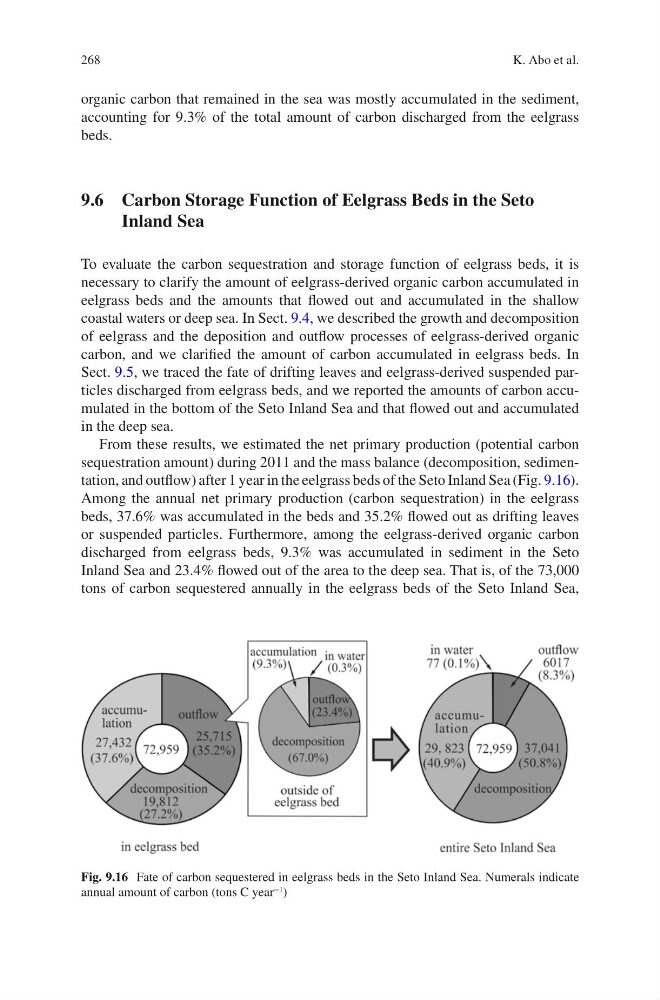
sequestration amount) during 2011 and the mass balance (decomposition, sedimentation, and outflow) after 1 year in the eelgrass beds of the Seto Inland Sea (Fig. 9.16).
Among the annual net primary production (carbon sequestration) in the eelgrass
beds, 37.6% was accumulated in the beds and 35.2% flowed out as drifting leaves
or suspended particles. Furthermore, among the eelgrass-derived organic carbon
discharged from eelgrass beds, 9.3% was accumulated in sediment in the Seto
Inland Sea and 23.4% flowed out of the area to the deep sea. That is, of the 73,000
tons of carbon sequestered annually in the eelgrass beds of the Seto Inland Sea,
Fig. 9.16 Fate of carbon sequestered in eelgrass beds in the Seto Inland Sea. Numerals indicate
annual amount of carbon (tons C year
−1 )
K. Abo et al.
organic carbon that remained in the sea was mostly accumulated in the sediment,
accounting for 9.3% of the total amount of carbon discharged from the eelgrass
beds.
9.6 Carbon Storage Function of Eelgrass Beds in the Seto
Inland Sea
To evaluate the carbon sequestration and storage function of eelgrass beds, it is
necessary to clarify the amount of eelgrass-derived organic carbon accumulated in
eelgrass beds and the amounts that flowed out and accumulated in the shallow
coastal waters or deep sea. In Sect. 9.4, we described the growth and decomposition
of eelgrass and the deposition and outflow processes of eelgrass-derived organic
carbon, and we clarified the amount of carbon accumulated in eelgrass beds. In
Sect. 9.5, we traced the fate of drifting leaves and eelgrass-derived suspended particles discharged from eelgrass beds, and we reported the amounts of carbon accumulated in the bottom of the Seto Inland Sea and that flowed out and accumulated
in the deep sea.
From these results, we estimated the net primary production (potential carbon
sequestration amount) during 2011 and the mass balance (decomposition, sedimentation, and outflow) after 1 year in the eelgrass beds of the Seto Inland Sea (Fig. 9.16).
Among the annual net primary production (carbon sequestration) in the eelgrass
beds, 37.6% was accumulated in the beds and 35.2% flowed out as drifting leaves
or suspended particles. Furthermore, among the eelgrass-derived organic carbon
discharged from eelgrass beds, 9.3% was accumulated in sediment in the Seto
Inland Sea and 23.4% flowed out of the area to the deep sea. That is, of the 73,000
tons of carbon sequestered annually in the eelgrass beds of the Seto Inland Sea,
Fig. 9.16 Fate of carbon sequestered in eelgrass beds in the Seto Inland Sea. Numerals indicate
annual amount of carbon (tons C year
−1 )
K. Abo et al.