

154
In the long history of Earth, the ocean has had a strong influence on atmospheric
CO 2 concentrations and the global climate system. Examples can be seen during
times of global warming in the Jurassic and Cretaceous periods as well as during
Snowball Earth events in the Proterozoic Eon. Excessive increases or decreases of
atmospheric CO 2 concentrations due to volcanic activities and ecosystem metabolism are among the main causes of extreme climates. The ocean absorbs or releases
excess CO 2 over millennial time scales and thereby mitigates the extreme climate
change.
During the period of history before the Industrial Revolution, the absorption and
release of atmospheric CO 2 by the ocean were in balance. However, atmospheric
CO 2 concentrations have recently increased, mainly as a result of the combustion of
fossil fuels (Ciais et al. 2013). This increase of atmospheric CO 2 concentrations has
led to an imbalance between atmospheric and oceanic CO 2 ; the ocean is now a net
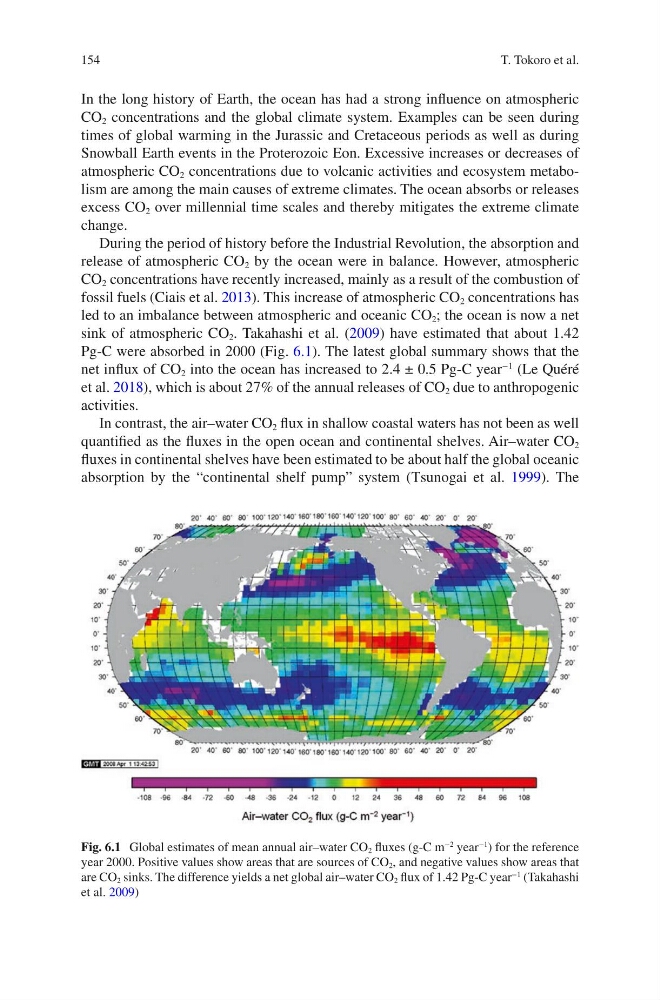
sink of atmospheric CO 2 . Takahashi et al. (2009) have estimated that about 1.42
Pg-C were absorbed in 2000 (Fig. 6.1). The latest global summary shows that the
net influx of CO 2 into the ocean has increased to 2.4 ± 0.5 Pg-C year
−1
(Le Quéré
et al. 2018), which is about 27% of the annual releases of CO 2 due to anthropogenic
activities.
In contrast, the air–water CO 2 flux in shallow coastal waters has not been as well
quantified as the fluxes in the open ocean and continental shelves. Air–water CO 2
fluxes in continental shelves have been estimated to be about half the global oceanic
absorption by the “continental shelf pump” system (Tsunogai et al. 1999). The
Fig. 6.1 Global estimates of mean annual air–water CO 2 fluxes (g-C m
−2
year
−1 ) for the reference
year 2000. Positive values show areas that are sources of CO 2 , and negative values show areas that
are CO 2 sinks. The difference yields a net global air–water CO 2 flux of 1.42 Pg-C year
−1 (Takahashi
et al. 2009)
T. Tokoro et al.
In the long history of Earth, the ocean has had a strong influence on atmospheric
CO 2 concentrations and the global climate system. Examples can be seen during
times of global warming in the Jurassic and Cretaceous periods as well as during
Snowball Earth events in the Proterozoic Eon. Excessive increases or decreases of
atmospheric CO 2 concentrations due to volcanic activities and ecosystem metabolism are among the main causes of extreme climates. The ocean absorbs or releases
excess CO 2 over millennial time scales and thereby mitigates the extreme climate
change.
During the period of history before the Industrial Revolution, the absorption and
release of atmospheric CO 2 by the ocean were in balance. However, atmospheric
CO 2 concentrations have recently increased, mainly as a result of the combustion of
fossil fuels (Ciais et al. 2013). This increase of atmospheric CO 2 concentrations has
led to an imbalance between atmospheric and oceanic CO 2 ; the ocean is now a net
sink of atmospheric CO 2 . Takahashi et al. (2009) have estimated that about 1.42
Pg-C were absorbed in 2000 (Fig. 6.1). The latest global summary shows that the
net influx of CO 2 into the ocean has increased to 2.4 ± 0.5 Pg-C year
−1
(Le Quéré
et al. 2018), which is about 27% of the annual releases of CO 2 due to anthropogenic
activities.
In contrast, the air–water CO 2 flux in shallow coastal waters has not been as well
quantified as the fluxes in the open ocean and continental shelves. Air–water CO 2
fluxes in continental shelves have been estimated to be about half the global oceanic
absorption by the “continental shelf pump” system (Tsunogai et al. 1999). The
Fig. 6.1 Global estimates of mean annual air–water CO 2 fluxes (g-C m
−2
year
−1 ) for the reference
year 2000. Positive values show areas that are sources of CO 2 , and negative values show areas that
are CO 2 sinks. The difference yields a net global air–water CO 2 flux of 1.42 Pg-C year
−1 (Takahashi
et al. 2009)
T. Tokoro et al.