

130
Many studies have estimated the carbon storage capacity of blue carbon ecosystems around the world, particularly in mangroves (Donato et al. 2012; Wang et al.
2013; Rahman et al. 2015; Inoue 2018) and seagrass meadows (Fourqurean et al.
2012; Lavery et al. 2013; Miyajima et al. 2015; Watanabe and Kuwae 2015;
Miyajima and Hamaguchi 2018; Yoshida et al. 2018). However, little is known
about carbon storage in tidal flat ecosystems, despite their importance as shallow
coastal habitats.
Because the conditions in tidal flats are distinct, they are inhabited by a unique
set of organisms. For example, crustaceans such as crabs and aquatic plants such as
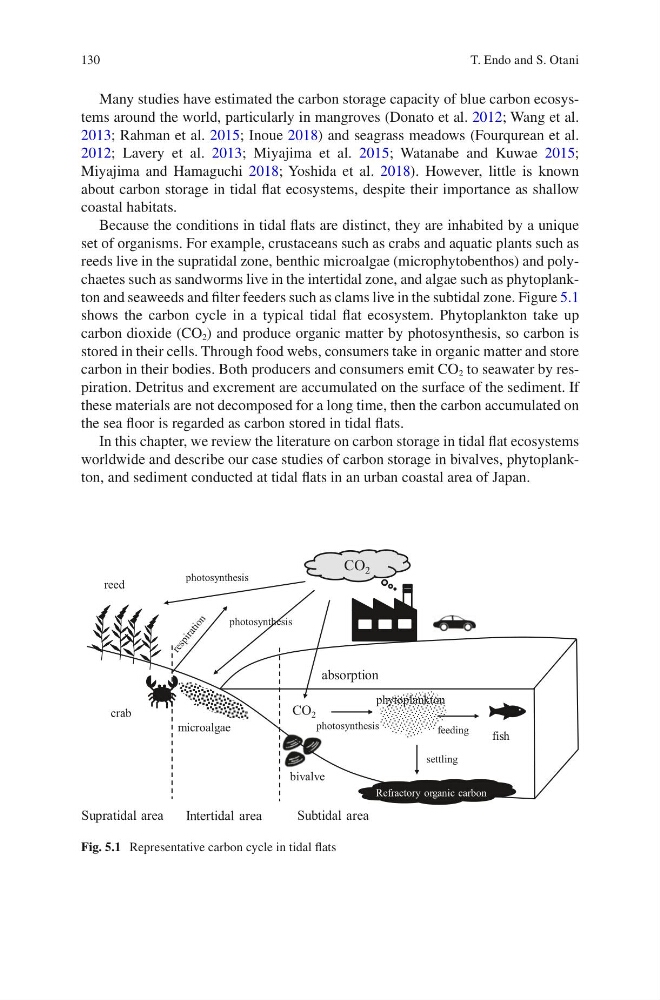
reeds live in the supratidal zone, benthic microalgae (microphytobenthos) and polychaetes such as sandworms live in the intertidal zone, and algae such as phytoplankton and seaweeds and filter feeders such as clams live in the subtidal zone. Figure 5.1
shows the carbon cycle in a typical tidal flat ecosystem. Phytoplankton take up
carbon dioxide (CO 2 ) and produce organic matter by photosynthesis, so carbon is
stored in their cells. Through food webs, consumers take in organic matter and store
carbon in their bodies. Both producers and consumers emit CO 2 to seawater by respiration. Detritus and excrement are accumulated on the surface of the sediment. If
these materials are not decomposed for a long time, then the carbon accumulated on
the sea floor is regarded as carbon stored in tidal flats.
In this chapter, we review the literature on carbon storage in tidal flat ecosystems
worldwide and describe our case studies of carbon storage in bivalves, phytoplankton, and sediment conducted at tidal flats in an urban coastal area of Japan.
Intertidal area
Subtidal area
Supratidal area
CO 2
photosynthesis
settling
reed
microalgae
crab
bivalve
phytoplankton
fish
CO 2
photosynthesis
absorption
feeding
Refractory organic carbon
photosynthesis
Fig. 5.1 Representative carbon cycle in tidal flats
T. Endo and S. Otani
Many studies have estimated the carbon storage capacity of blue carbon ecosystems around the world, particularly in mangroves (Donato et al. 2012; Wang et al.
2013; Rahman et al. 2015; Inoue 2018) and seagrass meadows (Fourqurean et al.
2012; Lavery et al. 2013; Miyajima et al. 2015; Watanabe and Kuwae 2015;
Miyajima and Hamaguchi 2018; Yoshida et al. 2018). However, little is known
about carbon storage in tidal flat ecosystems, despite their importance as shallow
coastal habitats.
Because the conditions in tidal flats are distinct, they are inhabited by a unique
set of organisms. For example, crustaceans such as crabs and aquatic plants such as
reeds live in the supratidal zone, benthic microalgae (microphytobenthos) and polychaetes such as sandworms live in the intertidal zone, and algae such as phytoplankton and seaweeds and filter feeders such as clams live in the subtidal zone. Figure 5.1
shows the carbon cycle in a typical tidal flat ecosystem. Phytoplankton take up
carbon dioxide (CO 2 ) and produce organic matter by photosynthesis, so carbon is
stored in their cells. Through food webs, consumers take in organic matter and store
carbon in their bodies. Both producers and consumers emit CO 2 to seawater by respiration. Detritus and excrement are accumulated on the surface of the sediment. If
these materials are not decomposed for a long time, then the carbon accumulated on
the sea floor is regarded as carbon stored in tidal flats.
In this chapter, we review the literature on carbon storage in tidal flat ecosystems
worldwide and describe our case studies of carbon storage in bivalves, phytoplankton, and sediment conducted at tidal flats in an urban coastal area of Japan.
Intertidal area
Subtidal area
Supratidal area
CO 2
photosynthesis
settling
reed
microalgae
crab
bivalve
phytoplankton
fish
CO 2
photosynthesis
absorption
feeding
Refractory organic carbon
photosynthesis
Fig. 5.1 Representative carbon cycle in tidal flats
T. Endo and S. Otani