

122
able, the mean value of production data of the other regions of central and western Japan was used.
4. Kombu-ba: Because there were large variations in production reported among
species and locations in the Hokkaido and Pacific Tohoku regions in which coldtemperate kelp beds are distributed, these areas were further divided into several
subregions depending on dominant species of kombu and their geographic distributions. These included S. japonica var. diabolica (northeastern Hokkaido
region), S. longissima (Pacific coastal area of the eastern Hokkaido region), S.
japonica var. ochotensis (Okhotsk Sea coastal area in the northern Hokkaido
region), S. japonica var. religiosa (Japan Sea coastal area of the western Hokkaido
region), and S. japonica (the southern Hokkaido and Tohoku regions). Annual
production of cold-temperate kelp beds was represented by these dominant species in each subregion, based on published and measured values. Annual production in each subregion was calculated and summed (Onitsuka et al. 2014).
5. Conversion to carbon sequestration amount: Depending on the species, 30%
to 35% of the annual production (dry weight) of seagrass and macroalgae in each
bed was assumed to be the mean organic carbon content (Table 4.1; Onitsuka
et al. 2014). These mean values of organic carbon were then converted into
equivalent amount of carbon dioxide.
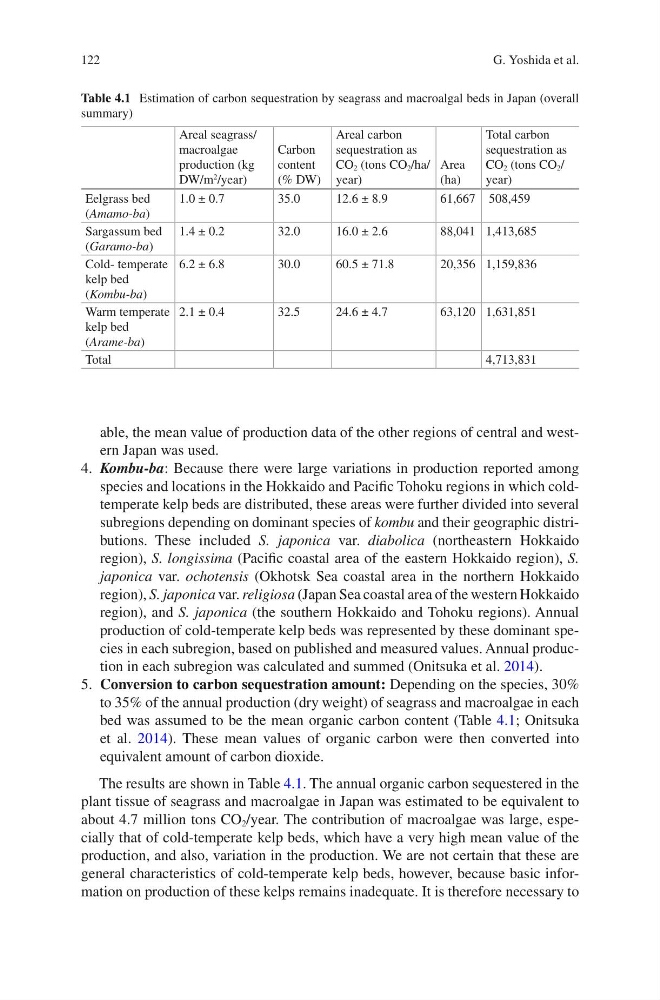
The results are shown in Table 4.1. The annual organic carbon sequestered in the
plant tissue of seagrass and macroalgae in Japan was estimated to be equivalent to
about 4.7 million tons CO 2 /year. The contribution of macroalgae was large, especially that of cold-temperate kelp beds, which have a very high mean value of the
production, and also, variation in the production. We are not certain that these are
general characteristics of cold-temperate kelp beds, however, because basic information on production of these kelps remains inadequate. It is therefore necessary to
Table 4.1 Estimation of carbon sequestration by seagrass and macroalgal beds in Japan (overall
summary)
Areal seagrass/
macroalgae
production (kg
DW/m
2 /year)
Carbon
content
(% DW)
Areal carbon
sequestration as
CO 2 (tons CO 2 /ha/
year)
Area
(ha)
Total carbon
sequestration as
CO 2 (tons CO 2 /
year)
Eelgrass bed
(Amamo-ba)
1.0 ± 0.7
35.0
12.6 ± 8.9
61,667 508,459
Sargassum bed
(Garamo-ba)
1.4 ± 0.2
32.0
16.0 ± 2.6
88,041 1,413,685
Cold- temperate
kelp bed
(Kombu-ba)
6.2 ± 6.8
30.0
60.5 ± 71.8
20,356 1,159,836
Warm temperate
kelp bed
(Arame-ba)
2.1 ± 0.4
32.5
24.6 ± 4.7
63,120 1,631,851
Total
4,713,831
G. Yoshida et al.
able, the mean value of production data of the other regions of central and western Japan was used.
4. Kombu-ba: Because there were large variations in production reported among
species and locations in the Hokkaido and Pacific Tohoku regions in which coldtemperate kelp beds are distributed, these areas were further divided into several
subregions depending on dominant species of kombu and their geographic distributions. These included S. japonica var. diabolica (northeastern Hokkaido
region), S. longissima (Pacific coastal area of the eastern Hokkaido region), S.
japonica var. ochotensis (Okhotsk Sea coastal area in the northern Hokkaido
region), S. japonica var. religiosa (Japan Sea coastal area of the western Hokkaido
region), and S. japonica (the southern Hokkaido and Tohoku regions). Annual
production of cold-temperate kelp beds was represented by these dominant species in each subregion, based on published and measured values. Annual production in each subregion was calculated and summed (Onitsuka et al. 2014).
5. Conversion to carbon sequestration amount: Depending on the species, 30%
to 35% of the annual production (dry weight) of seagrass and macroalgae in each
bed was assumed to be the mean organic carbon content (Table 4.1; Onitsuka
et al. 2014). These mean values of organic carbon were then converted into
equivalent amount of carbon dioxide.
The results are shown in Table 4.1. The annual organic carbon sequestered in the
plant tissue of seagrass and macroalgae in Japan was estimated to be equivalent to
about 4.7 million tons CO 2 /year. The contribution of macroalgae was large, especially that of cold-temperate kelp beds, which have a very high mean value of the
production, and also, variation in the production. We are not certain that these are
general characteristics of cold-temperate kelp beds, however, because basic information on production of these kelps remains inadequate. It is therefore necessary to
Table 4.1 Estimation of carbon sequestration by seagrass and macroalgal beds in Japan (overall
summary)
Areal seagrass/
macroalgae
production (kg
DW/m
2 /year)
Carbon
content
(% DW)
Areal carbon
sequestration as
CO 2 (tons CO 2 /ha/
year)
Area
(ha)
Total carbon
sequestration as
CO 2 (tons CO 2 /
year)
Eelgrass bed
(Amamo-ba)
1.0 ± 0.7
35.0
12.6 ± 8.9
61,667 508,459
Sargassum bed
(Garamo-ba)
1.4 ± 0.2
32.0
16.0 ± 2.6
88,041 1,413,685
Cold- temperate
kelp bed
(Kombu-ba)
6.2 ± 6.8
30.0
60.5 ± 71.8
20,356 1,159,836
Warm temperate
kelp bed
(Arame-ba)
2.1 ± 0.4
32.5
24.6 ± 4.7
63,120 1,631,851
Total
4,713,831
G. Yoshida et al.